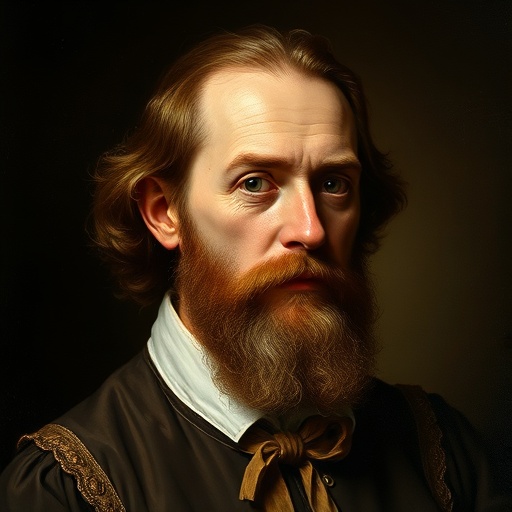
William Harvey — "The examination of the bodies of animals has always been my delight."
The examination of the bodies of animals has always been my delight.
The examination of the bodies of animals has always been my delight.
Click any product to generate a realistic preview. Up to 3 at a time.
* Initial load can take up to 90 seconds — revising the preview in another color is nearly instant.
"I profess to learn and to teach anatomy not from books but from dissections."
"The animal body is a commonwealth, in which every member is a subject to the whole."
"I avow myself the partisan of truth alone."
"There is no perfect knowledge which can be entitled ours, that is innate; none but what has been obtained from experience, or derived in some way from our senses."
"The heart is the beginning of life; the sun of the microcosm."
English physician whose On the Motion of the Heart and Blood in Animals (1628) demonstrated blood circulation, overturning 1,400 years of Galenic medicine. Closely associated with Francis Bacon (his contemporary in the new English empiricism). For an intellectual contrast, see Galenic medicine, the 2nd-century Greek medical tradition (humors, blood-as-consumed-fuel) — Harvey calculated that the heart pumps more blood per hour than the body could possibly produce as fuel — a single quantitative observation that demolished the entire Galenic-Aristotelian medical worldview. The cleanest example in medical history of arithmetic disproving 14 centuries of authority.
Found in 1 providers: deepseek
1 source checked
The speaker finds genuine joy and fascination in dissecting and studying animal bodies. This expresses an intrinsic love of hands-on anatomical investigation — not as duty or obligation, but as personal pleasure. It captures the disposition of someone driven by curiosity about how living things work, prioritizing direct physical examination over inherited texts or abstract theorizing as the proper path to biological knowledge.
Harvey spent decades performing meticulous dissections of dozens of species — deer, fish, snakes, insects — to understand the heart and blood. His discovery of circulation depended entirely on this hands-on method rather than Galenic tradition. He dissected King Charles I's deer at Hampton Court. His 1628 Exercitatio Anatomica de Motu Cordis was built entirely on empirical animal observation, making this statement a precise autobiographical truth.
In early 17th-century Europe, Galenic medicine derived from ancient Greek texts still dominated medical education. Direct dissection was controversial and limited. The Scientific Revolution was challenging textual authority with empirical observation — Vesalius had recently corrected Galen anatomically. Harvey worked during a period when personally examining nature, rather than citing Aristotle, was a radical and defining intellectual act that separated modern science from scholastic tradition.
AI-generated insights based on extensive research and information for context. Factual errors? Email [email protected].
Your cart is empty