What it means
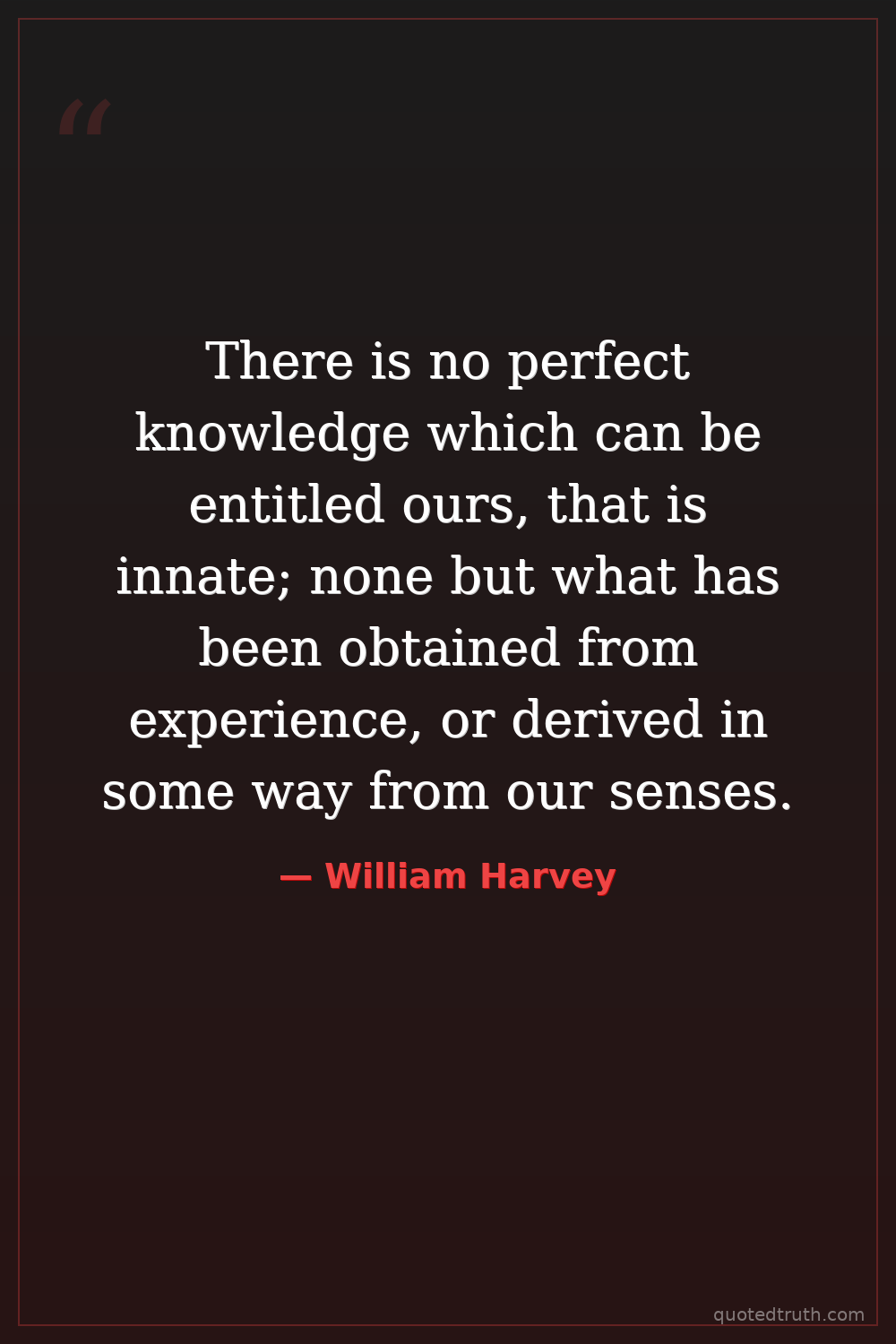
True knowledge cannot come from pure reasoning or intuition alone — it must be earned through direct observation and sensory experience. What we think we know from tradition or logic is not genuine knowledge until tested against reality. Understanding is built from evidence gathered in the world, not inherited assumptions or abstract speculation handed down without verification.
Relevance to William Harvey
Harvey proved blood circulates continuously through the body by conducting systematic dissections and experiments on living animals — directly overturning Galen's 1,400-year-old theory accepted purely on authority. His discovery of cardiac circulation in De Motu Cordis (1628) was the triumph of empirical observation over inherited doctrine, embodying exactly this belief that real knowledge demands hands-on sensory investigation rather than received wisdom.
The era
The early 17th century saw the Scientific Revolution challenging medieval scholasticism, which treated Aristotle and Galen as unquestionable authorities. Harvey worked as scholars debated whether ancient texts or direct experiment should ground medicine. Francis Bacon simultaneously championed empiricism. Harvey's era was a turning point where dissection, vivisection, and quantitative measurement began displacing centuries of unexamined classical authority as the foundation of natural philosophy.
AI-generated insights based on extensive research and information for context. Factual errors? Email [email protected].