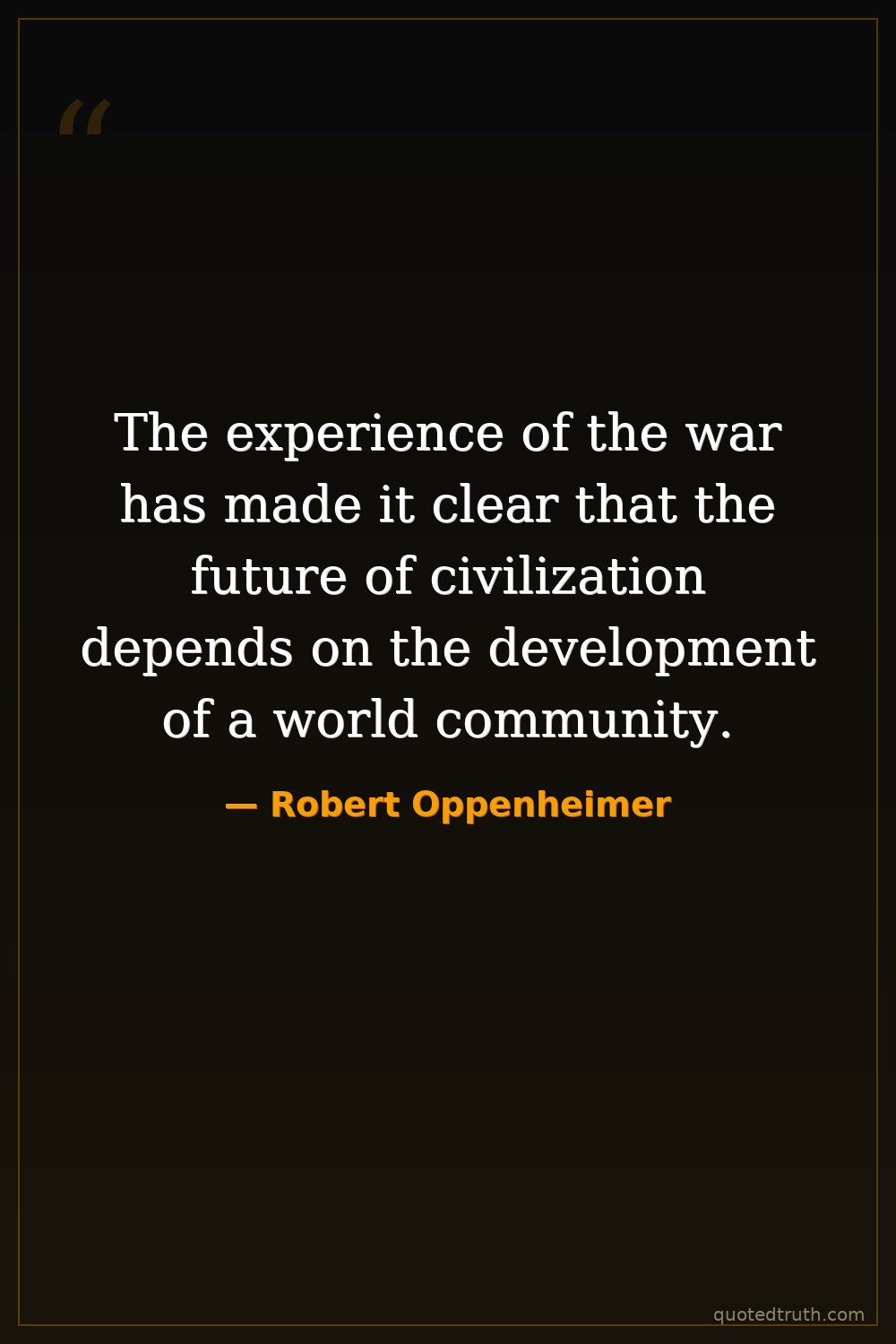
Robert Oppenheimer — "The experience of the war has made it clear that the future of civilization depe…"
The experience of the war has made it clear that the future of civilization depends on the development of a world community.
The experience of the war has made it clear that the future of civilization depends on the development of a world community.
Click any product to generate a realistic preview. Up to 3 at a time.
* Initial load can take up to 90 seconds — revising the preview in another color is nearly instant.
"We are not to be saved by technology, we are to be saved by humanity."
"I carry a great burden of responsibility."
"There are some people who can live without wild places, and some who cannot."
"The atomic bomb is a stark reminder that we are living in a new era, an era of unprecedented power and unprecedented danger."
"Pragmatism is an intellectually safe but ultimately sterile philosophy."
American theoretical physicist who directed the Manhattan Project's Los Alamos Laboratory and oversaw the atomic bombs; lost his security clearance in 1954. Closely associated with Niels Bohr (Manhattan Project consultant and atomic-policy advisor) and Hans Bethe (Los Alamos theoretical-division chief). For an intellectual contrast, see Edward Teller, Hungarian-American physicist and 'father of the H-bomb' — Teller pushed the H-bomb against Oppenheimer's objections and testified against him at his 1954 security hearing — the precise moment that ended Oppenheimer's career. The canonical 'physicist-of-conscience vs physicist-of-state' pairing in nuclear-age ethics; Christopher Nolan's Oppenheimer (2023) dramatized this rivalry for a mass audience.
Found in 1 providers: grok
1 source checked
What humanity learned from World War II proves civilization cannot survive if nations remain isolated, competing powers. The war revealed the catastrophic cost of fragmented nationalism and unchecked militarism. Only by building shared institutions, mutual accountability, and cooperative global governance can humanity prevent future catastrophes — particularly as modern warfare introduced weapons capable of unprecedented destruction. Lasting peace requires nations to transcend narrow self-interest and commit to a shared human future.
Oppenheimer directed the Manhattan Project, creating the atomic bombs dropped on Hiroshima and Nagasaki in 1945. Witnessing their devastation, he grew deeply troubled, famously invoking the Bhagavad Gita's line about becoming Death. He became a leading voice for international nuclear arms control, supporting UN oversight of atomic energy through the Baruch Plan. This quote captures his post-war conviction that the bomb's existence made global political cooperation not idealistic but existentially necessary.
World War II ended in 1945 with atomic bombings of Japan, exposing humanity's capacity for mass destruction on a new scale. The Cold War quickly emerged, with the US and Soviet Union racing to build nuclear arsenals. The United Nations was founded that same year, embodying fragile hopes for collective security. Oppenheimer spoke amid urgent debates about whether national sovereignty or supranational cooperation would govern the terrifying new atomic age.
AI-generated insights based on extensive research and information for context. Factual errors? Email [email protected].
Your cart is empty