What it means
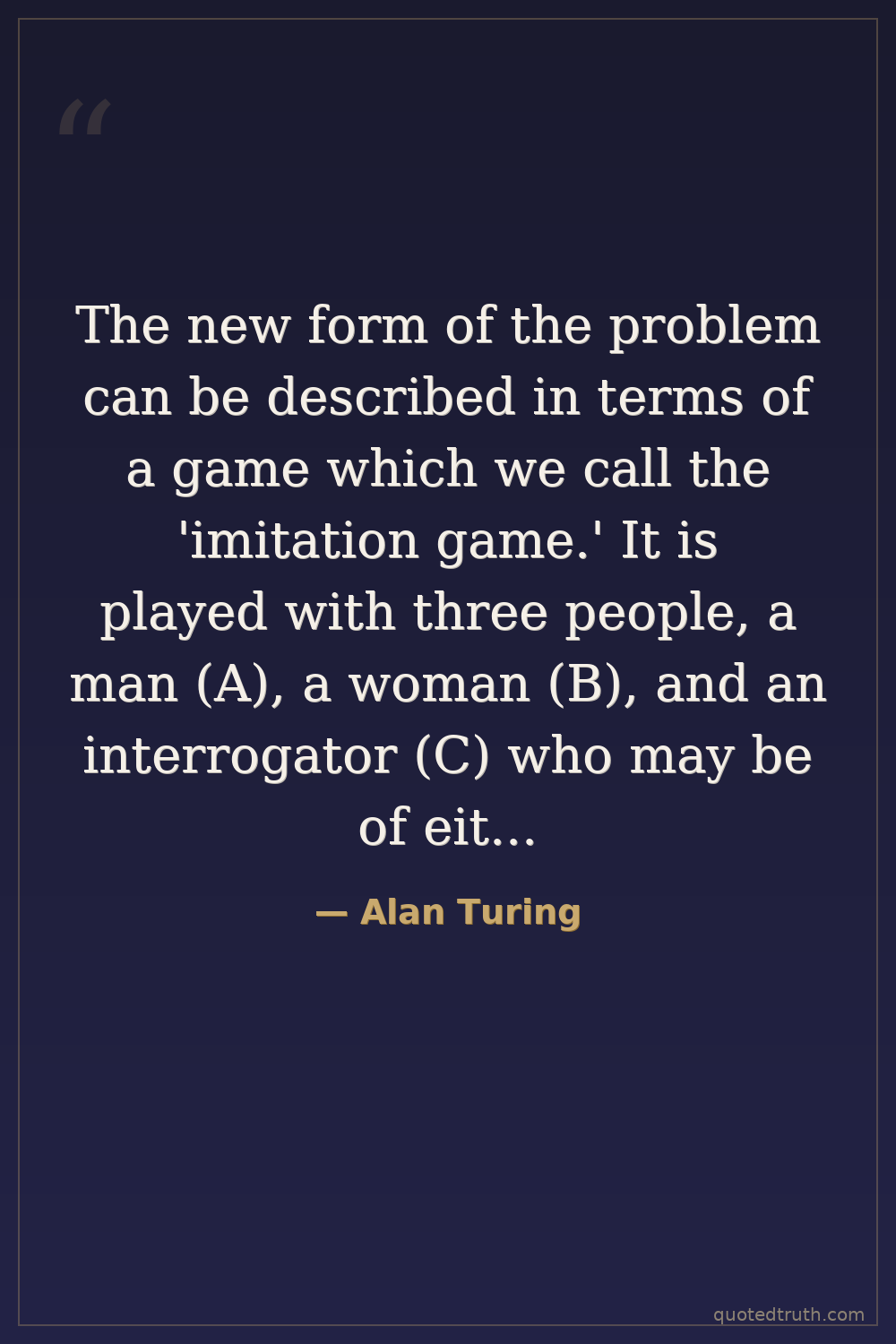
This describes the opening rules of a thought experiment Turing called the imitation game: an interrogator, separated from two hidden participants, must determine which is male and which is female using only written questions. Turing then reframes the game by substituting a machine for one participant, asking whether a computer could fool an interrogator as convincingly as a human can. It launched the field of machine intelligence evaluation.
Relevance to Alan Turing
Turing, a gay man in Britain where homosexuality was criminalized, knew firsthand the pressure to conceal identity and perform an expected role. The imitation game—built around deceiving an interrogator about one's true nature—resonates with his own enforced masquerade. As the architect of modern computing and the Enigma codebreaker at Bletchley Park, he channeled both personal and professional obsessions with hidden meaning, disguise, and decipherment into this foundational question.
The era
Published in 1950 in the journal Mind, this appeared as the first programmable computers were just becoming operational and five years after WWII ended. Britain was rebuilding under austerity, the Cold War was accelerating, and conformity was enforced socially and legally. The idea that a machine might think was radical and unsettling to both scientists and philosophers. Turing's framing made an abstract question concrete and testable, founding artificial intelligence as a discipline.
AI-generated insights based on extensive research and information for context. Factual errors? Email [email protected].