Stephen Hawking — "The fact that we humans, who are ourselves mere collections of fundamental parti…"

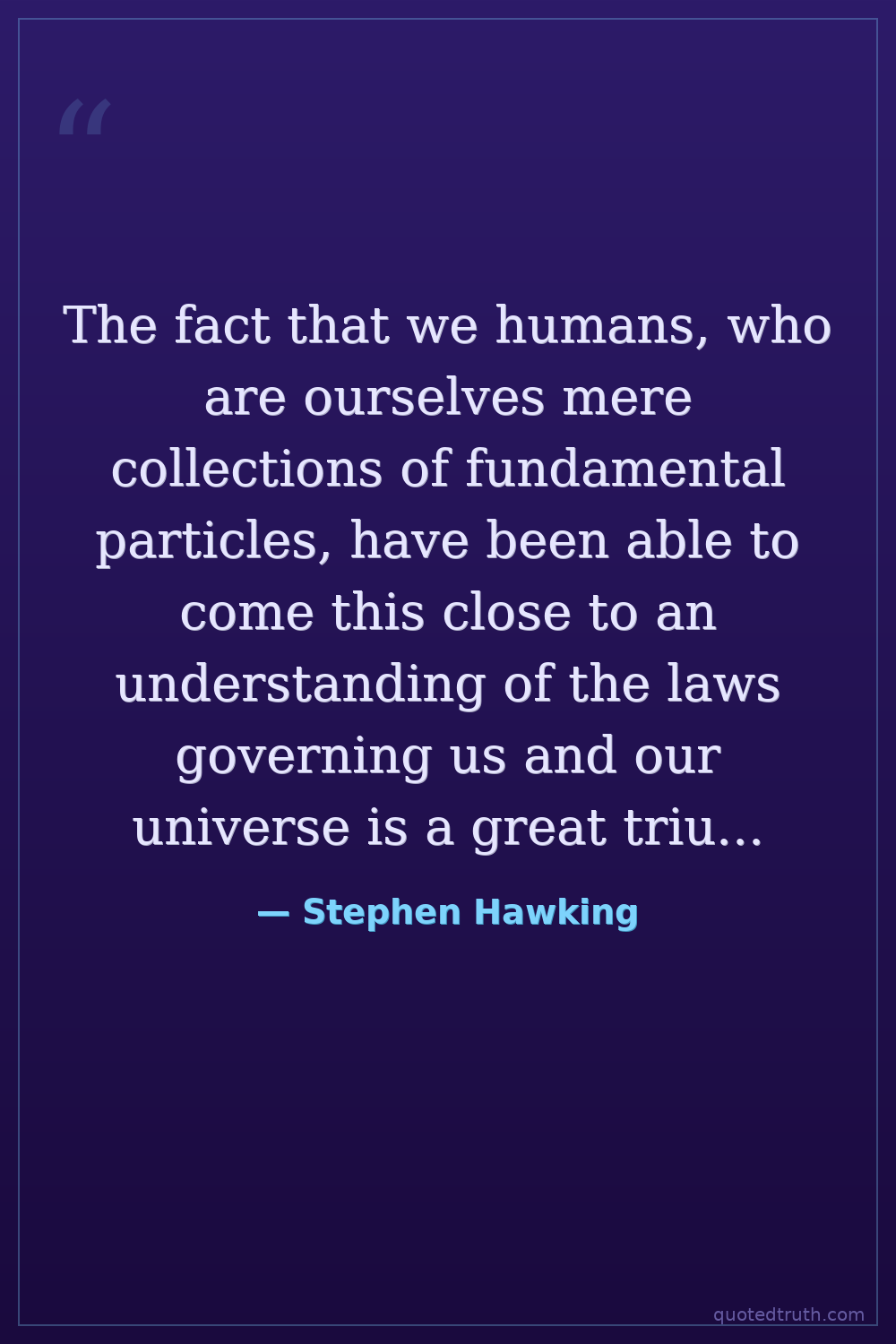
The fact that we humans, who are ourselves mere collections of fundamental particles, have been able to come this close to an understanding of the laws governing us and our universe is a great triumph.
Stephen Hawking — Stephen Hawking Contemporary · Black holes, cosmology

Get This Quote & Author's Image Illustrated On:

Click any product to generate a realistic preview. Up to 3 at a time.
* Initial load can take up to 90 seconds — revising the preview in another color is nearly instant.

Kitchen

Apparel

Other

About Stephen Hawking (1942-2018)

British theoretical physicist whose Hawking radiation work and A Brief History of Time (1988) brought black-hole physics to a mass audience while he lived with ALS for 55 years. Closely associated with Roger Penrose (his collaborator on singularity theorems) and Carl Sagan (fellow popularizer who wrote Brief History's foreword). For an intellectual contrast, see William Lane Craig, American philosopher of religion — Craig's Kalam cosmological argument depends on the Big Bang requiring a divine first cause; Hawking's no-boundary proposal was specifically designed to remove the moment that would require one — the cleanest cosmology-vs-natural-theology contrast in modern thought.

Details

From 'A Brief History of Time'

Date: 1988

Wisdom

Verification

Unverifiable

Found in 1 providers: grok

1 source checked

Understanding this quote

What it means

Despite being made of the same basic particles as everything else in existence, humans have managed to decode the mathematical laws that govern reality itself. This is a remarkable achievement — elementary matter somehow organizing itself to comprehend its own origin and operation. The wonder lies not in what remains unknown, but in how much we have actually figured out about the cosmos we inhabit.

Relevance to Stephen Hawking

Hawking spent his career decoding the universe's deepest laws while confined to a wheelchair by ALS, a profound irony he embraced. His work on black hole radiation and the Big Bang unified quantum mechanics with general relativity. He saw science as humanity's greatest dignity — that fragile biological creatures could derive equations describing spacetime itself directly echoes his personal defiance of physical limitation through intellectual achievement.

The era

Hawking worked during a golden age of theoretical physics spanning the 1960s through 2010s. String theory, quantum field theory, and precision cosmology from COBE and WMAP satellites were revealing the universe's structure in unprecedented detail. The Standard Model was confirmed, CERN expanded, and gravitational waves were detected. Humanity genuinely was closing in on a Theory of Everything, making his triumphant framing historically grounded rather than merely rhetorical.

AI-generated insights based on extensive research and information for context. Factual errors? Email [email protected].

Your Cart

Your cart is empty