Confucius — "The faults of a man are characteristic of his class. It is by observing a man's …"
The faults of a man are characteristic of his class. It is by observing a man's faults that one may know his virtue.
The faults of a man are characteristic of his class. It is by observing a man's faults that one may know his virtue.
Click any product to generate a realistic preview. Up to 3 at a time.
* Initial load can take up to 90 seconds — revising the preview in another color is nearly instant.
"Is humanity far away? Whenever I want the virtue of humanity, it comes at once."
"The superior man has a proper pride, but is not proud."
"The superior man, in the world, does not set his mind either for anything, or against anything; what is right he will follow."
"The gentleman concerns himself with the Way; he does not worry about his salary."
"The man who asks a question is a fool for a minute, the man who does not ask is a fool for life."
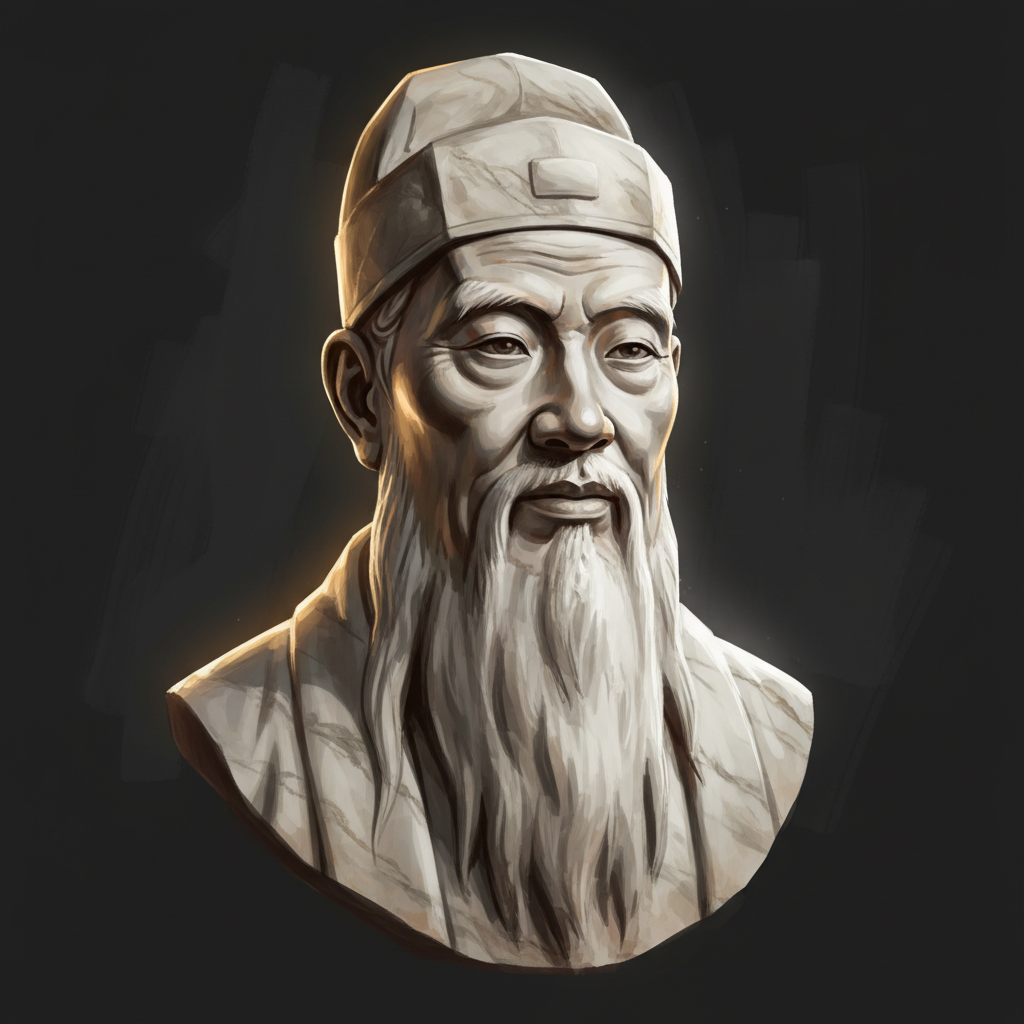
Chinese philosopher and teacher whose teachings (compiled by his students in the Analects) became the foundational ethical framework of East Asian civilization for 2,500 years. Closely associated with Mencius (his most-influential follower a century later). For an intellectual contrast, see Laozi, near-contemporary Chinese sage and Tao Te Ching author — Confucius systematized social order through ritual and family hierarchy; Laozi's Taoist effortless-action philosophy argued such systems were the disease, not the cure. The two founding poles of Chinese moral philosophy — every East Asian moral tradition since has positioned itself between them.
The standard scholarly entry points to Confucius's work: Philip J. Ivanhoe (Georgetown, Chinese philosophy) — Confucian Moral Self Cultivation (2000); Edward Slingerland (UBC, Asian Studies) — Effortless Action: Wu-wei as Conceptual Metaphor (2003); Tu Weiming (Harvard, Confucian scholar) — Confucian Thought: Selfhood as Creative Transformation (1985). These are the works graduate seminars cite when teaching Confucius.
Found in 1 providers: grok
1 source checked
People's flaws tend to match the kind of person they are. A generous person errs by giving too much; a cautious person errs by hesitating too long. So if you watch carefully how someone fails, you can infer what they actually value and where their strengths lie. Faults are not separate from virtues but the shadow cast by them, revealing character more honestly than polished behavior does.
Confucius spent his life trying to identify and cultivate the junzi, the morally refined person, and he taught by closely observing his disciples' temperaments. He believed moral growth required honest self-examination rather than hiding weakness. As a teacher who placed each student on a tailored path, he read character diagnostically, treating errors as data about inner disposition. This saying reflects his practical, relational approach to ethics over rigid rule-following.
Confucius lived during the late Spring and Autumn period, roughly 551 to 479 BCE, when the Zhou dynasty's authority was collapsing and rival states fought constantly. Social hierarchies were fracturing, and old ritual codes no longer reliably produced virtuous officials. Confucius responded by rebuilding ethics from the ground up, focused on personal cultivation and sound judgment about people. Evaluating character carefully mattered because rulers desperately needed trustworthy advisors to restore order.
AI-generated insights based on extensive research and information for context. Factual errors? Email [email protected].
Your cart is empty