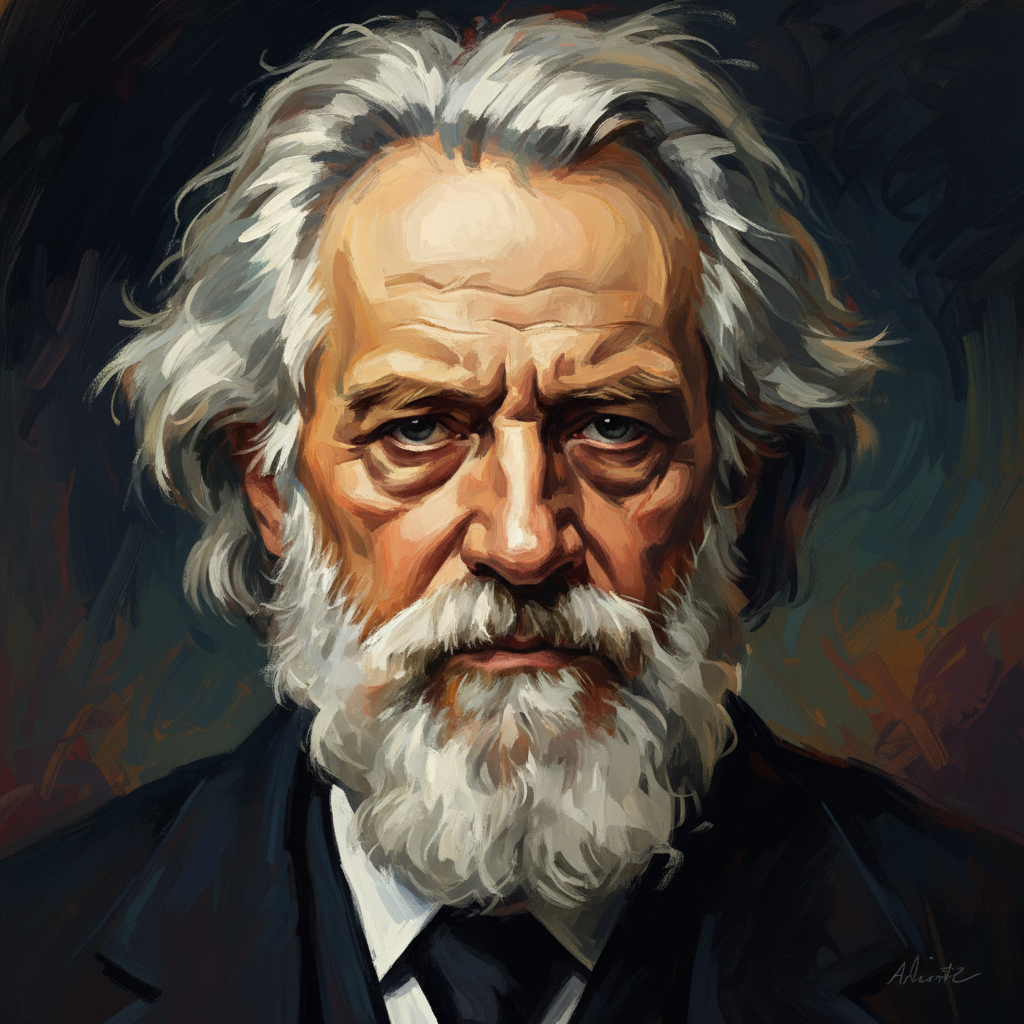
Arthur Schopenhauer — "The first forty years of life give us the text; the next thirty supply the comme…"
The first forty years of life give us the text; the next thirty supply the commentary.
The first forty years of life give us the text; the next thirty supply the commentary.
Click any product to generate a realistic preview. Up to 3 at a time.
* Initial load can take up to 90 seconds — revising the preview in another color is nearly instant.
"Human life, when viewed in its entirety, is a tragedy; but in its details it has the character of a comedy."
"Marrying means, to grasp blindfolded into a sack hoping to find out an eel out of an assembly of snakes."
"The discovery of truth is prevented more effectively, not by the false appearance things present and which mislead into error, not directly by weakness of the reasoning powers, but by preconceived opi…"
"The life of man is a constant struggle against pain and boredom."
"The fundament upon which all our knowledge and learning rests is the inexplicable."
German philosopher of pessimism whose The World as Will and Representation (1819) defined the suffering-and-renunciation tradition. Closely associated with Immanuel Kant (the system Schopenhauer built on and revised). For an intellectual contrast, see G.W.F. Hegel, German Idealist of the rational unfolding of Spirit — Schopenhauer scheduled his Berlin lectures opposite Hegel's and spent decades attacking Hegel's optimistic system as deliberately mystifying nonsense — the foundational rivalry of 19th-century German philosophy.
The standard scholarly entry points to Arthur Schopenhauer's work: Bryan Magee (Oxford, populariser-philosopher) — The Philosophy of Schopenhauer (1983); Christopher Janaway (Southampton, Schopenhauer specialist) — Self and World in Schopenhauer's Philosophy (1989); David E. Cartwright (Wisconsin–Whitewater) — Schopenhauer: A Biography (2010). These are the works graduate seminars cite when teaching Arthur Schopenhauer.
Your cart is empty