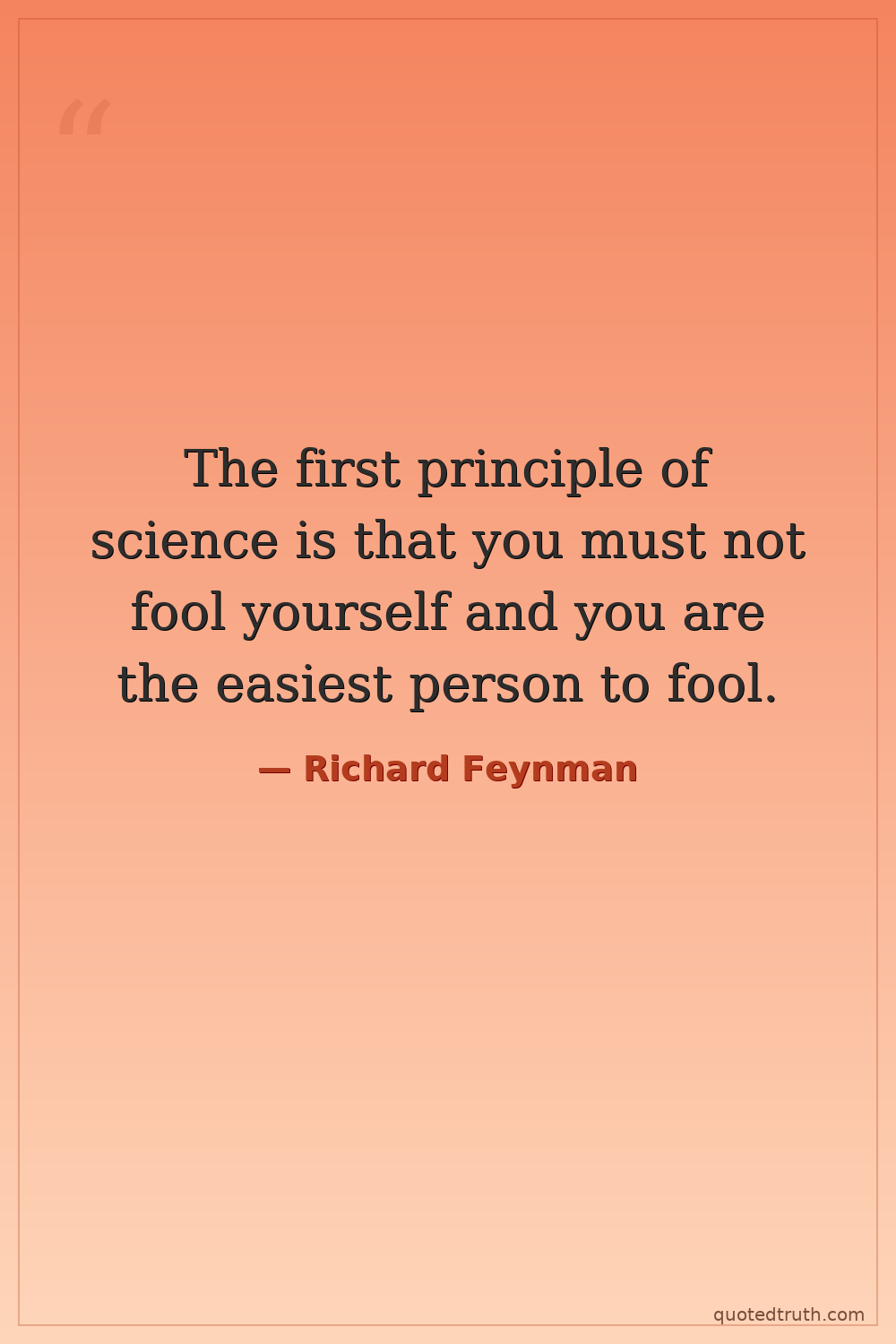
Richard Feynman — "The first principle of science is that you must not fool yourself and you are th…"
The first principle of science is that you must not fool yourself and you are the easiest person to fool.
The first principle of science is that you must not fool yourself and you are the easiest person to fool.
Click any product to generate a realistic preview. Up to 3 at a time.
* Initial load can take up to 90 seconds — revising the preview in another color is nearly instant.
"When you are a scientist, you are a child. You are always asking 'Why?'"
"If you're going to be a scientist, you don't need to be a genius. You just need to be able to work hard and be curious."
"I don't care what you think. I care what's true."
"The thing about science is that it's all about discovery. It's all about trying to find out what's going on."
"People would often think I'm a faker, but I'm usually honest, in a certain way- in such a way that often nobody believes me!"
American theoretical physicist who shared the 1965 Nobel for QED, developed Feynman diagrams, and wrote the Feynman Lectures on Physics. Closely associated with Julian Schwinger (co-Nobelist for QED) and Murray Gell-Mann (Caltech rival and Eightfold-Way physicist). For an intellectual contrast, see Deepak Chopra, physician and quantum-mysticism author — Feynman's Caltech 'cargo cult science' commencement address is the precise template for what he saw as misuse of physics terminology — Chopra-style appropriation of quantum vocabulary for metaphysical claims is the canonical example of what Feynman called 'fooling yourself'.
Found in 3 providers: grok,deepseek,gemini
3 sources checked
Honest inquiry demands guarding against your own wishful thinking before anyone else's. We naturally want our ideas to be right, so we unconsciously cherry-pick evidence, dismiss contradictions, and rationalize failures. The danger isn't external critics — it's the subtle ways your own mind bends reality to match what you hope is true. Genuine understanding requires treating your own conclusions with the same skepticism you'd apply to anyone else's.
Feynman delivered this principle in his landmark 1974 Caltech commencement address on 'Cargo Cult Science.' A Nobel laureate who revolutionized quantum electrodynamics, he obsessed over genuine understanding versus performance. He famously exposed NASA's O-ring failure with a simple ice-water demonstration when bureaucratic self-deception had clouded the Challenger safety analysis. His entire career was defined by stripping away comfortable illusions — including his own — to reach bedrock truth.
Feynman spoke these words in 1974, amid widespread institutional collapse: Watergate had shattered government credibility, Vietnam had exposed military self-deception, and pseudoscientific movements — ESP research, alternative medicine, Uri Geller's spoon-bending — were gaining mainstream traction. Cold War funding pressures pushed scientists toward confirming desired results rather than truth-seeking. The era's crisis of institutional honesty made Feynman's warning about self-deception acutely relevant beyond the laboratory.
AI-generated insights based on extensive research and information for context. Factual errors? Email [email protected].
Your cart is empty