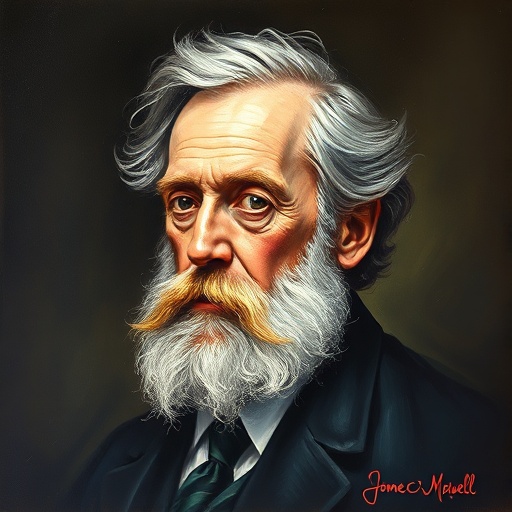
James Clerk Maxwell — "The first thing that I always do is to try to understand the problem."
The first thing that I always do is to try to understand the problem.
The first thing that I always do is to try to understand the problem.
Click any product to generate a realistic preview. Up to 3 at a time.
* Initial load can take up to 90 seconds — revising the preview in another color is nearly instant.
"The only way to avoid being wrong is to say nothing."
"The only use of a knowledge of the past is to equip us for the present."
"I have also a paper afloat, with an electromagnetic theory of light, which, till I am convinced to the contrary, I hold to be great guns."
"But I think that the results which each man arrives at in his attempts to harmonize his science with his Christianity ought not to be regarded as having any significance except to the man himself, and…"
"The only laws of matter are those which our minds must fabricate, and the only laws of mind are fabricated for it by matter."
Found in 1 providers: grok
1 source checked
Before attempting any solution, take the time to fully grasp what is actually being asked. Rushing to answer without understanding the question leads to wasted effort and wrong conclusions. True problem-solving starts with careful analysis of the situation itself, identifying what is known, what is unknown, and what connects them. Understanding precedes action, and clarity about the problem is often most of the battle.
Maxwell embodied this approach throughout his work unifying electricity, magnetism, and light into four elegant equations. Rather than rushing to calculate, he built deep physical intuition, famously visualizing fields through mechanical analogies before formalizing them mathematically. His kinetic theory of gases and color vision research show the same pattern: prolonged contemplation of underlying structure before producing breakthrough formalism. Colleagues noted his patient, methodical temperament and refusal to skip foundational understanding.
Maxwell worked during the Victorian scientific revolution (1850s-1870s), when natural philosophy was formalizing into modern physics. Faraday's experimental discoveries awaited mathematical unification, telegraphy was reshaping communication, and Cambridge's Mathematical Tripos demanded rigorous analytical training. Scientists wrestled with the ether, thermodynamics, and emerging statistical methods. Maxwell's insistence on understanding over calculation stood against growing pressure for technical specialization, foreshadowing debates about intuition versus formalism that would shape twentieth-century physics.
AI-generated insights based on extensive research and information for context. Factual errors? Email [email protected].
Your cart is empty