What it means
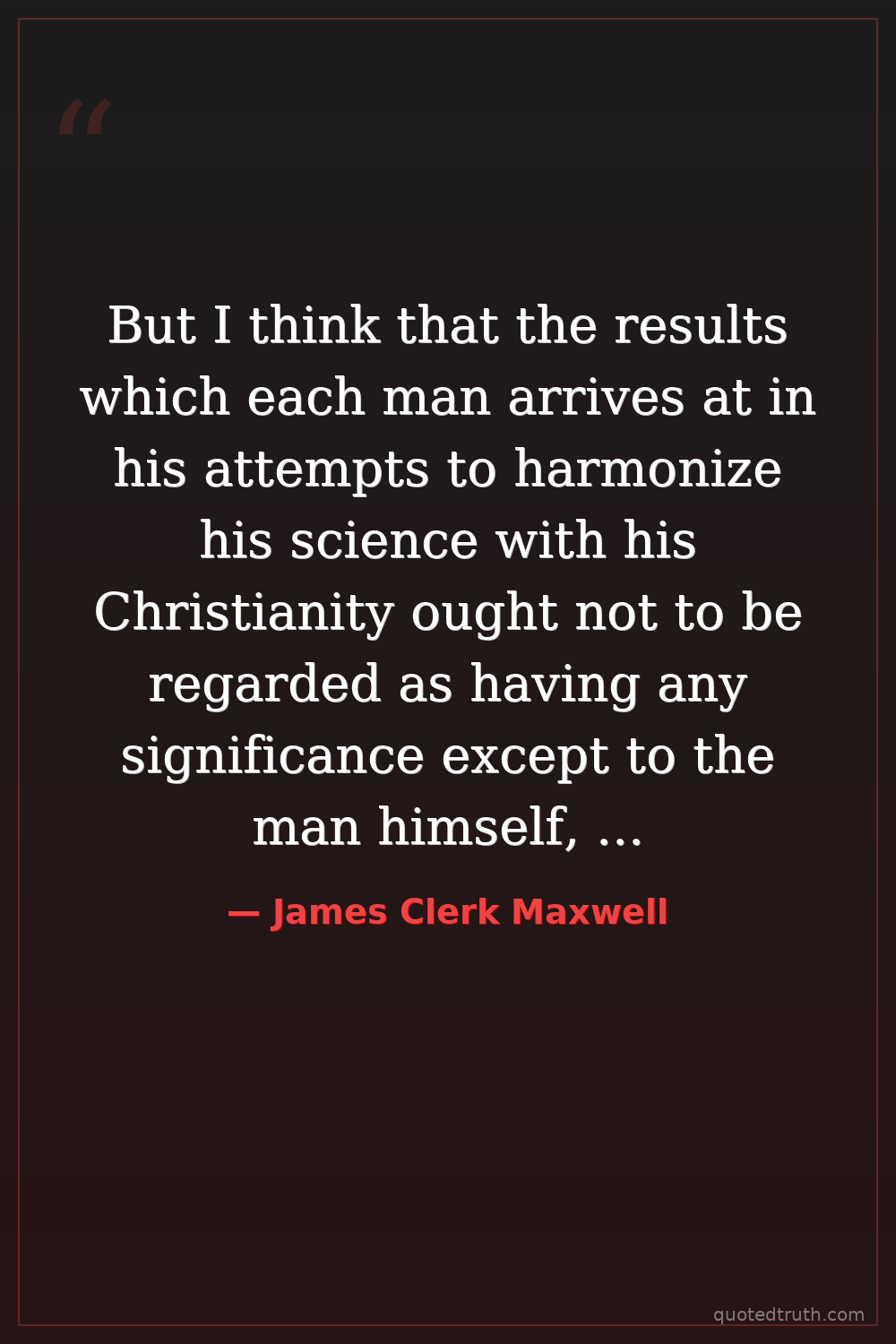
Maxwell argues that how someone personally reconciles scientific findings with religious faith is a private matter. Such reconciliations are individual, temporary, and subject to revision as understanding grows. No scientific society or institution should officially endorse any particular synthesis of science and religion, because doing so would impose one person's private working-out onto others as if it were authoritative truth.
Relevance to James Clerk Maxwell
Maxwell was a devout Presbyterian who prayed nightly and studied theology, yet he founded the Cavendish Laboratory and unified electromagnetism through rigorous mathematics. He actively wrestled with faith-science questions but refused to conflate them publicly. When asked to sign declarations linking science to Christianity, he declined—consistent with this quote's insistence that personal belief remain separate from institutional science.
The era
Maxwell wrote during the Victorian turmoil following Darwin's 1859 Origin of Species, when clergy, scientists, and the public fiercely debated whether science threatened faith. Groups like the Victoria Institute pushed scientists to publicly harmonize the two. Maxwell, working amid this pressure at Cambridge in the 1870s, saw societies increasingly tempted to issue collective theological-scientific statements, and he resisted that institutional overreach.
AI-generated insights based on extensive research and information for context. Factual errors? Email [email protected].