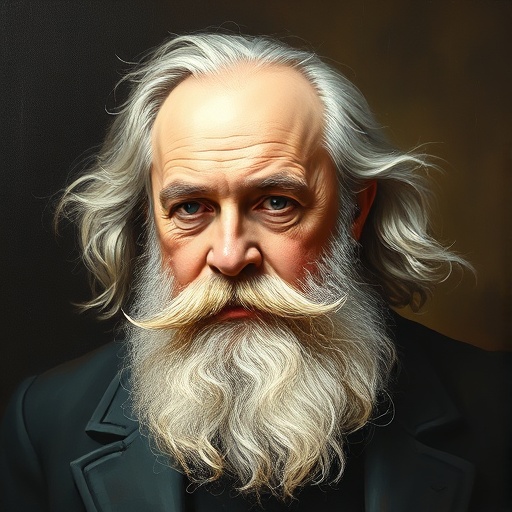
Dmitri Mendeleev — "The future of the Russian nation lies in the hands of the schoolmaster and the p…"
The future of the Russian nation lies in the hands of the schoolmaster and the priest.
The future of the Russian nation lies in the hands of the schoolmaster and the priest.
Click any product to generate a realistic preview. Up to 3 at a time.
* Initial load can take up to 90 seconds — revising the preview in another color is nearly instant.
"To conceive, understand, and grasp the whole symmetry of the scientific edifice, including its unfinished portions, is equivalent to tasting that enjoyment only conveyed by the highest forms of beauty…"
"I saw in a dream a table where all the elements fell into place as required. Awakening, I immediately wrote it down on a piece of paper."
"Hypotheses help and guide scientific work — the search for truth — as the tiller's plough helps the cultivation of useful plants."
"There is no death, but only change."
"The chemical elements are the children of the sun."
Found in 1 providers: deepseek
1 source checked
A nation's destiny depends less on politicians, generals, or wealthy elites than on two everyday figures: the teacher who shapes young minds and the priest who shapes moral character. Whoever forms a country's thinking and values in childhood ultimately decides what that country becomes. Education and ethics, working together at the local level, matter more than grand policy in determining long-term national outcomes.
Mendeleev devoted much of his life beyond chemistry to Russian national development, writing extensively on education, industry, and agriculture. He taught at St. Petersburg University for decades, trained generations of Russian scientists, and believed deeply that Russia's backwardness could only be cured through mass schooling. A devout Orthodox believer from a family of thirteen whose mother sacrificed everything for his education, he personally embodied how teachers and faith shape destiny.
Late 19th-century Russia was overwhelmingly peasant, largely illiterate, and decades behind Western Europe industrially. Serfdom had only ended in 1861, and debates raged between Westernizers pushing secular modernization and Slavophiles defending Orthodox tradition. Revolutionary nihilism was spreading among educated youth while tsars resisted reform. Mendeleev's statement bridged both camps, insisting Russia needed expanded schooling and preserved moral-spiritual foundations simultaneously to avoid either stagnation or violent upheaval.
AI-generated insights based on extensive research and information for context. Factual errors? Email [email protected].
Your cart is empty