What it means
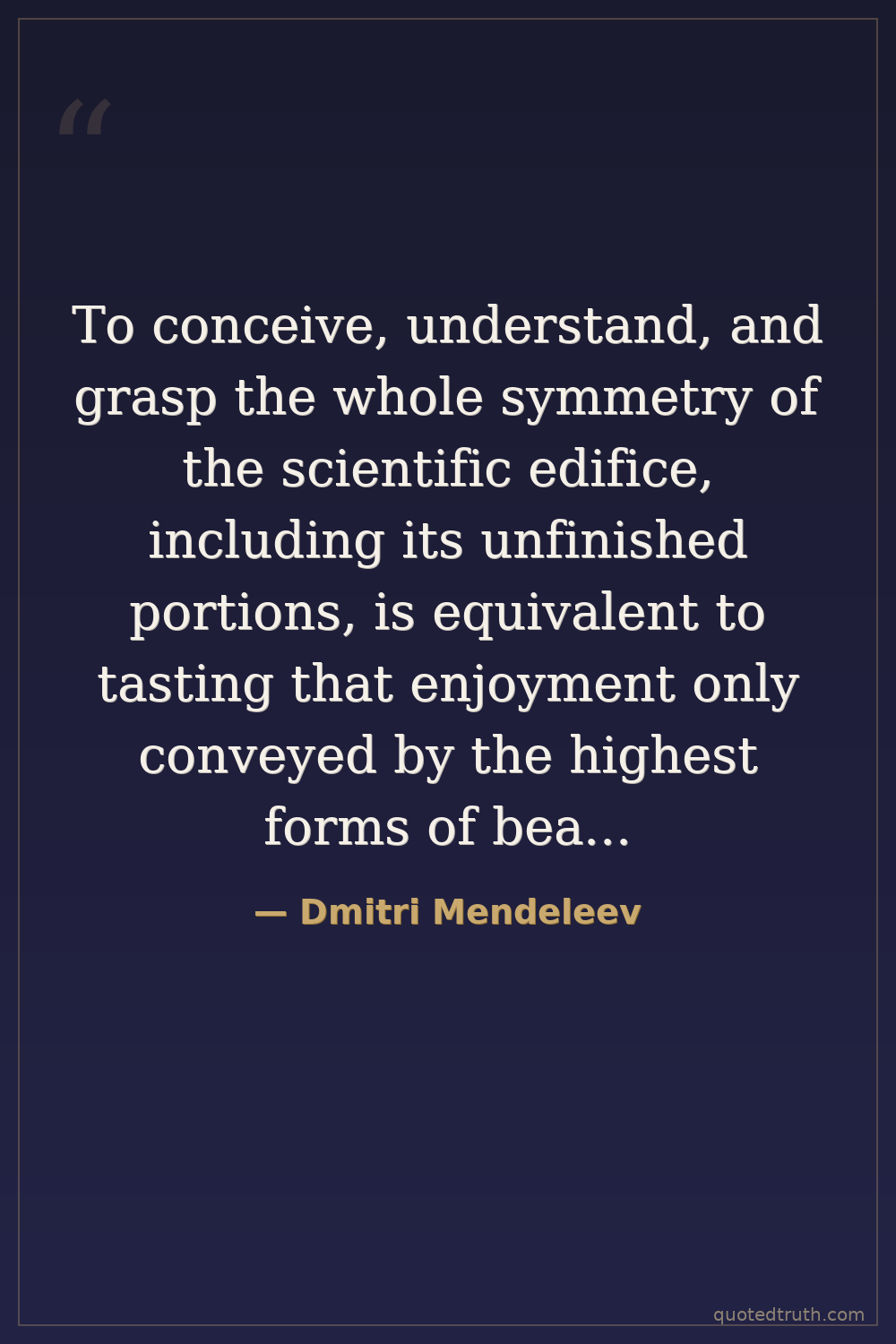
Truly understanding how all scientific knowledge fits together, including the gaps where answers are still missing, brings a deep pleasure comparable to experiencing great art or profound truth. Seeing the pattern, the structure, and the elegant way discoveries connect into a coherent whole is itself a form of beauty. This grasp of the bigger picture, unfinished as it may be, offers a rare satisfaction that rivals the joy found in the most sublime human experiences.
Relevance to Dmitri Mendeleev
Mendeleev built the periodic table precisely by perceiving symmetry in the elements and trusting the pattern enough to leave empty slots for undiscovered ones like gallium and germanium. He predicted their properties before they were found. This quote mirrors his actual working method: seeing beauty in an incomplete structure, finding joy in gaps that would later be filled. The unfinished edifice was literally his greatest discovery.
The era
Mendeleev worked in late-19th-century Russia when chemistry was transitioning from descriptive cataloging to systematic science. Dozens of elements had been isolated but seemed disconnected. Romantic-era thinking still valued aesthetic unity in nature, and scientists like Maxwell and Darwin were revealing grand organizing principles. Mendeleev's 1869 table emerged amid this hunger for underlying order, when educated society embraced the idea that scientific discovery carried the same spiritual weight as art or philosophy.
AI-generated insights based on extensive research and information for context. Factual errors? Email [email protected].