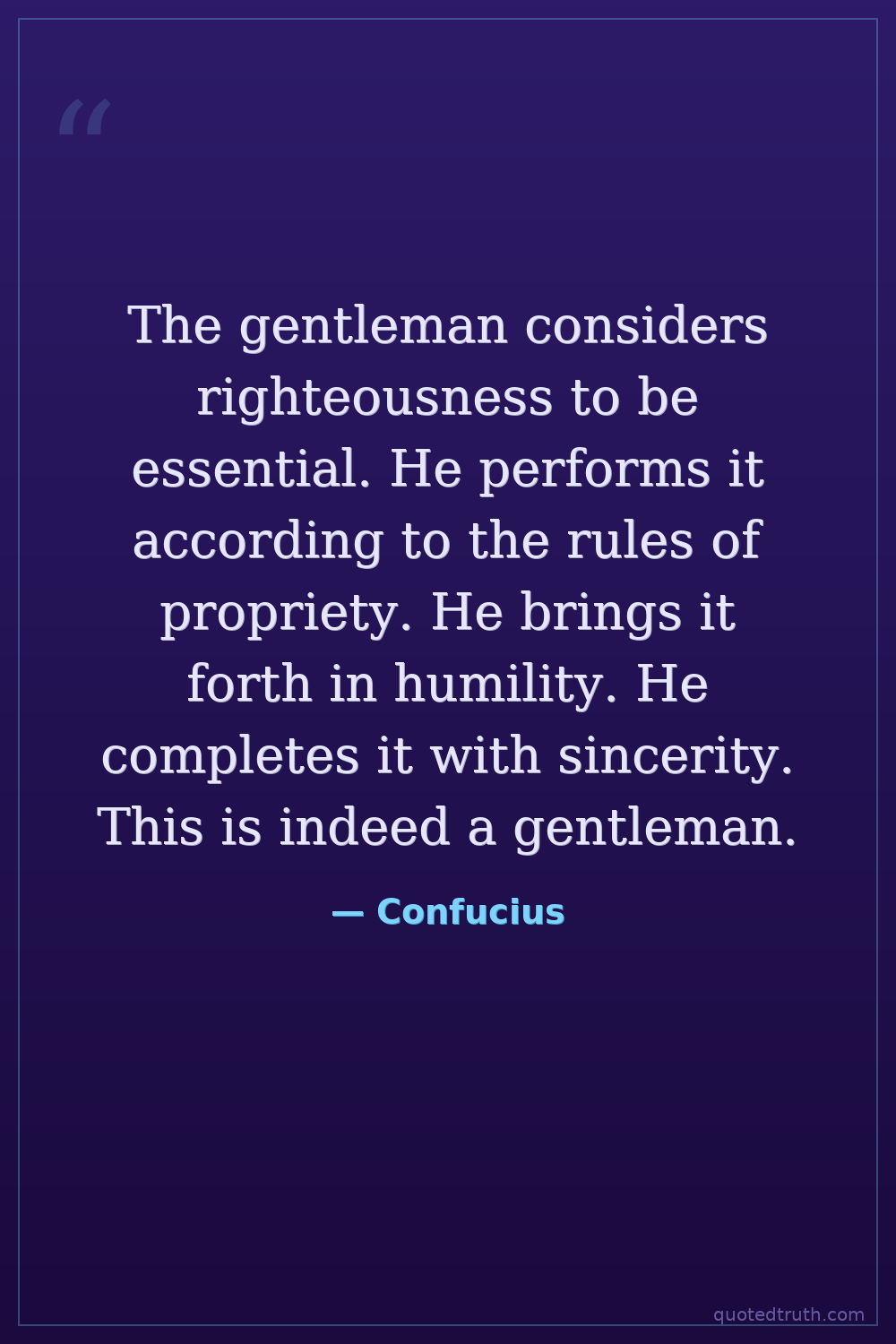
Confucius — "The gentleman considers righteousness to be essential. He performs it according …"

The gentleman considers righteousness to be essential. He performs it according to the rules of propriety. He brings it forth in humility. He completes it with sincerity. This is indeed a gentleman.
Confucius — Confucius Ancient · Chinese philosopher, founder of Confucianism

Get This Quote & Author's Image Illustrated On:

Click any product to generate a realistic preview. Up to 3 at a time.
* Initial load can take up to 90 seconds — revising the preview in another color is nearly instant.

Kitchen

Apparel

Other

About Confucius (551-479 BCE)

Chinese philosopher and teacher whose teachings (compiled by his students in the Analects) became the foundational ethical framework of East Asian civilization for 2,500 years. Closely associated with Mencius (his most-influential follower a century later). For an intellectual contrast, see Laozi, near-contemporary Chinese sage and Tao Te Ching author — Confucius systematized social order through ritual and family hierarchy; Laozi's Taoist effortless-action philosophy argued such systems were the disease, not the cure. The two founding poles of Chinese moral philosophy — every East Asian moral tradition since has positioned itself between them.

The standard scholarly entry points to Confucius's work: Philip J. Ivanhoe (Georgetown, Chinese philosophy) — Confucian Moral Self Cultivation (2000); Edward Slingerland (UBC, Asian Studies) — Effortless Action: Wu-wei as Conceptual Metaphor (2003); Tu Weiming (Harvard, Confucian scholar) — Confucian Thought: Selfhood as Creative Transformation (1985). These are the works graduate seminars cite when teaching Confucius.

Details

Analects 15.17

Date: c. 5th century BCE

Biblical

Verification

Unverifiable

Found in 1 providers: grok

1 source checked

Understanding this quote

What it means

A person of true character treats moral rightness as the core of who they are. They express it through proper conduct and social respect, carry it out with humility rather than arrogance, and follow through with genuine sincerity. Righteousness alone isn't enough—how you enact it matters just as much. The combination of moral substance, respectful manner, modest attitude, and honest completion defines real integrity in action, not just intention.

Relevance to Confucius

Confucius built his entire ethical system around the junzi, or 'gentleman'—a moral ideal anyone could strive toward regardless of birth. As a teacher who trained students for government service, he emphasized that virtue required both inner substance (righteousness, sincerity) and outer form (ritual propriety, li). His own life of humble teaching after failing to secure lasting political office modeled the humility he describes, making this saying a distilled blueprint of his lifelong curriculum.

The era

Confucius lived during the Spring and Autumn period (6th–5th century BCE), when the Zhou dynasty's authority was collapsing and warring states fought ruthlessly for power. Traditional rituals and social bonds were eroding, and aristocratic 'gentleman' status was becoming hereditary privilege rather than moral achievement. Confucius radically redefined the junzi as character-based, offering a template for restoring social order through cultivated individuals. In an age of political chaos and moral decay, teaching virtuous conduct was itself a revolutionary stabilizing act.

AI-generated insights based on extensive research and information for context. Factual errors? Email [email protected].
Your Cart

Your cart is empty