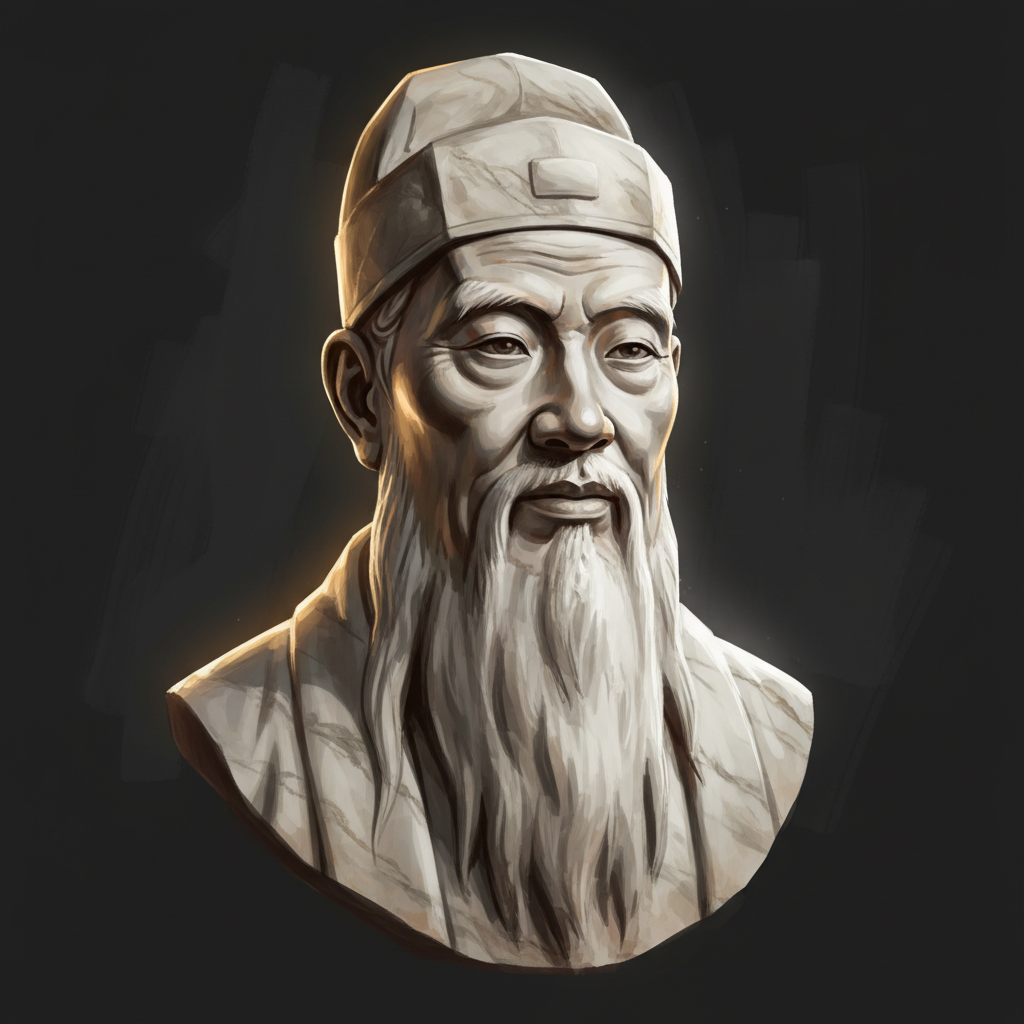
Confucius — "When you see a good person, think of becoming like her/him. When you see someone…"
When you see a good person, think of becoming like her/him. When you see someone not so good, reflect on your own weak points.
When you see a good person, think of becoming like her/him. When you see someone not so good, reflect on your own weak points.
Click any product to generate a realistic preview. Up to 3 at a time.
* Initial load can take up to 90 seconds — revising the preview in another color is nearly instant.
"It is not possible for one to be a gentleman and yet not be benevolent."
"If names be not correct, language is not in accordance with the truth of things. If language be not in accordance with the truth of things, affairs cannot be carried on to success."
"The wise find pleasure in water; the virtuous find pleasure in mountains. The wise are active; the virtuous are tranquil. The wise are joyful; the virtuous are long-lived."
"To govern is to rectify. If you lead the people by being rectified yourself, who will dare not be rectified?"
"The cautious seldom err."
Chinese philosopher and teacher whose teachings (compiled by his students in the Analects) became the foundational ethical framework of East Asian civilization for 2,500 years. Closely associated with Mencius (his most-influential follower a century later). For an intellectual contrast, see Laozi, near-contemporary Chinese sage and Tao Te Ching author — Confucius systematized social order through ritual and family hierarchy; Laozi's Taoist effortless-action philosophy argued such systems were the disease, not the cure. The two founding poles of Chinese moral philosophy — every East Asian moral tradition since has positioned itself between them.
The standard scholarly entry points to Confucius's work: Philip J. Ivanhoe (Georgetown, Chinese philosophy) — Confucian Moral Self Cultivation (2000); Edward Slingerland (UBC, Asian Studies) — Effortless Action: Wu-wei as Conceptual Metaphor (2003); Tu Weiming (Harvard, Confucian scholar) — Confucian Thought: Selfhood as Creative Transformation (1985). These are the works graduate seminars cite when teaching Confucius.
Found in 1 providers: gemini
1 source checked
Use other people as mirrors for your own growth. When you meet someone admirable, study what makes them good and work to develop those same qualities in yourself. When you meet someone flawed, resist the urge to judge them and instead look inward, asking whether you share any of those same faults. Every person you encounter becomes a chance to improve, whether through imitation or honest self-examination.
Confucius built his entire teaching around self-cultivation through daily moral reflection, not divine revelation or rigid law. As a traveling teacher who spent decades advising rulers and training disciples, he constantly modeled learning from everyone encountered. His Analects repeatedly return to this theme of treating every interaction as a lesson, and he famously said three people walking together always contain a teacher for him.
Confucius lived during the Spring and Autumn period around 551-479 BCE, when the Zhou dynasty's authority was collapsing and rival states fought constantly. Traditional rituals and social bonds were breaking down, and warlords ruled through force rather than virtue. Confucius offered an alternative path, arguing that social order had to be rebuilt person by person through moral self-improvement, making individual character reflection a radical political and cultural act.
AI-generated insights based on extensive research and information for context. Factual errors? Email [email protected].
Your cart is empty