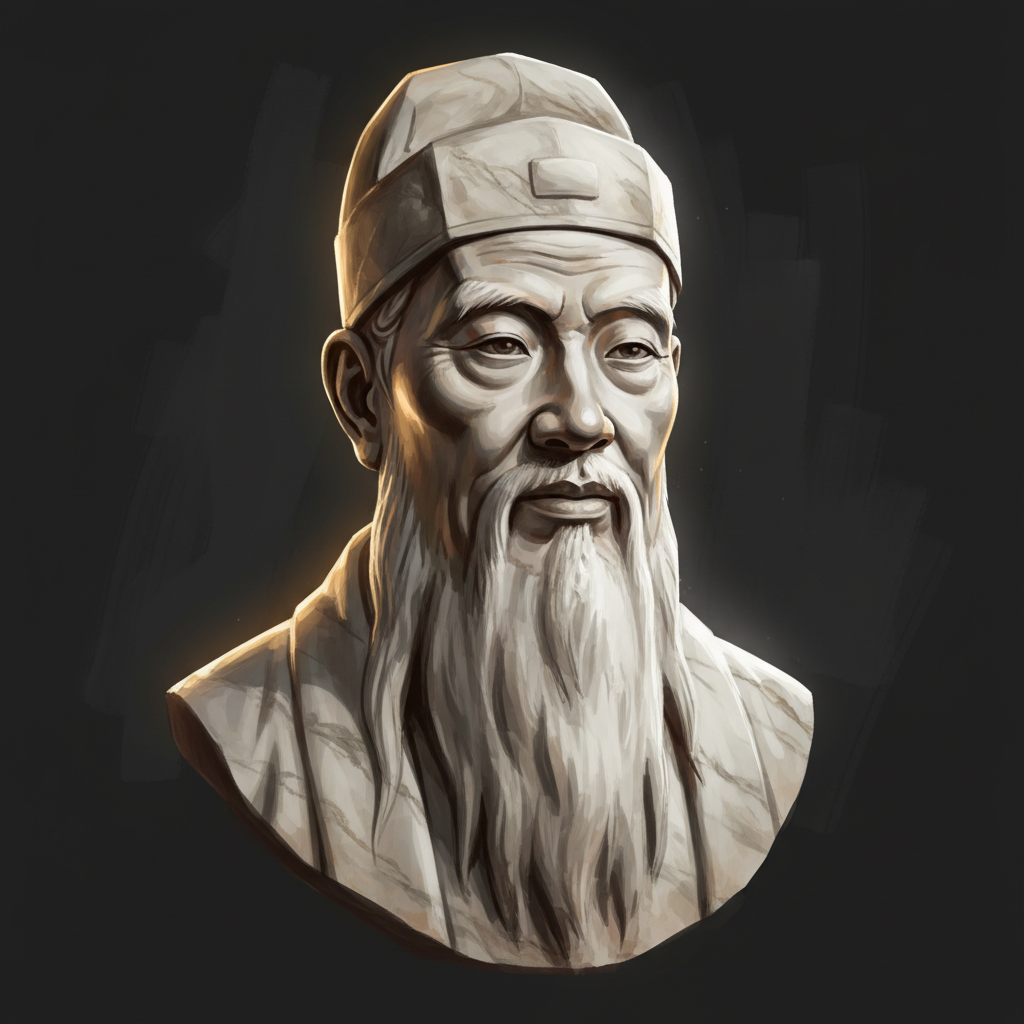
Confucius — "The gentleman has nothing to contend for."
The gentleman has nothing to contend for.
The gentleman has nothing to contend for.
Click any product to generate a realistic preview. Up to 3 at a time.
* Initial load can take up to 90 seconds — revising the preview in another color is nearly instant.
"The man who asks a question is a fool for a minute, the man who does not ask is a fool for life."
"The superior man thinks of virtue; the small man thinks of comfort. The superior man thinks of the sanctions of law; the small man thinks of favors which he may receive."
"The Master said, 'I have not seen one who loves virtue as he loves sexual beauty.'"
"The superior man thinks of virtue; the small man thinks of comfort."
"The superior man is watchful over himself when alone."
Chinese philosopher and teacher whose teachings (compiled by his students in the Analects) became the foundational ethical framework of East Asian civilization for 2,500 years. Closely associated with Mencius (his most-influential follower a century later). For an intellectual contrast, see Laozi, near-contemporary Chinese sage and Tao Te Ching author — Confucius systematized social order through ritual and family hierarchy; Laozi's Taoist effortless-action philosophy argued such systems were the disease, not the cure. The two founding poles of Chinese moral philosophy — every East Asian moral tradition since has positioned itself between them.
The standard scholarly entry points to Confucius's work: Philip J. Ivanhoe (Georgetown, Chinese philosophy) — Confucian Moral Self Cultivation (2000); Edward Slingerland (UBC, Asian Studies) — Effortless Action: Wu-wei as Conceptual Metaphor (2003); Tu Weiming (Harvard, Confucian scholar) — Confucian Thought: Selfhood as Creative Transformation (1985). These are the works graduate seminars cite when teaching Confucius.
Found in 1 providers: grok
1 source checked
A person of genuine moral character does not compete for status, wealth, or recognition. They focus on self-cultivation and doing what is right rather than jostling against others for position. Rivalry and one-upmanship are beneath them because their sense of worth comes from inner virtue, not from beating someone else. Disputes, arguments, and ambition-driven conflicts hold no appeal for someone genuinely committed to character.
Confucius spent his life promoting ren (humaneness) and li (proper conduct), teaching that the junzi, or exemplary person, embodies moral refinement over ambition. Despite seeking government posts to reform corrupt states, he refused to flatter rulers or undercut rivals. He valued ritual archery precisely because it channeled competition into courtesy. This saying distills his ideal: true nobility is measured by character cultivated inwardly, not victories won over others.
During the Spring and Autumn period, the Zhou dynasty's authority had collapsed and rival states waged constant war for supremacy. Aristocrats schemed, assassinated, and betrayed one another chasing land and titles. Into this violent, status-obsessed climate Confucius proposed a radical alternative: a ruling class defined by ethical refinement rather than brute ambition. His teaching directly rebuked the warlord culture of his day and offered a blueprint for restoring social harmony through personal virtue.
AI-generated insights based on extensive research and information for context. Factual errors? Email [email protected].
Your cart is empty