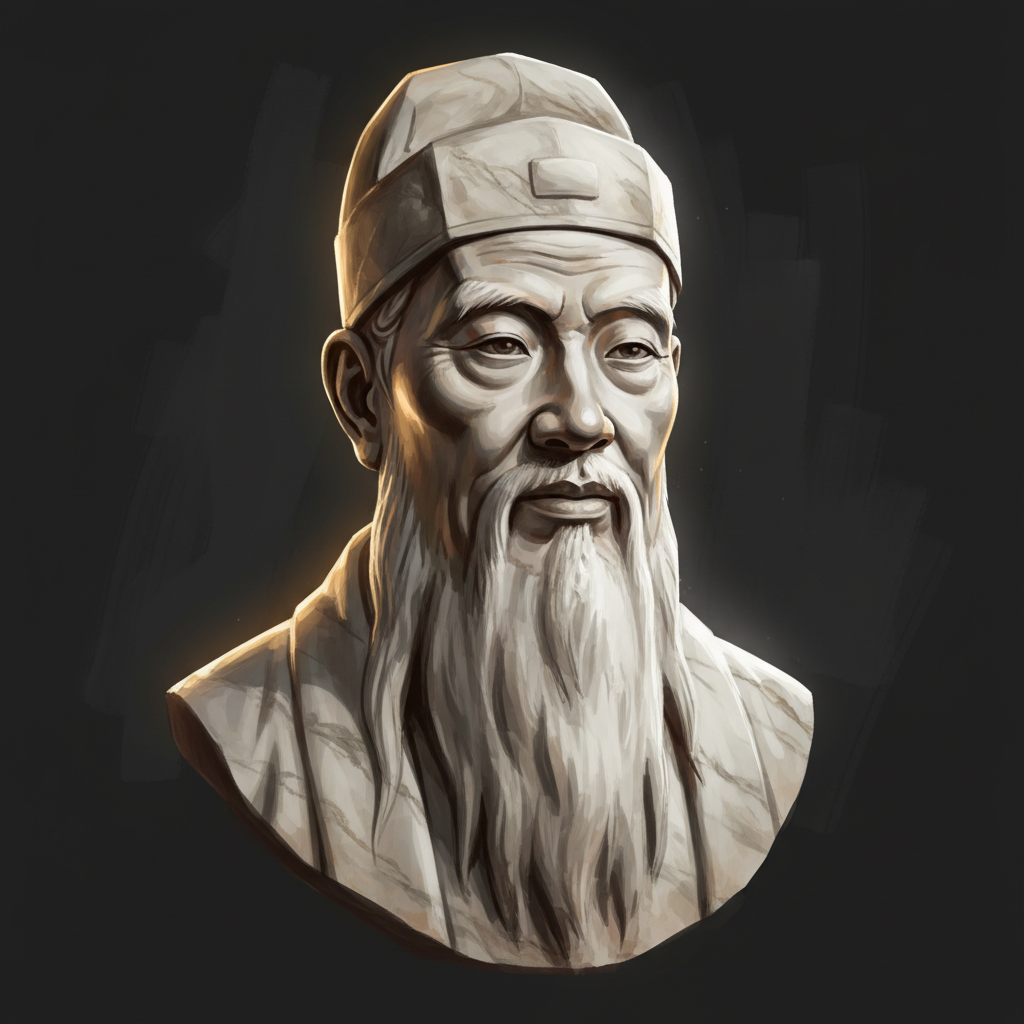
Confucius — "The superior man thinks of virtue; the small man thinks of comfort."
The superior man thinks of virtue; the small man thinks of comfort.
The superior man thinks of virtue; the small man thinks of comfort.
Click any product to generate a realistic preview. Up to 3 at a time.
* Initial load can take up to 90 seconds — revising the preview in another color is nearly instant.
"A man without constancy cannot be a diviner or a physician."
"The Master said, 'It is not easy to find a man who has learned for three years without having his thoughts bent on learning.'"
"The superior man is watchful over himself when alone."
"One who does not understand the Mandate of Heaven cannot be a gentleman."
"To be able to practice five things everywhere under heaven constitutes perfect virtue... gravity, generosity of soul, sincerity, earnestness, and kindness."
Chinese philosopher and teacher whose teachings (compiled by his students in the Analects) became the foundational ethical framework of East Asian civilization for 2,500 years. Closely associated with Mencius (his most-influential follower a century later). For an intellectual contrast, see Laozi, near-contemporary Chinese sage and Tao Te Ching author — Confucius systematized social order through ritual and family hierarchy; Laozi's Taoist effortless-action philosophy argued such systems were the disease, not the cure. The two founding poles of Chinese moral philosophy — every East Asian moral tradition since has positioned itself between them.
The standard scholarly entry points to Confucius's work: Philip J. Ivanhoe (Georgetown, Chinese philosophy) — Confucian Moral Self Cultivation (2000); Edward Slingerland (UBC, Asian Studies) — Effortless Action: Wu-wei as Conceptual Metaphor (2003); Tu Weiming (Harvard, Confucian scholar) — Confucian Thought: Selfhood as Creative Transformation (1985). These are the works graduate seminars cite when teaching Confucius.
Found in 2 providers: grok,deepseek
2 sources checked
A person of high character focuses on doing what is morally right, even when it's difficult or costly. A shallow person prioritizes their own ease, convenience, and personal benefits. The distinction isn't about wealth or status but about what someone chooses to value when making decisions. Character is revealed by whether you pursue what is good or simply what feels easy in the moment.
Confucius built his entire teaching around the junzi, the 'superior' or exemplary person who cultivates moral excellence through discipline and self-reflection. Having spent years as a low-ranking official frustrated by corrupt nobles who chose luxury over duty, he championed virtue as the true mark of nobility, not birth or wealth. This contrast between junzi and xiaoren (small person) appears throughout the Analects as his core ethical framework.
During the Spring and Autumn period (6th-5th century BCE), the Zhou dynasty was fracturing into warring states where rulers indulged in excess while society collapsed into violence and opportunism. Hereditary aristocrats claimed nobility by birth alone, often lacking any moral substance. Confucius taught during this chaos, insisting that true nobility came from cultivated virtue, not bloodline or comfort. His words directly challenged the ruling class to earn their status through character.
AI-generated insights based on extensive research and information for context. Factual errors? Email [email protected].
Your cart is empty