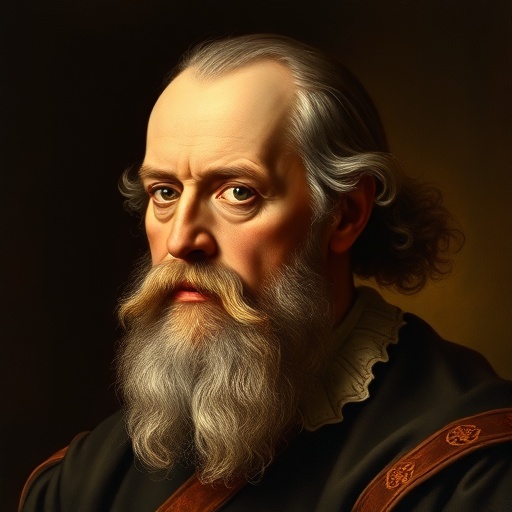
Galileo Galilei — "The greater the number of people who believe a proposition, the more likely it i…"
The greater the number of people who believe a proposition, the more likely it is to be false.
The greater the number of people who believe a proposition, the more likely it is to be false.
Click any product to generate a realistic preview. Up to 3 at a time.
* Initial load can take up to 90 seconds — revising the preview in another color is nearly instant.
"The senses, being the interpreters of natural effects, are the only door to scientific knowledge."
"I have never met a man so ignorant that I couldn't learn something from him."
"Measure what is measurable, and make measurable what is not so."
"I consider the sun's axial rotation to be an excellent argument for the diurnal rotation of the earth."
"Where the senses fail us, reason must step in."
Found in 1 providers: grok
1 source checked
Popular belief is not evidence of truth. When nearly everyone accepts something as fact, it usually means the idea is comfortable, inherited, or institutionally enforced — not that it has been tested. Real discoveries tend to contradict what the crowd assumes. The quote inverts the appeal-to-majority fallacy: widespread agreement signals conformity and unexamined tradition, not verified knowledge. Truth is often lonely before it becomes obvious.
Galileo spent his career dismantling near-universal consensus. His defense of heliocentrism contradicted what virtually every scholar, clergyman, and layperson believed about the cosmos. In 1633, the Inquisition forced him to recant under threat of torture — majority belief weaponized as institutional suppression. His telescopic discoveries — lunar craters, Jupiter's moons, Venus's phases — each overturned accepted wisdom. He didn't just say this; he lived it as biography.
Early modern Europe was intellectually policed by the Catholic Church, which enforced Aristotelian geocentrism as divinely revealed truth. The Inquisition and Index of Forbidden Books made dissent genuinely dangerous. The Scientific Revolution — Copernicus, Kepler, Galileo, Newton — was precisely a project of overturning majority-held, authority-endorsed beliefs through empirical observation. Popular consensus was literally enforced by institutional power, making it a profoundly unreliable guide to what was actually true.
AI-generated insights based on extensive research and information for context. Factual errors? Email [email protected].
Your cart is empty