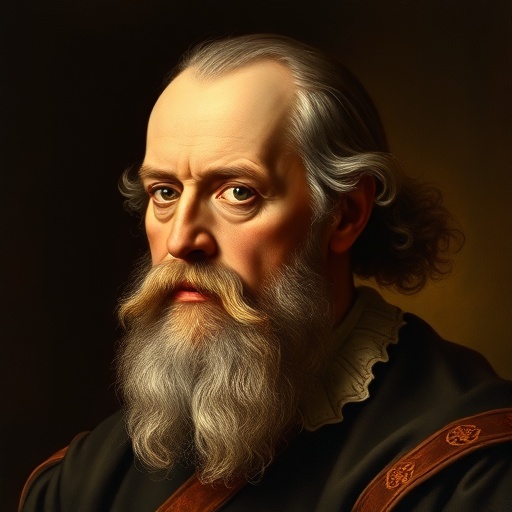
Galileo Galilei — "Where the senses fail us, reason must step in."
Where the senses fail us, reason must step in.
Where the senses fail us, reason must step in.
Click any product to generate a realistic preview. Up to 3 at a time.
* Initial load can take up to 90 seconds — revising the preview in another color is nearly instant.
"The more I study nature, the more I stand amazed at the work of the Creator."
"I cannot without great astonishment — I might say without great insult to my intelligence — hear it attributed as a prime perfection and nobility of the natural and integral bodies of the universe tha…"
"The difficulties in the study of the infinite arise because we attempt, with our finite minds, to discuss the infinite, assigning to it those properties which we give to the finite and limited; but th…"
"Who would set a limit to the mind of man? Who would dare assert that we know all there is to be known?"
"Mathematics is the language in which God has written the universe."
Found in 1 providers: grok
1 source checked
When our direct senses—sight, touch, hearing—can no longer give reliable answers, logical analysis must take over. Human perception is limited and easily deceived; it cannot accurately capture the very small, very distant, or very fast. When raw observation reaches its boundary, systematic reasoning and mathematics become the essential tools for uncovering deeper truths about how the world actually works beyond what we can see or feel.
Galileo's telescope revealed Jupiter's moons and lunar craters invisible to the unaided eye, but his deepest contributions came through mathematics. He derived the laws of falling bodies and projectile motion—phenomena too subtle for direct perception. His defense of heliocentrism required logical inference, since Earth's movement cannot be felt. Condemned by the Inquisition in 1633 for trusting calculation over Church-sanctioned common sense, his entire career demonstrated reason surpassing sensory limits.
In early 17th-century Europe, Aristotelian philosophy treated direct sensory experience as the foundation of all knowledge, and the Catholic Church reinforced this with Scripture as final authority. The geocentric universe seemed self-evident—no one could feel Earth moving. Galileo lived at the pivot point of the Scientific Revolution, when thinkers began replacing passive observation with mathematical models. His 1633 trial showed how dangerous it was to trust reason over received sensory and theological consensus.
AI-generated insights based on extensive research and information for context. Factual errors? Email [email protected].
Your cart is empty