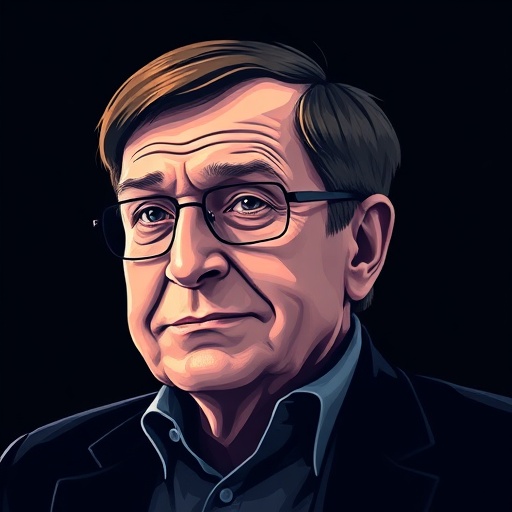
Stephen Hawking — "The greatest achievement of the human race is not the invention of the wheel, bu…"
The greatest achievement of the human race is not the invention of the wheel, but the ability to communicate.
The greatest achievement of the human race is not the invention of the wheel, but the ability to communicate.
Click any product to generate a realistic preview. Up to 3 at a time.
* Initial load can take up to 90 seconds — revising the preview in another color is nearly instant.
"There is a fundamental difference between religion, which is based on authority, and science, which is based on observation and reason. Science will win because it works."
"We are very, very small, but we are capable of understanding the universe."
"I believe that we are alone in the universe, or that we are the only intelligent life."
"The universe is a pretty big place. If it's just us, seems like an awful waste of space."
"People think I'm really smart. But when people ask me a question I type in the answer on my little computer screen. How do you know I am not just googling that shit before I answer?"
British theoretical physicist whose Hawking radiation work and A Brief History of Time (1988) brought black-hole physics to a mass audience while he lived with ALS for 55 years. Closely associated with Roger Penrose (his collaborator on singularity theorems) and Carl Sagan (fellow popularizer who wrote Brief History's foreword). For an intellectual contrast, see William Lane Craig, American philosopher of religion — Craig's Kalam cosmological argument depends on the Big Bang requiring a divine first cause; Hawking's no-boundary proposal was specifically designed to remove the moment that would require one — the cleanest cosmology-vs-natural-theology contrast in modern thought.
Found in 1 providers: grok
1 source checked
Communication, not physical invention, is humanity's defining achievement. The wheel is a symbol of practical ingenuity, but communication is what allows knowledge to compound across generations, enables large-scale cooperation, and makes civilization itself possible. Without the ability to transmit thought, every generation starts from zero—no progress stacks, no culture survives. Ideas can only build on each other when they can be shared, making language and expression more foundational than any single tool.
For Hawking, communication was existential. ALS robbed him of natural speech, yet through a synthesizer voice he published landmark physics papers, gave lectures worldwide, and sold over 10 million copies of A Brief History of Time. He devoted his career to translating the mathematics of black holes and spacetime into language ordinary people could grasp. This quote carries unmistakable personal weight from someone who fought his own body daily just to share a thought.
Hawking's career spanned the birth of the internet, the World Wide Web, email, and social media—the greatest expansion of human communication capacity in history. Scientists moved from isolated research silos toward open, globally networked collaboration; the Human Genome Project depended on cross-continental data sharing. Hawking himself used early digital speech technology to remain a voice in physics after losing his natural speech, witnessing firsthand how communication tools were reshaping what was scientifically and culturally possible.
AI-generated insights based on extensive research and information for context. Factual errors? Email [email protected].
Your cart is empty