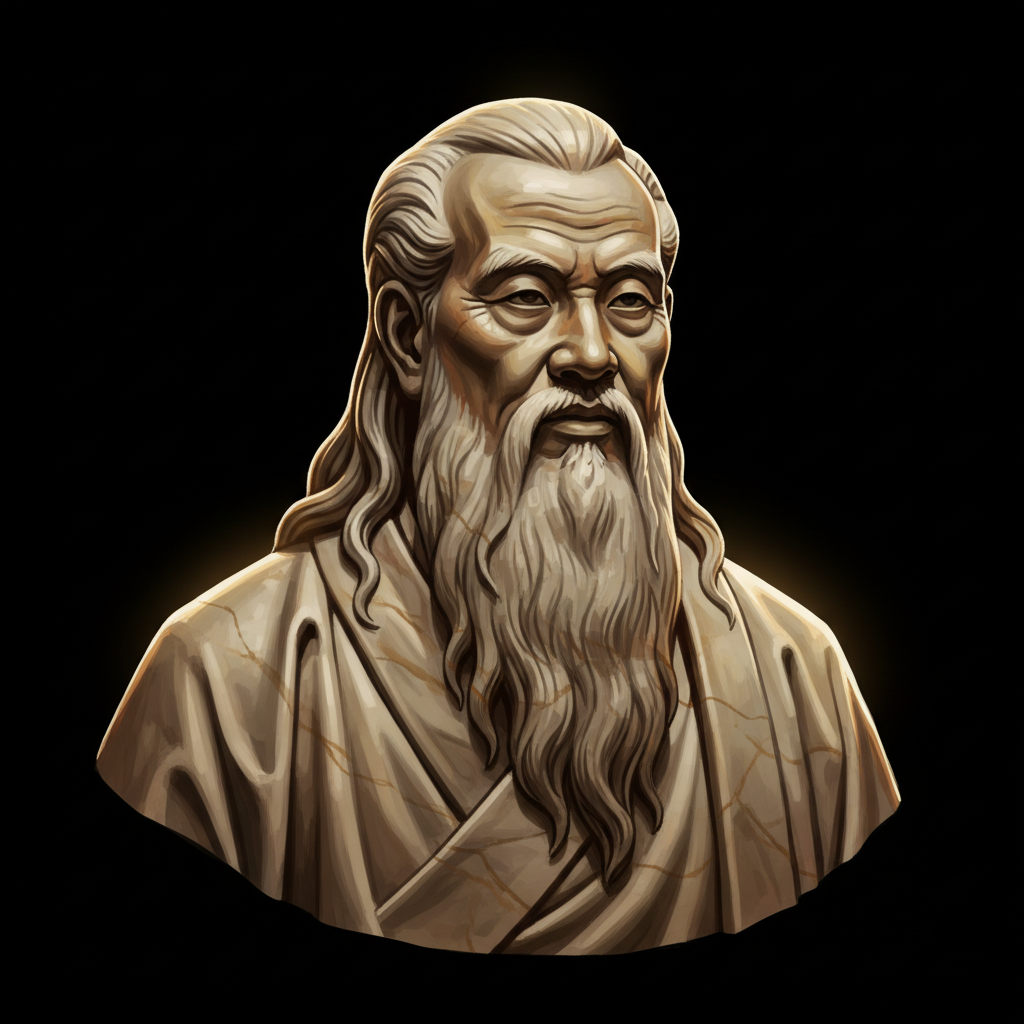
Laozi — "The greatest conquest is to conquer oneself."
The greatest conquest is to conquer oneself.
The greatest conquest is to conquer oneself.
Click any product to generate a realistic preview. Up to 3 at a time.
* Initial load can take up to 90 seconds — revising the preview in another color is nearly instant.
"He who boasts of his own achievements will not endure."
"Fame or integrity: which is more important? Money or happiness: which is more precious?"
"Govern a state by justice, wage war by surprise, and take the world by doing nothing."
"The best fighter is never angry."
"Therefore the sage holds to the one and becomes a model for the world. He does not display himself; therefore he shines. He does not assert himself; therefore he is known. He does not boast; therefore…"
Reputed founder of Taoism and author of the Tao Te Ching, whose wu wei (effortless action) shaped East Asian philosophy. Closely associated with Zhuangzi (later Taoist who extended Laozi's framework). For an intellectual contrast, see Confucius, near-contemporary Chinese sage of social ritual and duty — Confucius systematized social order through ritual and hierarchy; Laozi argued that all such systems were the disease, not the cure — the two founding poles of Chinese moral philosophy.
Attributed, but more of a general philosophical concept than a direct quote from the Tao Te Ching.
Date: Unknown
Food & DrinkFound in 1 providers: grok
1 source checked
True power is not defeating others but mastering your own impulses, desires, and fears. External victories mean little if you remain controlled by anger, greed, or ego. The hardest opponent anyone faces is themselves, because your own habits and reactions follow you everywhere. Winning over yourself means gaining clarity, discipline, and freedom from being jerked around by passing emotions or cravings for approval, wealth, or status.
Laozi taught wu wei, effortless action aligned with the Tao, and warned against forceful striving and outward ambition. As the reputed keeper of the Zhou royal archives, he valued quiet observation over public display. His Tao Te Ching repeatedly prizes humility, yielding, and self-knowledge above dominance. This saying fits his conviction that the sage who governs inner chaos is wiser and stronger than any general who conquers kingdoms through armies.
Laozi lived during the late Zhou dynasty, as China slid toward the Warring States period of constant military campaigns, shifting alliances, and collapsing feudal order. Rulers hired strategists to help them conquer neighbors, and Confucian thinkers pushed rigid social hierarchy as the fix. Against this backdrop of external conquest and political striving, Laozi's focus on inner mastery offered a radical counterweight, suggesting the real crisis was spiritual disorder, not territorial weakness.
AI-generated insights based on extensive research and information for context. Factual errors? Email [email protected].
Your cart is empty