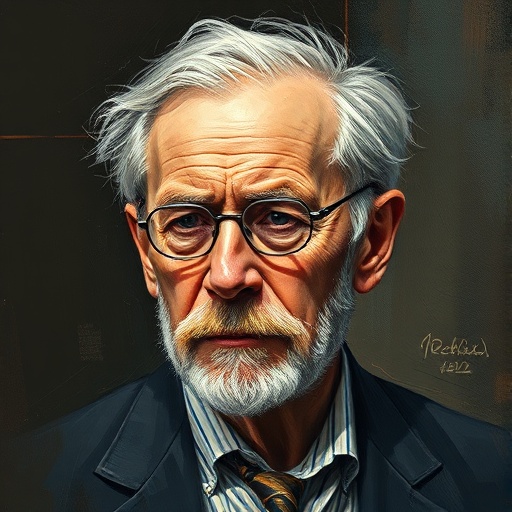
Erwin Schrodinger — "The greatest discovery of all time is the discovery that we can discover."
The greatest discovery of all time is the discovery that we can discover.
The greatest discovery of all time is the discovery that we can discover.
Click any product to generate a realistic preview. Up to 3 at a time.
* Initial load can take up to 90 seconds — revising the preview in another color is nearly instant.
"The world is much stranger than we can imagine."
"The world is a mystery, and we are here to unravel it."
"The number of children born from educated parents is much too small."
"Consciousness is a singular of which the plural is unknown."
"If a man never contradicts himself, the reason must be that he virtually never says anything at all."
Austrian physicist who shared the 1933 Nobel for the wave equation that bears his name and the famous cat thought-experiment. Closely associated with Werner Heisenberg (matrix-mechanics rival who reached the same physics by different math) and Albert Einstein (his pen-pal on quantum interpretation). For an intellectual contrast, see Niels Bohr, Danish physicist and architect of the Copenhagen interpretation — Schrödinger's cat thought-experiment was specifically designed to ridicule Bohr's 'observer-dependent reality' reading of quantum mechanics — Schrödinger thought the Copenhagen interpretation was absurd; the cat was meant as reductio ad absurdum.
Found in 1 providers: grok
1 source checked
This saying celebrates a turning point in human thought: realizing that knowledge is not fixed or handed down, but actively uncovered through inquiry. The deepest breakthrough is not any single fact about nature, but the meta-realization that systematic curiosity itself produces understanding. Once people grasp that they can investigate, question, and reveal hidden truths, every other discovery becomes possible. It frames the scientific method as humanity's master key.
Schrodinger embodied this idea by extending discovery beyond physics. His 1926 wave equation reframed the atom, but he also wrote What Is Life?, applying physical reasoning to genetics and inspiring Watson and Crick. Trained in philosophy and Vedanta as well as math, he treated inquiry as a universal stance. For him, the act of probing reality, whether subatomic or biological, mattered more than any one result he produced.
Schrodinger lived 1887-1961, through the quantum revolution that shattered classical certainty. Einstein, Bohr, Heisenberg, and Schrodinger himself rebuilt physics between 1905 and 1930, while Freud, Godel, and modernist artists overturned other fixed frameworks. Two world wars and the rise of industrial research labs made organized discovery a national priority. In this climate, the meta-insight that knowledge expands through method felt like the defining achievement of the modern age.
AI-generated insights based on extensive research and information for context. Factual errors? Email [email protected].
Your cart is empty