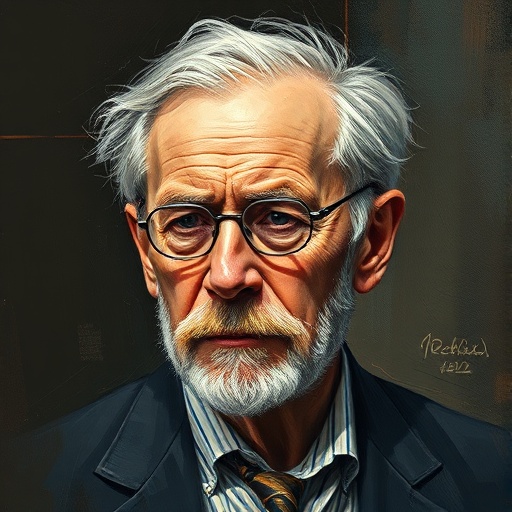
Erwin Schrodinger — "The number of children born from educated parents is much too small."
The number of children born from educated parents is much too small.
The number of children born from educated parents is much too small.
Click any product to generate a realistic preview. Up to 3 at a time.
* Initial load can take up to 90 seconds — revising the preview in another color is nearly instant.
"If a man never contradicts himself, the reason must be that he virtually never says anything at all."
"The only way to do great work is to love what you do."
"I am very astonished that the scientific picture of the real world around me is very deficient. It gives a lot of factual information, puts all our experience in a magnificently consistent order, but …"
"Needless to say, taken literally, this is just as absurd. For an adult organism the energy content is as stationary as the material content. Since, surely, any calorie is worth as much as any other ca…"
"The problem of the 'thing in itself' is not a problem that can be solved by science. It is a philosophical problem."
Austrian physicist who shared the 1933 Nobel for the wave equation that bears his name and the famous cat thought-experiment. Closely associated with Werner Heisenberg (matrix-mechanics rival who reached the same physics by different math) and Albert Einstein (his pen-pal on quantum interpretation). For an intellectual contrast, see Niels Bohr, Danish physicist and architect of the Copenhagen interpretation — Schrödinger's cat thought-experiment was specifically designed to ridicule Bohr's 'observer-dependent reality' reading of quantum mechanics — Schrödinger thought the Copenhagen interpretation was absurd; the cat was meant as reductio ad absurdum.
Attributed, from discussions on eugenics, though specific source is hard to verify.
Date: Likely 1930s-1940s
GeneralFound in 1 providers: grok
1 source checked
Educated people are having too few children relative to the broader population. The speaker believes education and intelligence are heritable, and that society loses something when those traits aren't passed on. It voices concern about differential birth rates between socioeconomic groups, implying that low reproduction among educated people carries long-term costs for intellectual and cultural progress across generations.
Schrödinger was shaped by Vienna's intellectual elite and held broad interests beyond physics—his landmark *What is Life?* (1944) explored heredity and biology as deeply as quantum mechanics. As a Nobel laureate who saw intellect as civilization's engine, he likely believed cognitive capacity was partly heritable. His concern here mirrors his lifelong conviction that human potential deserves active cultivation, not just inside laboratories but across generations of society.
In the early-to-mid 20th century, eugenics was mainstream academic science. Francis Galton's framework had made 'differential fertility' a standard concern—educated professionals were visibly having fewer children than working-class families. Schrödinger expressed such views decades before the Holocaust permanently discredited eugenic thinking. Industrialization and urbanization widened the demographic gap between professional and laboring classes, making educated birth rates a widely debated question among scientists, economists, and social reformers across Europe and America.
AI-generated insights based on extensive research and information for context. Factual errors? Email [email protected].
Your cart is empty