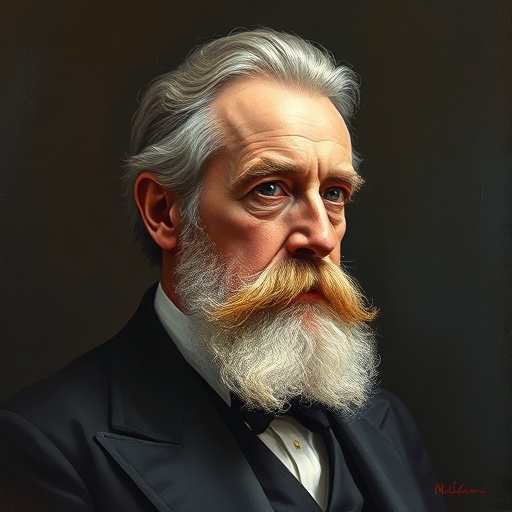
Alexander Graham Bell — "The greatest discovery of my life was the discovery of the value of hard work."
The greatest discovery of my life was the discovery of the value of hard work.
The greatest discovery of my life was the discovery of the value of hard work.
Click any product to generate a realistic preview. Up to 3 at a time.
* Initial load can take up to 90 seconds — revising the preview in another color is nearly instant.
"Perseverance is the chief; but perseverance must have some practical end, or it does not avail the man possessing it. A person without a practical end in view becomes a crank or an idiot. Such persons…"
"Any one, if he will only observe, can find some little thing he does not understand as a starter for an investigation."
"Every man has a right to his own opinion, but no man has a right to be wrong in his facts."
"Great discoveries and improvements invariably involve the cooperation of many minds."
"I begin my work at about nine or ten o'clock in the evening and continue until four or five in the morning. Night is a more quiet time to work. It aids thought."
Found in 1 providers: grok
1 source checked
Among all the breakthroughs Bell achieved, he considered learning the power of sustained effort his most important insight. The quote reframes work ethic itself as a discovery — something you have to find out for yourself, not just hear about. It argues that discipline and persistence, not talent or luck, are what actually produce meaningful results. Hard work isn't merely a means to discovery; it is the discovery.
Bell spent years of relentless laboratory work before successfully transmitting voice over wire in 1876. Trained by his father in elocution and speech science, Bell also worked tirelessly educating deaf students — his mother and wife Mabel were both deaf, grounding his commitment to results through effort. His other projects, from the photophone to hydrofoil boats, showed a man who returned to the workbench constantly, treating each failure as data rather than defeat.
Bell invented the telephone during the Second Industrial Revolution, an era of fierce competition among inventors — Elisha Gray filed a rival telephone patent claim the same day Bell did in 1876. American Gilded Age culture glorified self-made achievement and the Protestant work ethic. Edison's contemporaneous maxim that genius is 99% perspiration echoed the same belief. Industriousness was both a moral virtue and the practical engine powering the era's explosion of new technology.
AI-generated insights based on extensive research and information for context. Factual errors? Email [email protected].
Your cart is empty