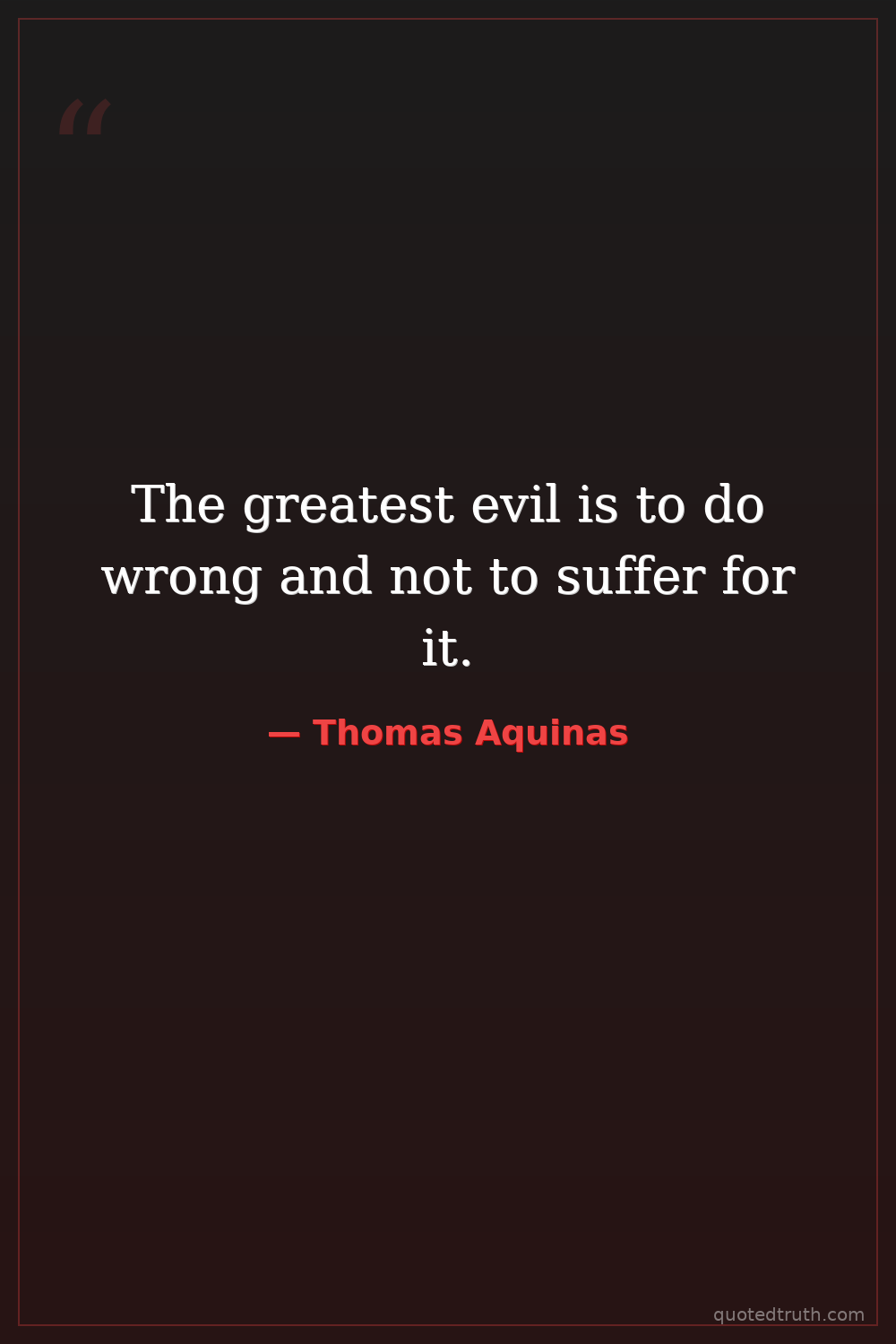
Thomas Aquinas — "The greatest evil is to do wrong and not to suffer for it."
The greatest evil is to do wrong and not to suffer for it.
The greatest evil is to do wrong and not to suffer for it.
Click any product to generate a realistic preview. Up to 3 at a time.
* Initial load can take up to 90 seconds — revising the preview in another color is nearly instant.
"Beware the man of a single book."
"It is lawful to take usury from Jews."
"Good can exist without evil, whereas evil cannot exist without good."
"The proper act of justice is to render to each one what is his own."
"No man can be justified without faith."
Often attributed, but exact source in Aquinas is difficult to pinpoint. Reflects his general ethical stance.
Date: c. 1265-1274
GeneralFound in 1 providers: grok
1 source checked
When someone does wrong and faces zero consequence — no punishment, guilt, or rebuke — their moral compass goes uncorrected. Suffering forces a reckoning with the harm caused; without it, the wrongdoer grows callous and the damage compounds. This isn't about revenge. It's about accountability as the mechanism that prevents moral rot from becoming permanent. An unrepentant wrongdoer cushioned from all consequence is in a far more dangerous moral position than someone who faces punishment.
Aquinas built his entire theological system around natural law, divine justice, and the idea that sin disorders the soul. His Summa Theologica treats punishment as medicinal — not merely retributive but corrective, restoring the moral balance sin disrupts. As a Dominican friar devoted to systematic moral reasoning, he saw unpunished wrongdoing as doubly catastrophic: it harms victims and leaves the sinner's soul permanently corrupted without the pressure that drives repentance and moral restoration.
Medieval Europe treated sin and crime as nearly inseparable — Church courts and feudal courts both dispensed punishment as God's earthly justice. Aquinas lived during the Crusades, the formalization of the Inquisition, and scholastic theology's peak influence. In this world, escaping temporal punishment wasn't a lucky escape; it meant facing far harsher divine judgment later. The cultural assumption that all wrongs would eventually be punished — in this life or the next — made unpunished wrongdoing a spiritually terrifying condition.
AI-generated insights based on extensive research and information for context. Factual errors? Email [email protected].
Your cart is empty