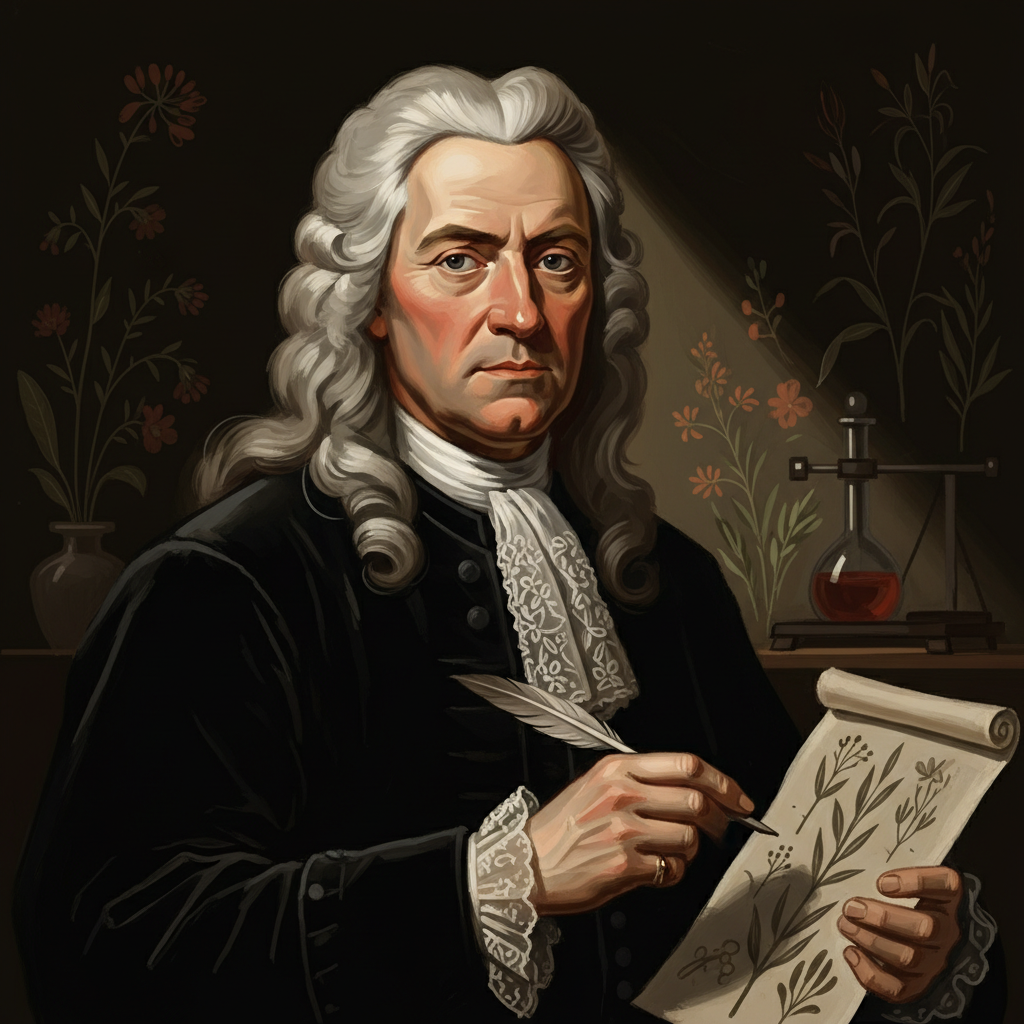
Carl Linnaeus — "The greatest pleasure in life is to be able to do what you love."
The greatest pleasure in life is to be able to do what you love.
The greatest pleasure in life is to be able to do what you love.
Click any product to generate a realistic preview. Up to 3 at a time.
* Initial load can take up to 90 seconds — revising the preview in another color is nearly instant.
"Human beings, having, above all creatures, received the power of reason... need to be aware where nature is unaware. Nature reaches its culmination in humans, but human consciousness has not its essen…"
"The stony rocks are not primeval, but daughters of Time."
"The whole world is a museum, and all its inhabitants are specimens."
"The species and the genus are always the work of nature [i.e. specially created]; the variety mostly that of circumstance; the class and the order are the work of nature and art."
"A plant is a living being, but it cannot feel."
Swedish botanist and the father of modern taxonomy whose Systema Naturae (1735) introduced binomial nomenclature for naming all species. Closely associated with Joseph Banks (British naturalist who carried Linnaean classification on Cook's voyages). For an intellectual contrast, see Comte de Buffon, French naturalist and Histoire Naturelle author (1749-1788) — Buffon explicitly attacked Linnaean fixed-categories taxonomy as artificial and rejected the binomial system; his gradualist, environment-shaped natural history was the explicit alternative. Anticipates the fixed-species-vs-evolution debate Darwin would later resolve.
A general reflection on happiness, particularly relevant to his own life.
Date: c. 1770s
ShockingFound in 1 providers: grok
1 source checked
The quote argues that life's deepest satisfaction comes from alignment between what you do and what genuinely excites you. It rejects the idea that pleasure belongs only to leisure — instead, it insists that purposeful, passion-driven work is itself the highest form of joy. The framing treats vocation as a potential source of meaning rather than mere economic necessity or social obligation.
Linnaeus embodied this conviction entirely. From childhood he collected plants obsessively, eventually building that passion into a full career at Uppsala University. His taxonomic project — naming over 7,700 plant species and 4,400 animals, and inventing binomial nomenclature — was driven by genuine delight in natural order. Contemporaries noted his infectious enthusiasm. He essentially created the professional role of systematic naturalist by living this belief.
During the 18th-century Enlightenment, the boundary between amateur naturalist and professional scientist was just forming. Most scholarly work remained the domain of wealthy gentlemen or clergy with independent means. Royal academies, university chairs, and patronage networks were beginning to make intellectual passion a viable livelihood. Linnaeus's funded position at Uppsala was itself evidence that this ideal was becoming achievable, though still exceptional, for men of his social standing.
AI-generated insights based on extensive research and information for context. Factual errors? Email [email protected].
Your cart is empty