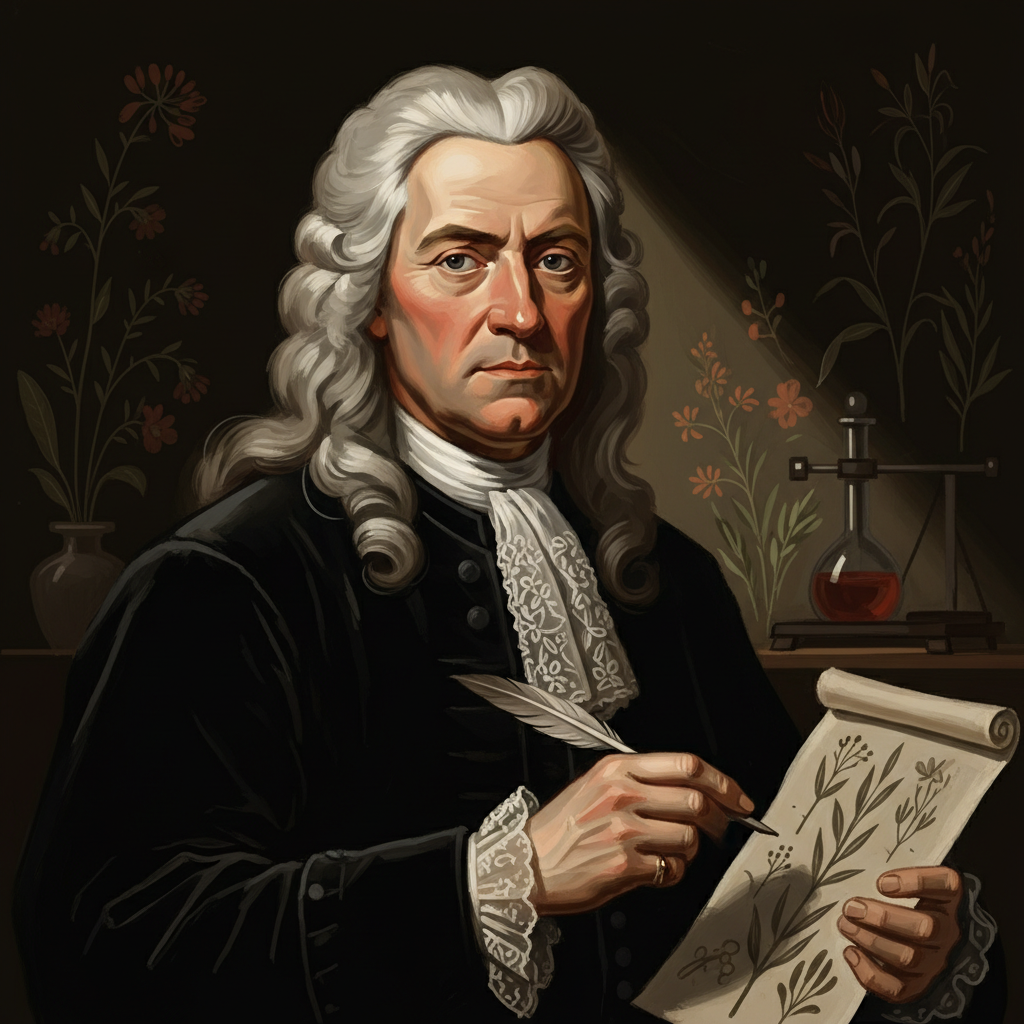
Carl Linnaeus — "The whole world is a museum, and all its inhabitants are specimens."
The whole world is a museum, and all its inhabitants are specimens.
The whole world is a museum, and all its inhabitants are specimens.
Click any product to generate a realistic preview. Up to 3 at a time.
* Initial load can take up to 90 seconds — revising the preview in another color is nearly instant.
"I am not ashamed to confess that I am a man who loves flowers."
"The American is obstinate, contented, free. He paints himself with red lines and is regulated by custom."
"The true botanist is not one who knows many plants, but one who knows how to find them."
"The method is the soul of science."
"I consider it the greatest achievement to be a good observer."
Swedish botanist and the father of modern taxonomy whose Systema Naturae (1735) introduced binomial nomenclature for naming all species. Closely associated with Joseph Banks (British naturalist who carried Linnaean classification on Cook's voyages). For an intellectual contrast, see Comte de Buffon, French naturalist and Histoire Naturelle author (1749-1788) — Buffon explicitly attacked Linnaean fixed-categories taxonomy as artificial and rejected the binomial system; his gradualist, environment-shaped natural history was the explicit alternative. Anticipates the fixed-species-vs-evolution debate Darwin would later resolve.
A metaphorical statement reflecting his view of nature as a vast collection for study.
Date: Uncertain (attributed)
WisdomFound in 1 providers: gemini
1 source checked
The quote frames nature as an infinite collection of observable, classifiable subjects. Every organism — from the smallest insect to the tallest tree — exists as a specimen worthy of study and categorization. Rather than viewing the world as merely a place we inhabit, it reframes our environment as a grand exhibition of biodiversity, where the scientist's task is to observe, name, and organize life's staggering variety.
Linnaeus spent his career doing exactly this — treating Earth as a collection. He created binomial nomenclature, naming over 7,700 plant and 4,400 animal species in works like Systema Naturae and Species Plantarum. He dispatched students — his apostles — across the globe to gather specimens. His home in Uppsala housed one of Europe's largest natural history collections, making him literally a museum curator of the living world.
Linnaeus worked during the Enlightenment, an era obsessed with imposing rational order on the natural world. European powers were colonizing new continents and shipping unknown plants and animals back to capitals hungry for novelty. Cabinets of curiosity filled aristocratic homes. Natural philosophers believed all of creation could be named, ranked, and catalogued. Linnaeus arrived precisely when the world needed a system — and he built one.
AI-generated insights based on extensive research and information for context. Factual errors? Email [email protected].
Your cart is empty