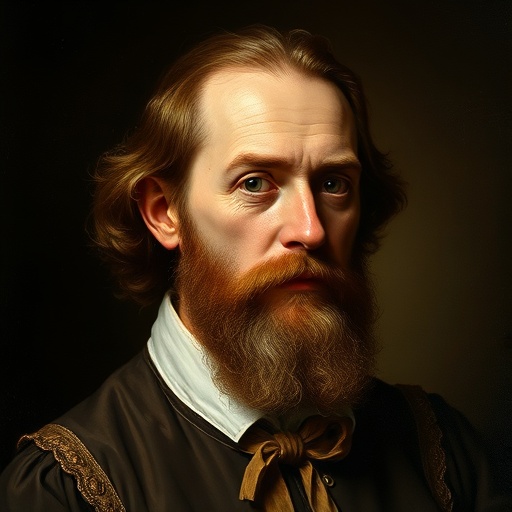
William Harvey — "The greatest pleasure is to discover something new."
The greatest pleasure is to discover something new.
The greatest pleasure is to discover something new.
Click any product to generate a realistic preview. Up to 3 at a time.
* Initial load can take up to 90 seconds — revising the preview in another color is nearly instant.
"The arteries are the channels through which the blood is driven from the heart."
"The valves in the veins are so constructed as to permit the passage of blood towards the heart, but to prevent its return."
"The more accurately we search into the wonderful works of God, the more a reason we shall find to admire them."
"All we know is that the blood is in motion, but what sets it in motion is God’s secret."
"The heart is the seat of the affections."
English physician whose On the Motion of the Heart and Blood in Animals (1628) demonstrated blood circulation, overturning 1,400 years of Galenic medicine. Closely associated with Francis Bacon (his contemporary in the new English empiricism). For an intellectual contrast, see Galenic medicine, the 2nd-century Greek medical tradition (humors, blood-as-consumed-fuel) — Harvey calculated that the heart pumps more blood per hour than the body could possibly produce as fuel — a single quantitative observation that demolished the entire Galenic-Aristotelian medical worldview. The cleanest example in medical history of arithmetic disproving 14 centuries of authority.
An expression of the joy and motivation behind scientific exploration.
Date: Uncertain (attributed)
EducationalFound in 1 providers: gemini
1 source checked
True satisfaction comes not from wealth, status, or comfort, but from uncovering something previously unknown — a fact, pattern, or truth the world has not yet seen. The moment of discovery itself, when understanding breaks through ignorance, is the purest form of human joy. This elevates curiosity and investigation as life's highest pursuits, placing intellectual breakthrough above all other rewards.
Harvey spent decades conducting painstaking dissections and experiments to prove blood circulates continuously — a claim that overturned Galen's 1,400-year-old doctrine. Colleagues ridiculed him; patients abandoned his practice. Yet he persisted. His 1628 publication of De Motu Cordis was the culmination of discovery-driven obsession. This quote captures exactly why he endured professional hostility: the act of finding truth was its own complete reward.
The early 1600s marked the Scientific Revolution's flowering, when figures like Galileo and Kepler began dismantling ancient authority through observation. Europe's universities still taught Galenic medicine as sacred dogma. Challenging established knowledge risked reputation and livelihood. Yet a growing culture of empirical investigation — enabled by anatomical dissection, the printing press, and cross-border scholarly correspondence — made systematic discovery newly possible, and Harvey stood at that thrilling frontier.
AI-generated insights based on extensive research and information for context. Factual errors? Email [email protected].
Your cart is empty