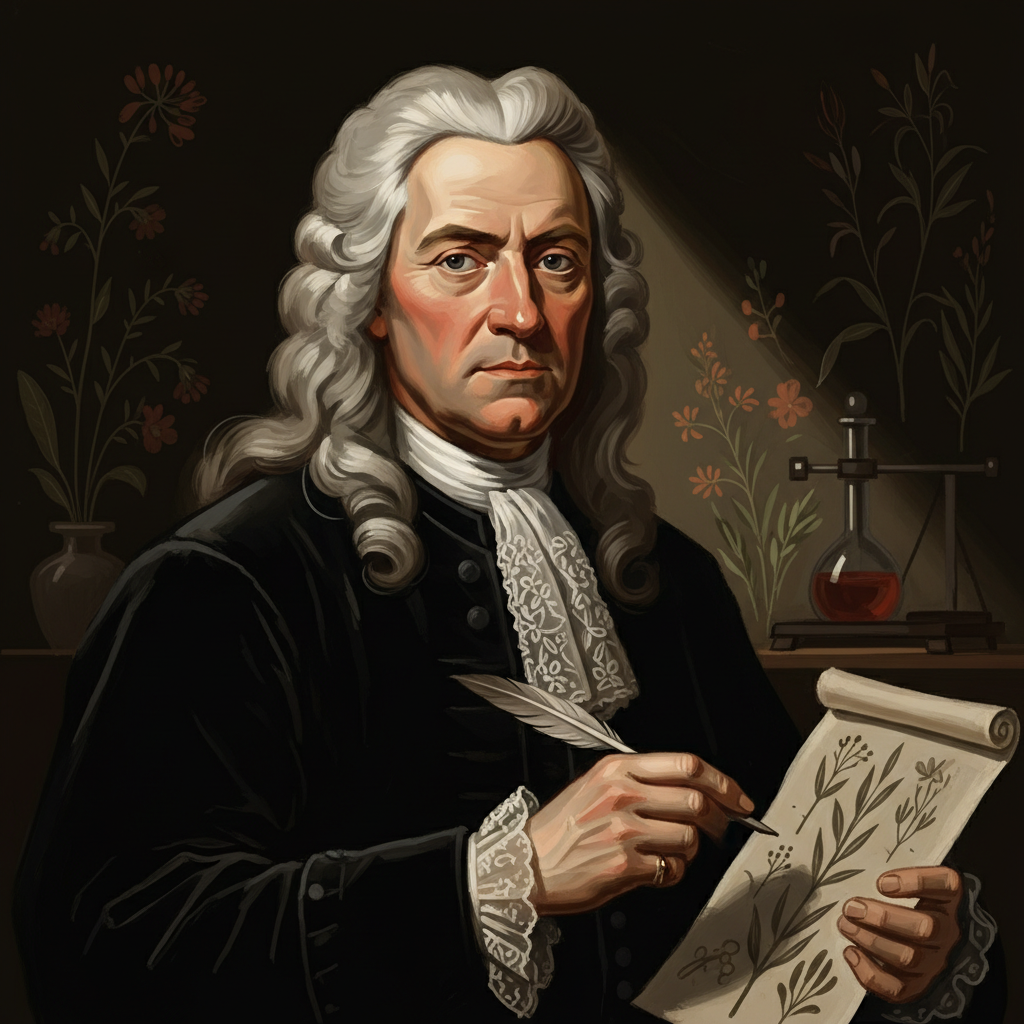
Carl Linnaeus — "The greatest pleasure of a naturalist is to make new discoveries."
The greatest pleasure of a naturalist is to make new discoveries.
The greatest pleasure of a naturalist is to make new discoveries.
Click any product to generate a realistic preview. Up to 3 at a time.
* Initial load can take up to 90 seconds — revising the preview in another color is nearly instant.
"Blessed be the Lord for the beauty of summer and spring, for the air, the water, the verdure, and the song of birds."
"The greatest delight is to behold the earth, and to know what it is."
"The study of nature will reveal the divine order of creation."
"The earth is the Lord's, and the fullness thereof; the world, and they that dwell therein."
"The earth is a paradise, but men make it a hell."
Swedish botanist and the father of modern taxonomy whose Systema Naturae (1735) introduced binomial nomenclature for naming all species. Closely associated with Joseph Banks (British naturalist who carried Linnaean classification on Cook's voyages). For an intellectual contrast, see Comte de Buffon, French naturalist and Histoire Naturelle author (1749-1788) — Buffon explicitly attacked Linnaean fixed-categories taxonomy as artificial and rejected the binomial system; his gradualist, environment-shaped natural history was the explicit alternative. Anticipates the fixed-species-vs-evolution debate Darwin would later resolve.
Found in 1 providers: grok
1 source checked
The deepest satisfaction a naturalist experiences comes from encountering and identifying something previously unknown to science. Discovery — finding a new species, describing an unseen organism, naming what no one has named before — is not merely professional achievement but the defining joy of the work itself. Curiosity fulfilled through observation and classification is the reward that drives the entire scientific enterprise forward.
Linnaeus named over 12,000 species and created the binomial nomenclature system still used today. His Systema Naturae catalogued the natural world with unprecedented rigor. He trained apostles — students sent worldwide to collect specimens — precisely because discovery was his obsession. Each new organism entering his system validated his life's mission of imposing rational order on nature's infinite variety.
The 18th century was the Age of Exploration's scientific peak. European voyages to the Americas, Pacific, and Asia returned with thousands of unknown specimens. Linnaeus worked during a period when natural philosophy was becoming empirical science, and cataloguing creation was seen as understanding God's design. New discoveries weren't just academic — they reshaped European understanding of the world's scope and diversity.
AI-generated insights based on extensive research and information for context. Factual errors? Email [email protected].
Your cart is empty