Joseph Smith — "The greatest responsibility in this world that God has laid upon us is to seek a…"
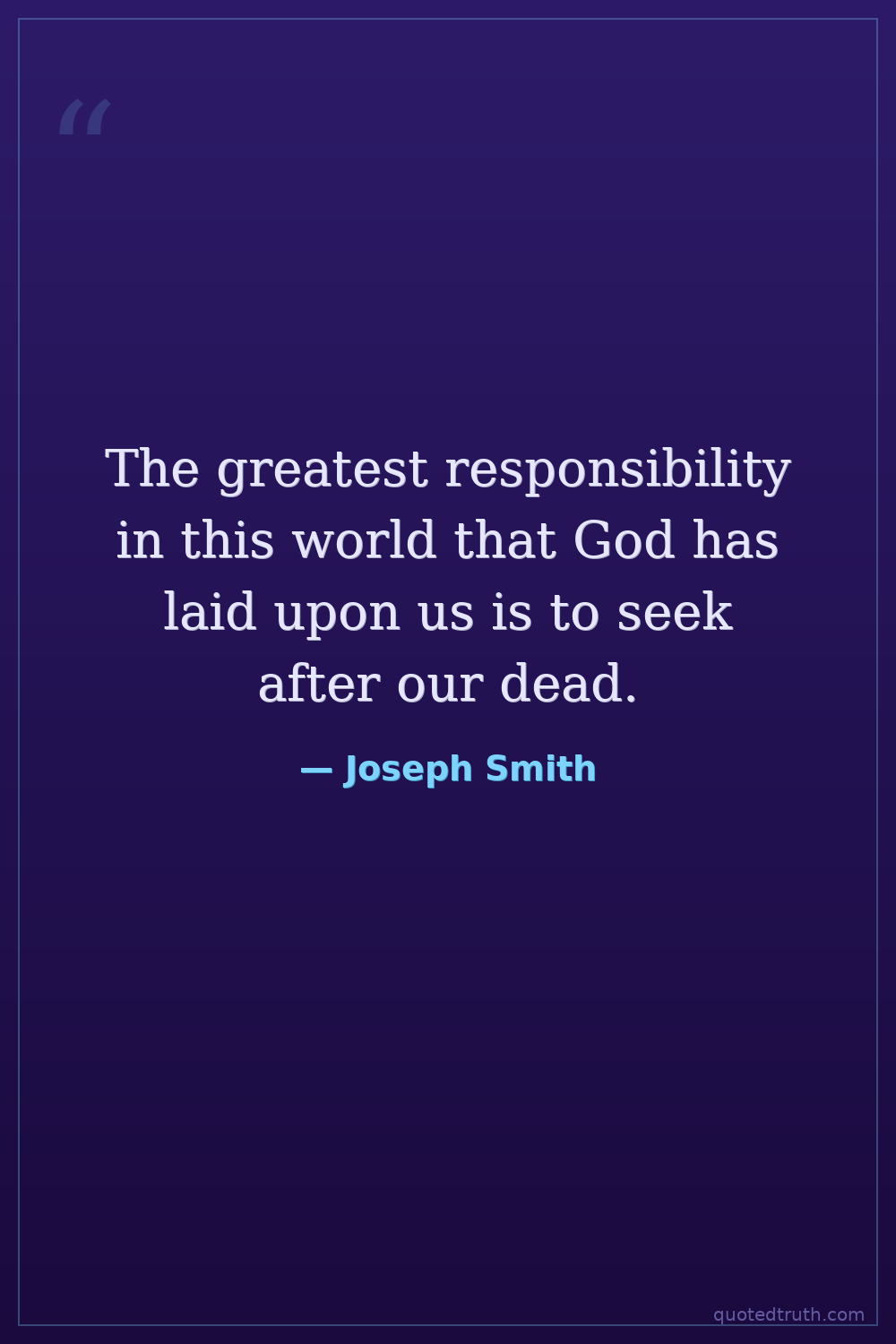
The greatest responsibility in this world that God has laid upon us is to seek after our dead.
The greatest responsibility in this world that God has laid upon us is to seek after our dead.
Click any product to generate a realistic preview. Up to 3 at a time.
* Initial load can take up to 90 seconds — revising the preview in another color is nearly instant.
"I defy all the world to produce a greater work than the Book of Mormon."
"Come on! ye prosecutors! ye false swearers! All hell, boil over! Ye burning mountains, roll down your lava! for I will come out on the top at last. I have more to boast of than ever any man had. I am …"
"This church, being 'the only true and living church upon the face of the whole earth, with which I, the Lord, am well pleased.'"
"I calculate to be one of the instruments of setting up the kingdom of Daniel."
"I have been in the midst of more wickedness and persecution than any man living."
History of the Church, Vol. 6, p. 313 (King Follett Discourse, April 7, 1844)
Date: 1844
BiblicalFound in 1 providers: grok
1 source checked
Caring for deceased ancestors through religious ritual is humanity's highest divine obligation. The living must perform saving ordinances—specifically proxy baptism and temple ceremonies—on behalf of those who died without access to them. Ancestral work is not optional piety but a God-commanded duty, making genealogical research and posthumous religious ceremonies a central moral imperative for believers, not peripheral devotion.
Smith revealed the doctrine of baptism for the dead in 1840, personally institutionalizing this practice. His brother Alvin died before the church's founding, creating urgent personal stakes around posthumous salvation. As prophet-founder, Smith built proxy ordinances into core LDS theology and initiated Nauvoo Temple construction to formalize this work. This quote encapsulates a doctrine uniquely his—distinguishing Mormonism from all other Christian traditions and driving the church's extraordinary genealogical infrastructure.
Smith taught this in early 1840s Nauvoo, Illinois, amid intense doctrinal expansion and violent persecution. Frontier America saw high mortality from disease and hardship, leaving families constantly confronting untimely death. Protestant theology fiercely debated the fate of the unevangelized dead. Smith's answer was radical: living proxies could retroactively save them. Construction of the Nauvoo Temple began 1841, formalizing posthumous baptism as a central, institutionalized Mormon religious obligation.
AI-generated insights based on extensive research and information for context. Factual errors? Email [email protected].
Your cart is empty