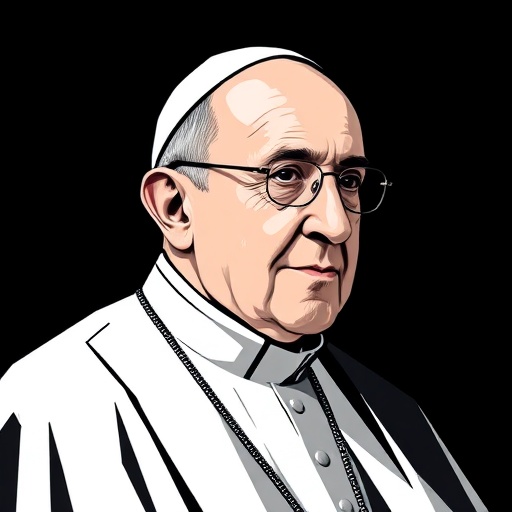
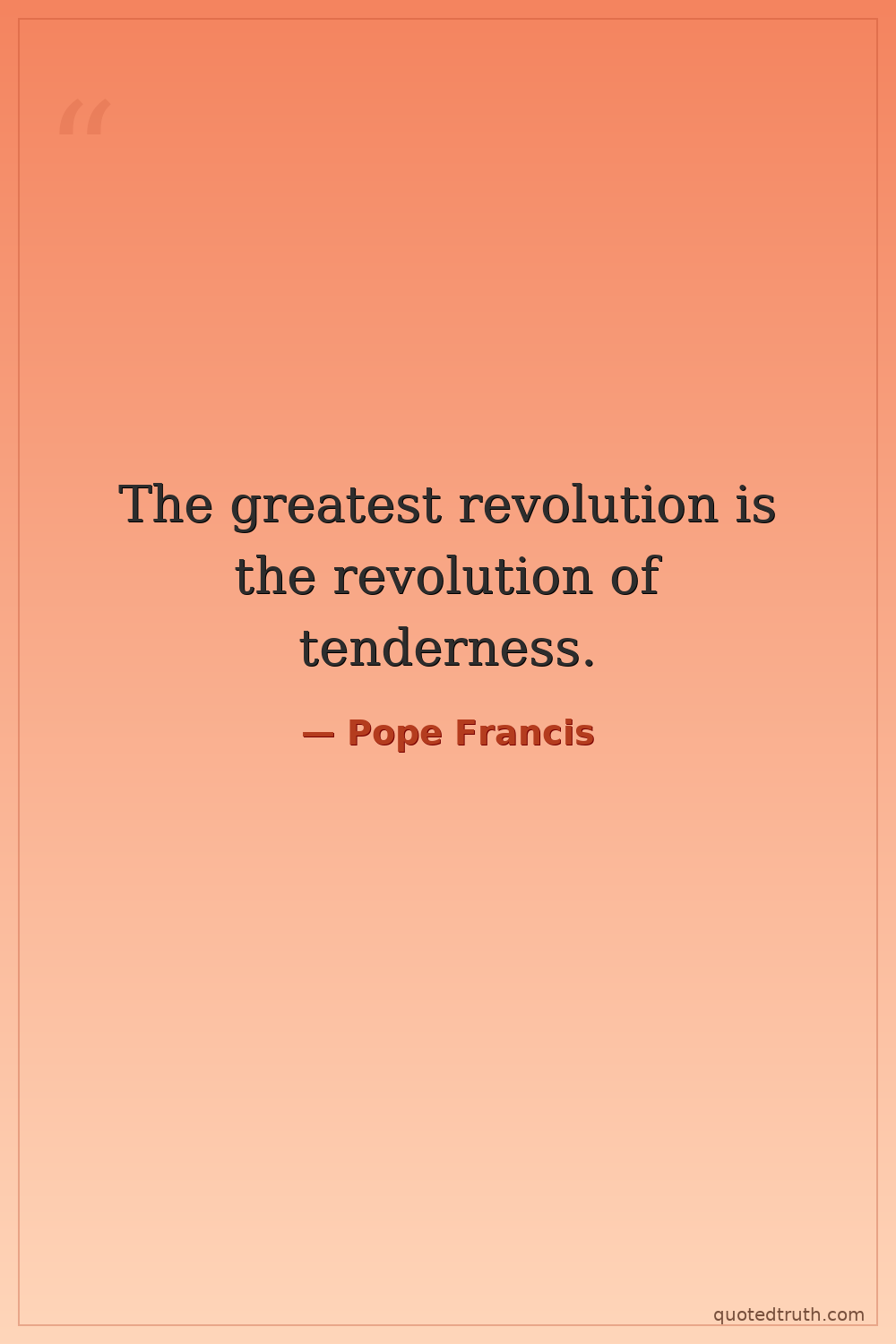
Pope Francis — "The greatest revolution is the revolution of tenderness."
The greatest revolution is the revolution of tenderness.
The greatest revolution is the revolution of tenderness.
Click any product to generate a realistic preview. Up to 3 at a time.
* Initial load can take up to 90 seconds — revising the preview in another color is nearly instant.
"The poor are the treasure of the Church."
"The worship of the golden calf has returned."
"It is not a good thing when priests become rigid. Rigidity is a sign of something bad. It is a sign of a lack of freedom, and that is a sign of spiritual worldliness."
"The measure of a society is its treatment of the poor and vulnerable."
"God is not a magician with a magic wand."
First Latin American and Jesuit pope (2013-), who has steered the Catholic Church toward pastoral inclusion on LGBTQ pastoral care, divorced Catholics, and climate. Closely associated with Pope John XXIII (the Vatican II reformer pope) and Cardinal Walter Kasper (his theological ally on pastoral reform). For an intellectual contrast, see Cardinal Raymond Burke, American traditionalist cardinal, former head of the Vatican Apostolic Signatura — Burke is the public face of Catholic traditionalism that views Francis's pastoral approach as doctrinally dangerous — he has formally challenged Amoris Laetitia and other Francis reforms.
Found in 1 providers: grok
1 source checked
Genuine, lasting change doesn't come from violence, ideology, or political force, but from radical compassion and human warmth. Tenderness means treating every person—especially the marginalized—with dignity, care, and mercy. This transformation is revolutionary because it confronts hardness, indifference, and systemic cruelty not with power, but with love that disarms and reshapes from within, making it more subversive than any armed uprising.
Jorge Mario Bergoglio grew up in Buenos Aires shaped by Jesuit spirituality and the theology of the poor. As the first Latin American pope, he consistently prioritized mercy over judgment—washing prisoners' feet, embracing the sick, championing migrants. His encyclicals Laudato Si and Evangelii Gaudium place compassion at the Church's center. For Francis, tenderness is not sentimentality; it is his entire pastoral theology incarnated in daily action.
Francis became pope in 2013 amid rising nationalism, mass refugee displacement, deepening inequality, and institutional distrust following the 2008 financial crisis. Social media amplified outrage culture while political discourse hardened globally. The Catholic Church itself faced credibility collapse from abuse scandals. Into this climate, Francis offered a direct counter-narrative: that gentleness and care—not power or ideology—are the forces capable of genuine societal and spiritual renewal.
AI-generated insights based on extensive research and information for context. Factual errors? Email [email protected].
Your cart is empty