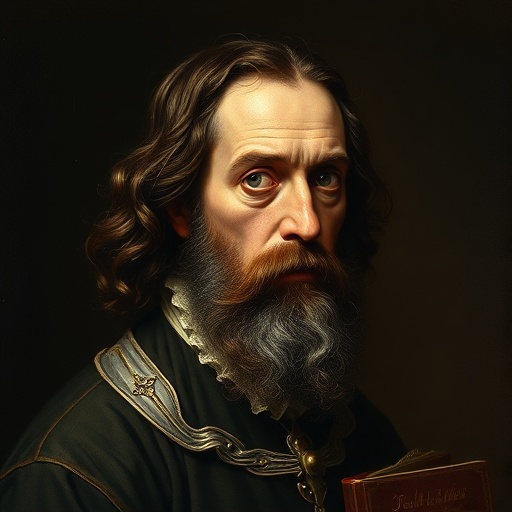
Johannes Kepler — "The heavenly motions are nothing but a continuous song for several voices, perce…"
The heavenly motions are nothing but a continuous song for several voices, perceived not by the ear but by the intellect.
The heavenly motions are nothing but a continuous song for several voices, perceived not by the ear but by the intellect.
Click any product to generate a realistic preview. Up to 3 at a time.
* Initial load can take up to 90 seconds — revising the preview in another color is nearly instant.
"I have often been poor, but I have always been rich in spirit."
"I have been a philosopher, and I have pondered the meaning of life."
"I have been a wanderer, but I have always found my way back to God."
"The universe is an image of God."
"I was measuring the heavens, now I must measure the shadows of the Earth. Though my soul was from the heavens, the shadow of my body lies here."
Found in 1 providers: deepseek
1 source checked
Planets moving through space create something like a symphony. You cannot hear this music with your ears, but if you study the math and patterns of their orbits, you recognize a harmony in how they move together. The universe operates with the same ordered beauty as a well-composed piece of polyphonic music, and understanding that order is a kind of listening done through reasoning rather than sound.
Kepler literally wrote Harmonices Mundi (1619), devoting an entire treatise to the 'music of the spheres' and assigning musical intervals to each planet's orbital speeds. A devout Lutheran who saw astronomy as uncovering God's geometric design, he discovered his three laws of planetary motion while hunting for this cosmic harmony. For Kepler, math, music, and theology were one pursuit: decoding the Creator's score written in the heavens.
Early modern Europe was transitioning from Ptolemaic earth-centered cosmology to Copernican heliocentrism amid the Thirty Years' War and Counter-Reformation turmoil. Pythagorean and Neoplatonic ideas about numerical harmony still shaped natural philosophy, and scholars expected the cosmos to reveal divine order through mathematics. Kepler wrote while Galileo faced Church scrutiny, making his fusion of rigorous observation with mystical harmony characteristic of a moment when science and sacred meaning had not yet fully separated.
AI-generated insights based on extensive research and information for context. Factual errors? Email [email protected].
Your cart is empty