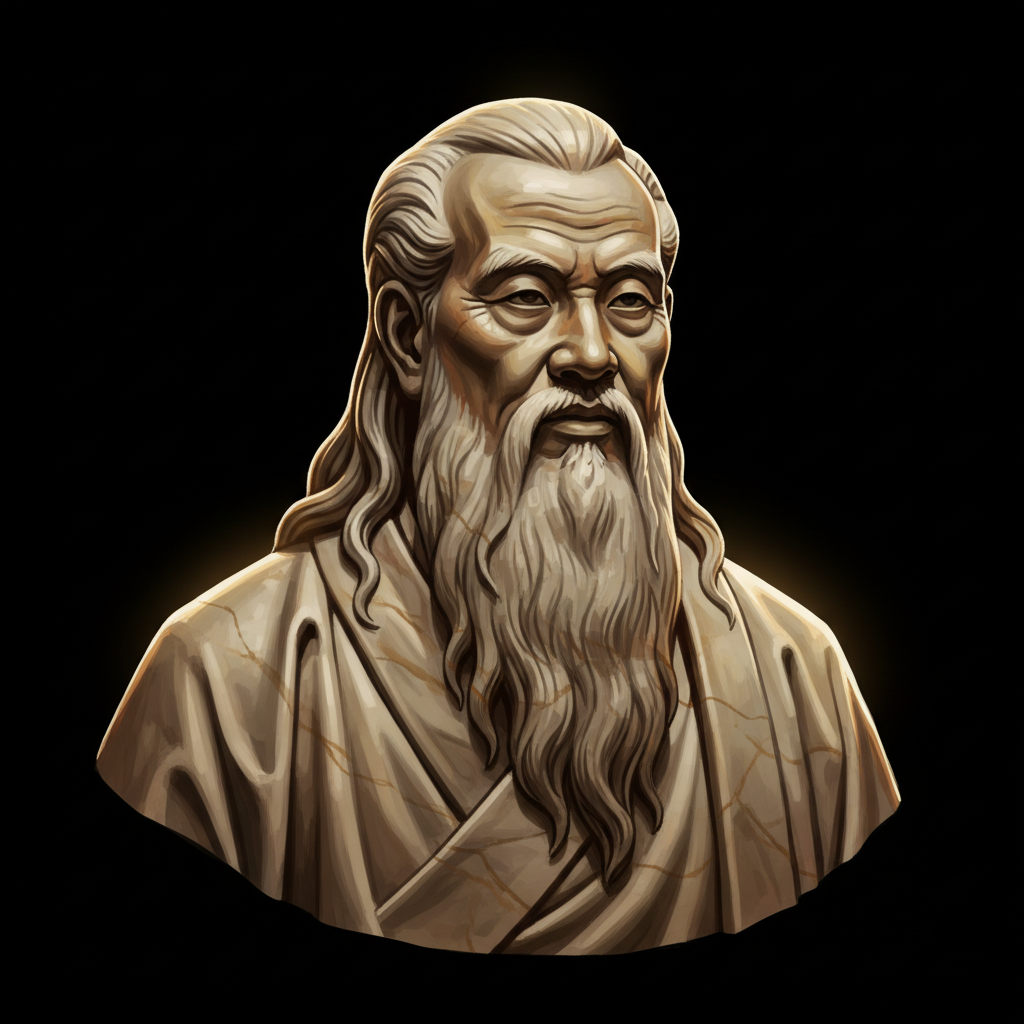
Laozi — "The highest virtue does nothing. Yet, nothing needs to be done. The lowest virtu…"
The highest virtue does nothing. Yet, nothing needs to be done. The lowest virtue does everything. Yet, much remains to be done.
The highest virtue does nothing. Yet, nothing needs to be done. The lowest virtue does everything. Yet, much remains to be done.
Click any product to generate a realistic preview. Up to 3 at a time.
* Initial load can take up to 90 seconds — revising the preview in another color is nearly instant.
"When the world has the Tao, the swift horses are used for hauling manure. When the world is without the Tao, war horses are bred in the suburbs."
"The sage puts his own person last, and yet it is found in the foremost place; he treats his person as foreign to him, and yet it is preserved."
"Therefore even the sage treats some things as difficult. That is why in the end no difficulties can get the better of him."
"Truthful words are not always beautiful; beautiful words are not always truthful."
"The Tao is always at ease. It is still, yet it moves the world."
Reputed founder of Taoism and author of the Tao Te Ching, whose wu wei (effortless action) shaped East Asian philosophy. Closely associated with Zhuangzi (later Taoist who extended Laozi's framework). For an intellectual contrast, see Confucius, near-contemporary Chinese sage of social ritual and duty — Confucius systematized social order through ritual and hierarchy; Laozi argued that all such systems were the disease, not the cure — the two founding poles of Chinese moral philosophy.
Found in 1 providers: gemini
1 source checked
True goodness flows naturally without force or effort, and somehow everything falls into place on its own. Lesser virtue tries hard, interferes constantly, and micromanages every situation, yet problems keep piling up. The paradox is that effortless action accomplishes more than frantic striving. When you stop forcing outcomes and let things unfold according to their own nature, the work gets done. Trying too hard often creates the very problems you're trying to solve.
Laozi built Taoism around wu wei, or effortless action, and this saying is its clearest statement. As a legendary archivist in the Zhou court, he reportedly grew disillusioned with rigid Confucian ritual and bureaucratic striving before riding west into retirement. His core teaching rejected forced moral performance in favor of aligning with the Tao's natural flow. This quote captures his lifelong conviction that the sage accomplishes by not meddling.
Laozi lived during the late Zhou dynasty, roughly the 6th century BCE, as China slid toward the Warring States chaos. Rulers competed through elaborate rituals, legalist codes, and Confucian hierarchies, each system promising order through more rules and active governance. Against this backdrop of constant interference and moral engineering, Laozi's call for non-action was radical. The Dao De Jing emerged as a quiet rebuke to rulers who believed endless effort and regulation could cure a fracturing society.
AI-generated insights based on extensive research and information for context. Factual errors? Email [email protected].
Your cart is empty