Nikola Tesla — "The human being is a self-propelled automaton entirely under the control of exte…"

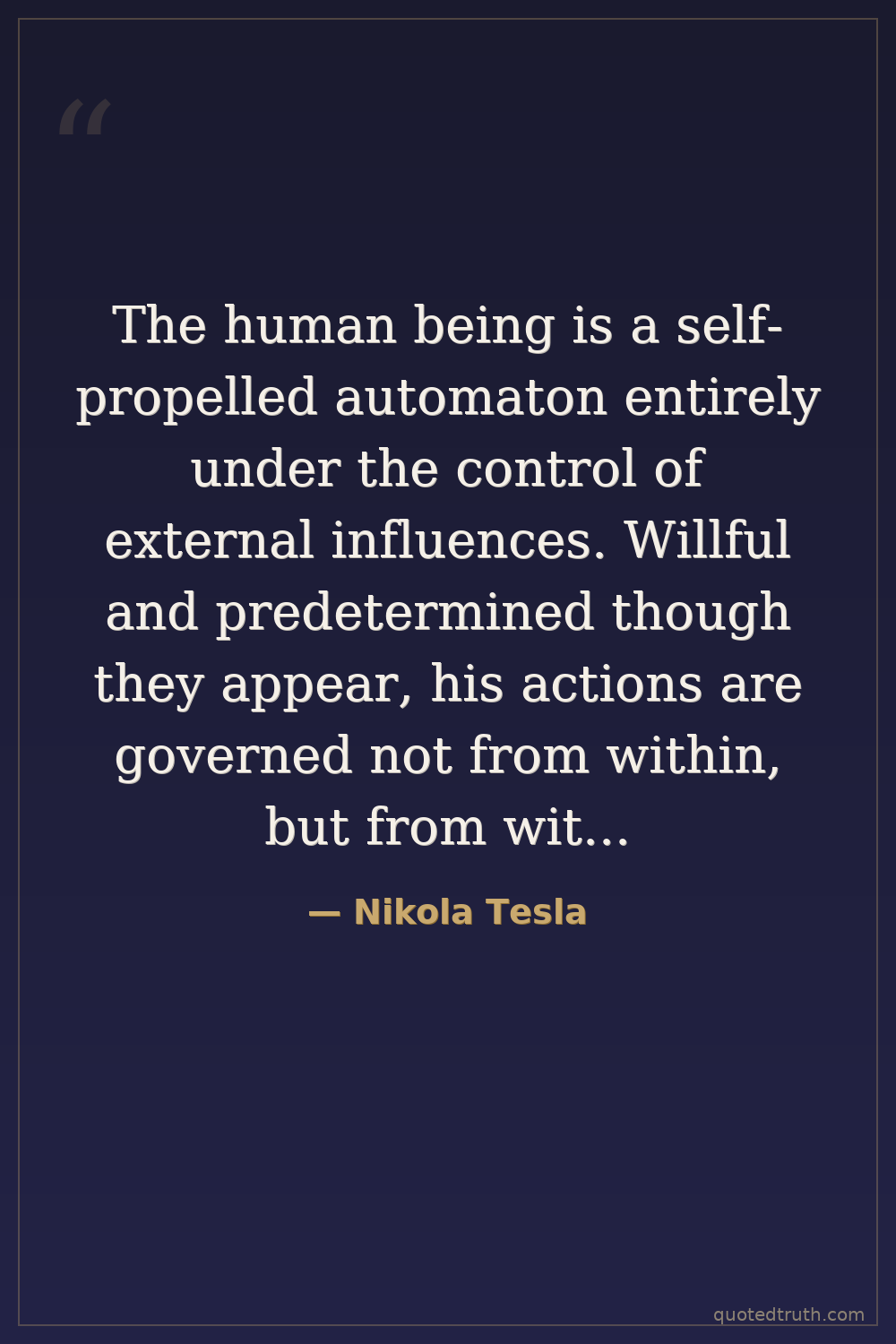
The human being is a self-propelled automaton entirely under the control of external influences. Willful and predetermined though they appear, his actions are governed not from within, but from without. He is like a float tossed about by the waves of a turbulent sea.
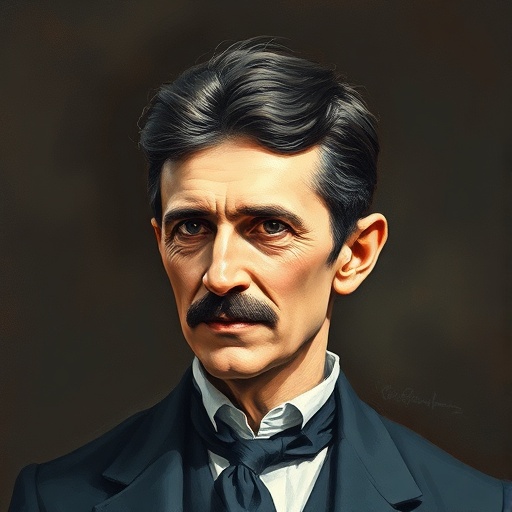
Nikola Tesla — Nikola Tesla Modern · AC electrical system, inventor

Get This Quote & Author's Image Illustrated On:

Click any product to generate a realistic preview. Up to 3 at a time.
* Initial load can take up to 90 seconds — revising the preview in another color is nearly instant.

Kitchen

Apparel

Other

About Nikola Tesla (1856-1943)

Serbian-American inventor and electrical engineer whose alternating-current designs powered the modern electrical grid; died poor and largely forgotten. Closely associated with George Westinghouse (his AC-power business partner) and Mihajlo Pupin (fellow Serbian-American physicist at Columbia). For an intellectual contrast, see Thomas Edison, American inventor and direct-current advocate — Edison's direct-current power-distribution scheme was displaced by Tesla-Westinghouse AC in the 1890s 'War of Currents'. Edison ran a public-relations campaign electrocuting animals to discredit AC — the most famous engineering-ethics rivalry in American history. Tesla's AC won and powers nearly every electrical grid on Earth.

Details

Deep, mind-bending, and controversial philosophical view on free will and human determinism.

Date: Approximate

Philosophical

Verification

Unverifiable

Found in 1 providers: gemini

1 source checked

Understanding this quote

What it means

Humans feel like independent agents making free choices, but Tesla argues the opposite: we are machines entirely driven by outside forces — environment, sensory input, circumstance. What looks like willpower or intention is actually a reaction to external stimuli. We have no true inner author of our actions. Like a piece of debris on a stormy ocean, we go where the forces push us, not where we decide to go.

Relevance to Nikola Tesla

Tesla built literal automatons and electrical machines that responded precisely to external inputs — he understood mechanistic systems deeply. He viewed the human nervous system through the same engineering lens. Tesla himself felt buffeted by forces beyond his control: Edison's campaign against AC power, J.P. Morgan withdrawing funding for Wardenclyffe, his mental breakdowns. His life reinforced the belief that even brilliant men are subject to external currents they cannot master, regardless of internal vision.

The era

Tesla wrote during the height of scientific determinism — Darwin had shown life shaped by environment, Pavlov demonstrated conditioned reflexes, and industrial capitalism reduced workers to interchangeable machine components. The Enlightenment ideal of the rational, self-directed individual was cracking. Philosophers like Schopenhauer questioned free will. Electricity itself — Tesla's domain — demonstrated that invisible external forces governed physical reality. This mechanistic worldview was not fringe thinking; it was cutting-edge science redefining human nature.

AI-generated insights based on extensive research and information for context. Factual errors? Email [email protected].
Your Cart

Your cart is empty