What it means
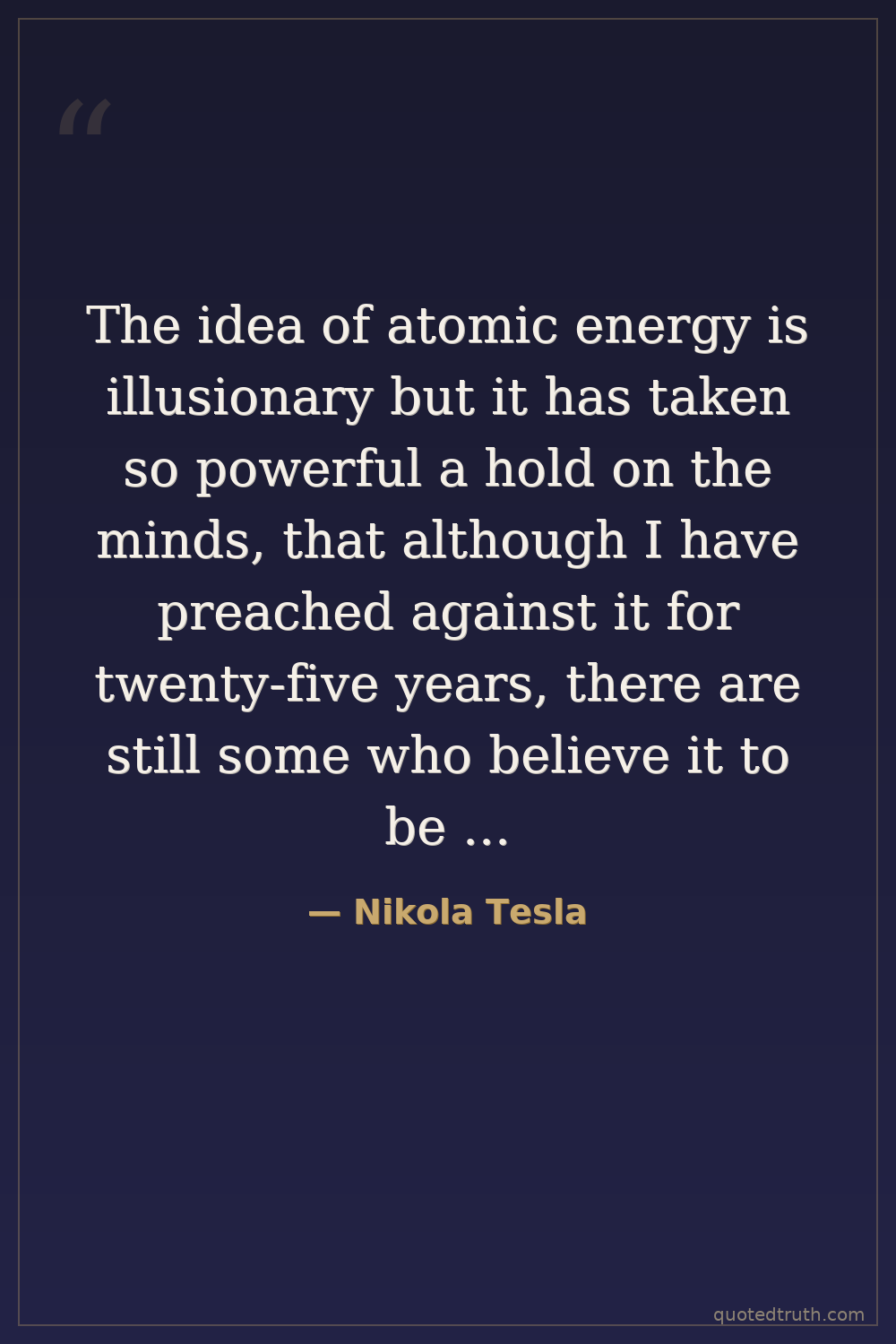
Tesla argues atomic energy is a seductive illusion — impossible in practice — yet so captivating that public belief persists despite his decades of opposition. He's expressing frustration that wishful thinking overpowers rigorous skepticism, casting himself as a rational holdout against a popular but fundamentally flawed idea. The quote reveals his certainty in his own judgment and his concern that bad science can grip the collective mind indefinitely.
Relevance to Nikola Tesla
Tesla's entire career centered on electromagnetic energy — AC current, wireless power transmission, resonant circuits. His worldview held that energy must be harnessed from fields and waves, not from splitting atoms. He publicly feuded with Einstein, rejecting relativity and quantum mechanics. This skepticism of nuclear energy fits his pattern of dismissing particle-physics frameworks entirely. Ironically, the man who revolutionized electrical power was spectacularly wrong about the next great energy source.
The era
Tesla spoke these words likely in the 1930s, a pivotal decade in nuclear physics. Rutherford split the atom in 1917; Chadwick discovered the neutron in 1932; Hahn achieved uranium fission in 1938. Einstein's 1905 mass-energy equation underpinned theoretical nuclear potential. The entire scientific establishment was converging on atomic energy's feasibility exactly as Tesla dismissed it — the Manhattan Project launched in 1942, just before his 1943 death, proving him categorically wrong.
AI-generated insights based on extensive research and information for context. Factual errors? Email [email protected].