What it means
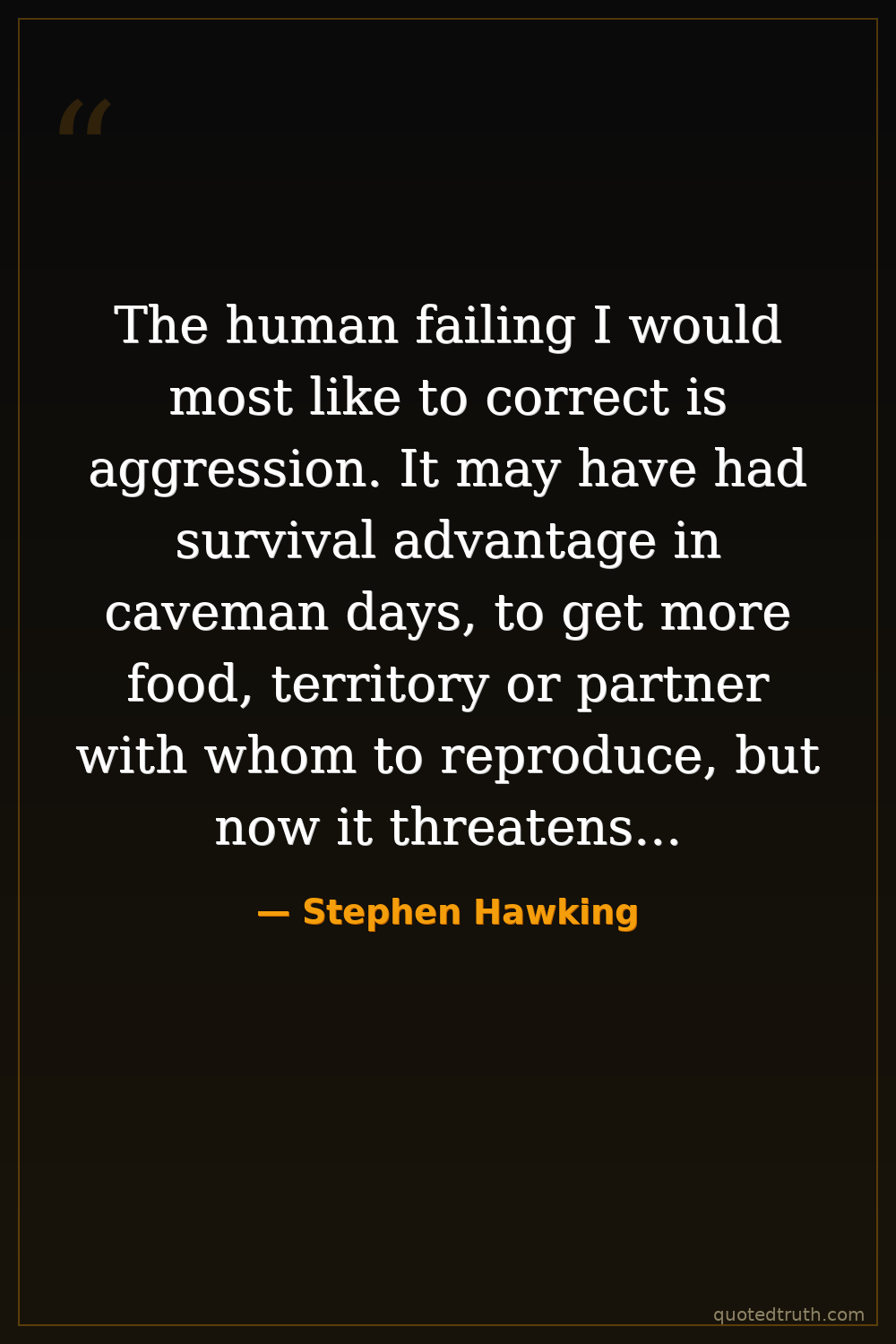
Aggression once helped early humans compete for food, land, and mates, giving them a survival edge. But in a modern world with nuclear weapons, climate crises, and global interdependence, that same instinct now endangers everyone. What evolution built as a tool for individual survival has become a collective liability capable of ending civilization itself.
Relevance to Stephen Hawking
Hawking spent his career contemplating existential threats — from black holes to artificial intelligence to nuclear war. Paralyzed by ALS yet driven by pure intellect, he embodied the opposite of physical aggression, relying entirely on reason. He repeatedly warned that humanity's greatest dangers were self-inflicted, and frequently cited nuclear conflict and environmental destruction as top extinction risks.
The era
Hawking spoke during a period of renewed nuclear anxiety, rising nationalist conflicts, and emerging climate warnings. The Cold War's end hadn't eliminated weapons arsenals, terrorism reshaped geopolitics after 9/11, and by the 2010s cyberwarfare added new dimensions to aggression. Meanwhile, global cooperation on existential problems — climate, pandemics — kept stalling against competitive national interests.
AI-generated insights based on extensive research and information for context. Factual errors? Email [email protected].