What it means
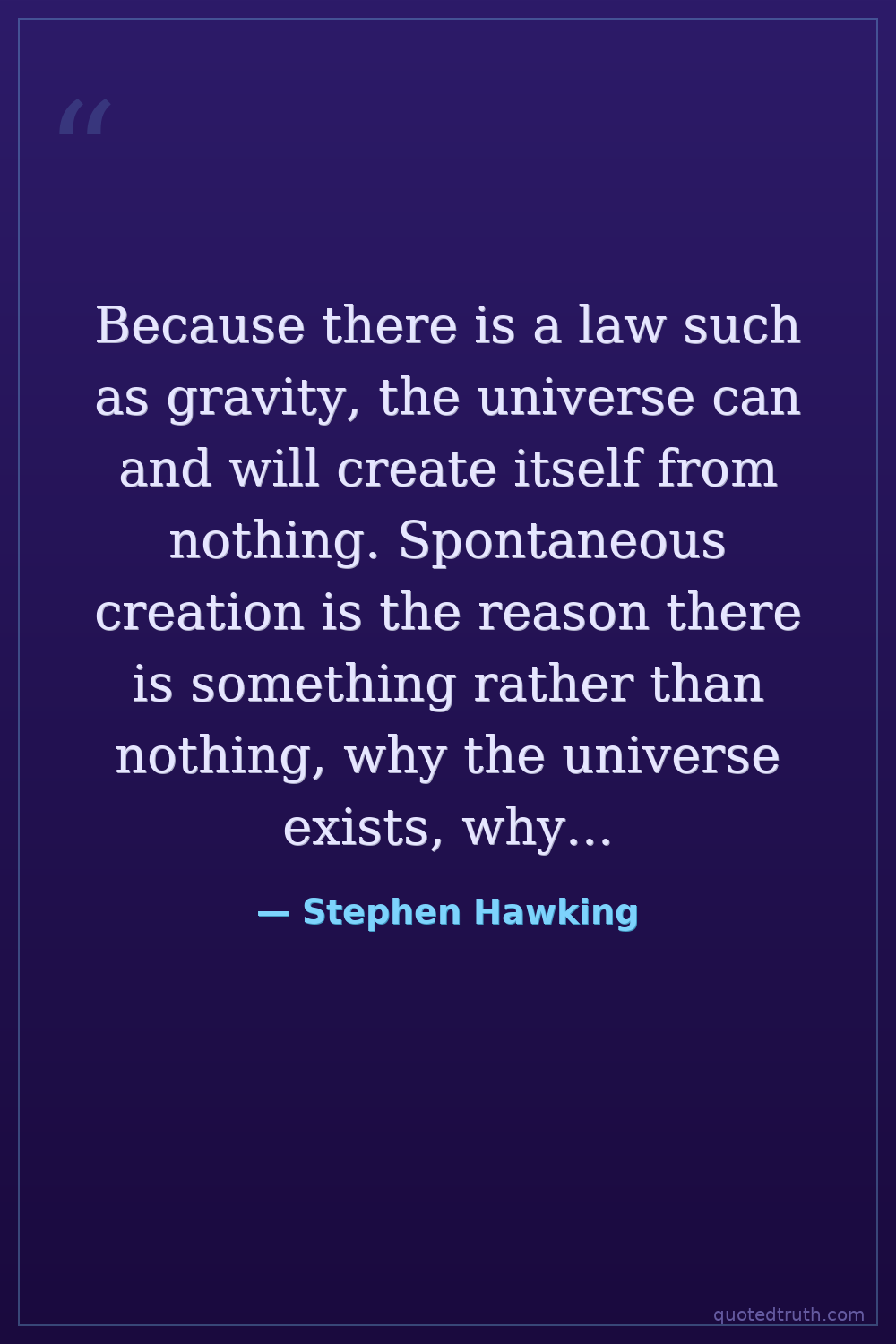
The quote asserts that physical laws — specifically gravity — are sufficient to explain why the universe exists at all. No creator or external cause is needed. Gravity's mathematics allows a zero-energy vacuum to spontaneously generate matter and space-time. This directly answers philosophy's oldest question — why is there something rather than nothing — with a physics-based answer: the universe's existence is a natural consequence of its own laws, not divine intervention.
Relevance to Stephen Hawking
Hawking spent his career probing the universe's origins, from Big Bang singularity theorems to the Hartle-Hawking no-boundary proposal. Diagnosed with ALS at 21, he outlived his prognosis by 55 years while advancing theoretical physics from a wheelchair. This quote, from his 2010 book The Grand Design, crystallizes his lifelong conviction that physics, not theology, explains existence. His willingness to state that publicly defined his role as science's most recognizable and provocative communicator.
The era
Published in 2010 at the height of New Atheism — Dawkins, Hitchens, and Dennett had reframed public science-versus-religion debate. M-theory and string cosmology offered new frameworks for universe origins without initial singularities. Hawking's statement drew immediate backlash from the Archbishop of Canterbury and Vatican-aligned commentators. It also arrived as physicists debated the anthropic principle and multiverse theory, making the question of why this universe exists scientifically urgent rather than merely philosophical.
AI-generated insights based on extensive research and information for context. Factual errors? Email [email protected].