What it means
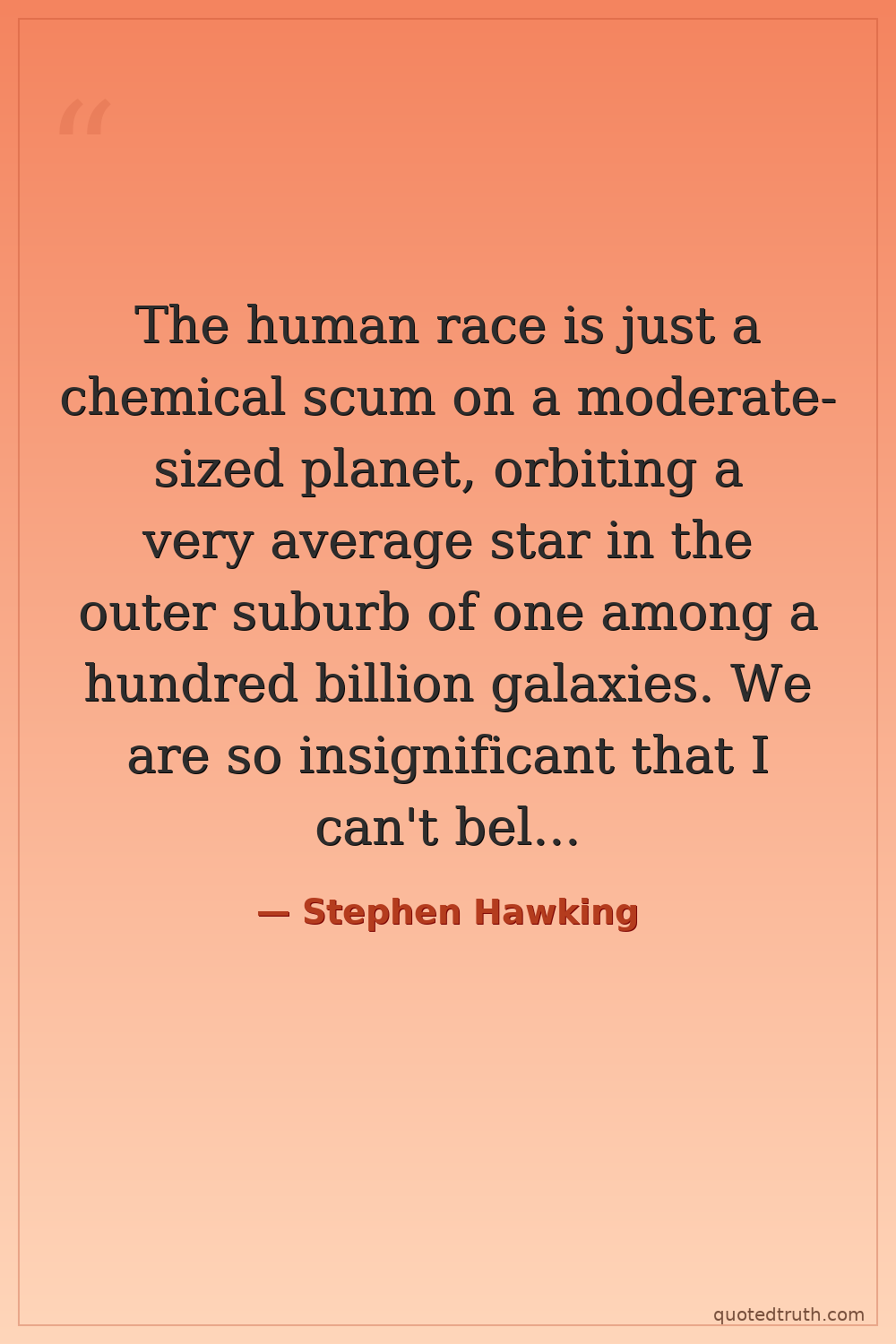
Humanity occupies no special or central place in the cosmos. We are tiny, chemically complex organisms on an unremarkable planet around an ordinary star, one of countless billions in an unimaginably vast universe. The idea that all of existence was created specifically for human benefit is statistically and scientifically absurd — the sheer scale of wasted space alone makes such cosmic self-importance laughable.
Relevance to Stephen Hawking
Hawking spent decades mapping the universe's most extreme phenomena — black holes, the Big Bang, spacetime singularities. His work constantly confronted the incomprehensible scale of existence. Despite being physically imprisoned by ALS, he intellectually roamed the cosmos, and that perspective bred genuine humility about humanity's place in it. This quote embodies his lifelong insistence that physics, not human ego, defines reality.
The era
Hawking delivered this view during the late 20th century, when Hubble Space Telescope imagery was first revealing the true staggering depth of the observable universe. The 1990s brought the discovery of exoplanets and deepened understanding of galactic structure, making Earth's ordinariness undeniable. Simultaneously, religious and anthropocentric worldviews remained culturally dominant, making Hawking's blunt cosmic deflation culturally provocative and scientifically grounding.
AI-generated insights based on extensive research and information for context. Factual errors? Email [email protected].