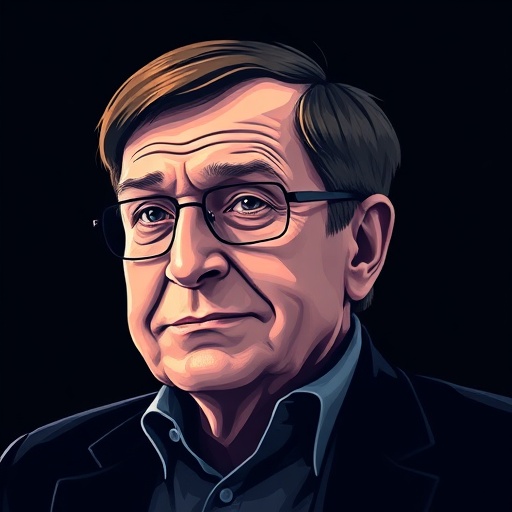
Stephen Hawking — "The universe is a big place, and we are a small part of it. But we are an import…"
The universe is a big place, and we are a small part of it. But we are an important part of it.
The universe is a big place, and we are a small part of it. But we are an important part of it.
Click any product to generate a realistic preview. Up to 3 at a time.
* Initial load can take up to 90 seconds — revising the preview in another color is nearly instant.
"The universe is a place of infinite beauty and mystery."
"The future of humanity depends on our ability to be able to make space travel possible."
"I felt ill the other day, but all they had to do was to turn me off, and then back on again."
"I'm a physicist, and I believe in science. I don't believe in miracles."
"The greatest enemy of knowledge is not ignorance, it is the illusion of knowledge."
British theoretical physicist whose Hawking radiation work and A Brief History of Time (1988) brought black-hole physics to a mass audience while he lived with ALS for 55 years. Closely associated with Roger Penrose (his collaborator on singularity theorems) and Carl Sagan (fellow popularizer who wrote Brief History's foreword). For an intellectual contrast, see William Lane Craig, American philosopher of religion — Craig's Kalam cosmological argument depends on the Big Bang requiring a divine first cause; Hawking's no-boundary proposal was specifically designed to remove the moment that would require one — the cleanest cosmology-vs-natural-theology contrast in modern thought.
Found in 1 providers: grok
1 source checked
Humans occupy an infinitesimally tiny corner of a cosmos spanning 93 billion light-years, yet our existence carries genuine significance. Size and importance are separate measures — a species capable of understanding, questioning, and marveling at the universe contributes something no mere mass of rock or gas can: conscious comprehension of reality itself.
Hawking spent his career mapping the universe's largest structures — black holes, the Big Bang, cosmic inflation — while trapped in a progressively failing body. This tension between physical smallness and intellectual reach defined him personally. Despite ALS confining him to a wheelchair, he insisted human curiosity and science gave us outsized meaning in an indifferent cosmos.
Hawking worked through the Space Age, the Hubble Deep Field's revelation of hundreds of billions of galaxies, and the dawn of exoplanet discovery — each discovery shrinking Earth's apparent significance. Simultaneously, late 20th-century existentialism and scientific materialism challenged human specialness. Hawking's framing offered a middle path: humility about scale, confidence about purpose.
AI-generated insights based on extensive research and information for context. Factual errors? Email [email protected].
Your cart is empty