Alexander Graham Bell — "The inventor is a man who looks at the world and is not contented with things as…"
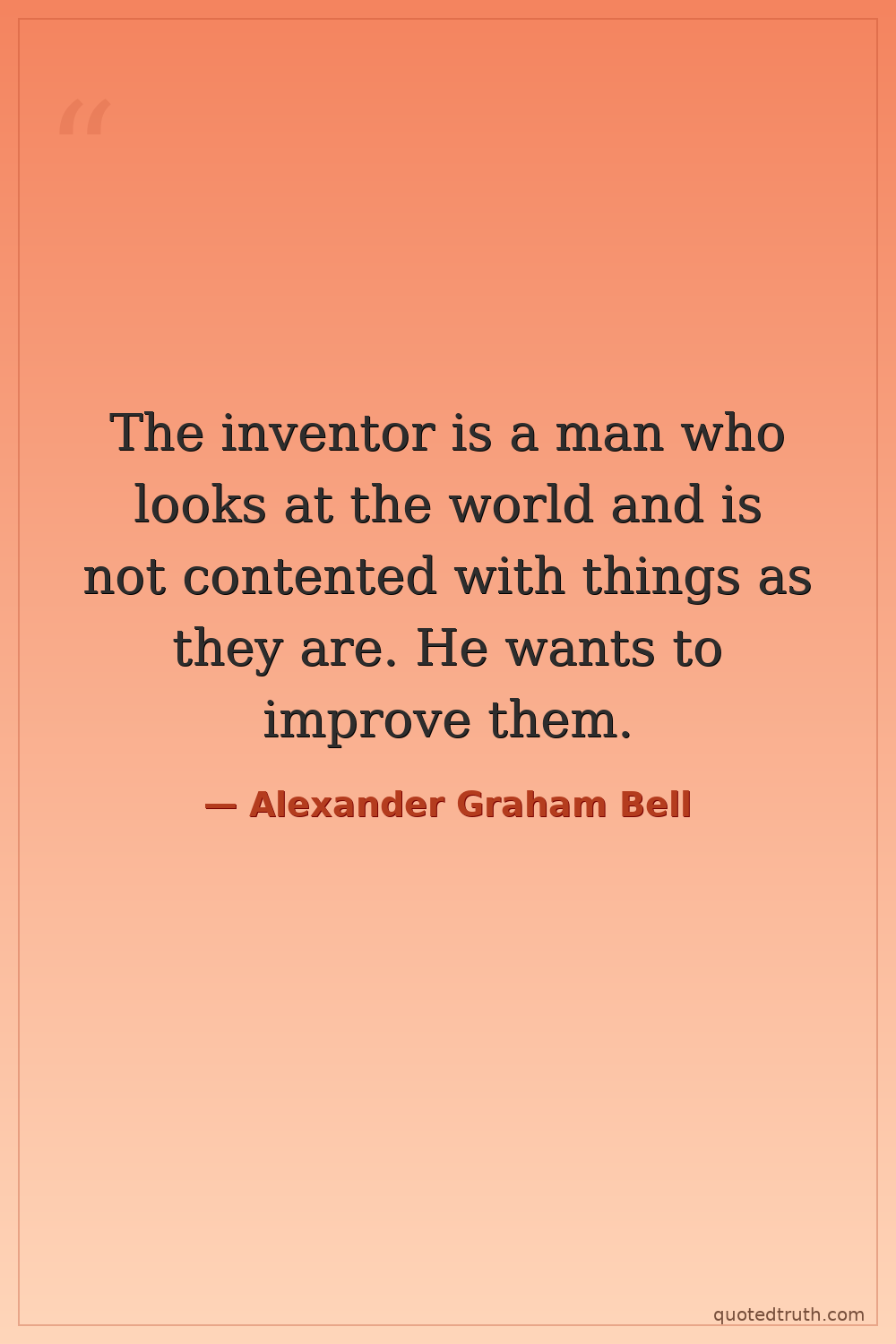
The inventor is a man who looks at the world and is not contented with things as they are. He wants to improve them.
The inventor is a man who looks at the world and is not contented with things as they are. He wants to improve them.
Click any product to generate a realistic preview. Up to 3 at a time.
* Initial load can take up to 90 seconds — revising the preview in another color is nearly instant.
"The only difference between success and failure is the ability to take action."
"The day will come when the man in the street will be able to send his voice to any part of the world, and hear the reply."
"A man, as a general rule, owes very little to what he is born with — a man is what he makes of himself."
"You cannot force ideas. Successful ideas are the result of slow growth."
"The true inventor is not the one who first conceives an idea, but the one who brings it to fruition."
Found in 2 providers: grok,deepseek
2 sources checked
Inventors don't accept the world as fixed. They see problems, inefficiencies, and gaps — and feel compelled to close them. Discontent here isn't frustration; it's a creative engine. The restless desire to improve is what drives innovation forward. It separates those who observe limitations from those who solve them. Being unsatisfied with how things are is presented as a gift, not a flaw — the starting point of every breakthrough.
Bell's entire life was shaped by communication barriers. His mother and wife were both deaf; his father developed 'Visible Speech,' a notation system for lip-reading. These personal stakes made improving human communication a moral imperative, not just a technical challenge. His telephone invention in 1876 proved that voice itself could cross wires. He later pursued aviation, deaf education, and hydrofoil boats — restless curiosity that matched his own words precisely.
Bell worked during the Second Industrial Revolution — an era when steam, steel, and electricity were remaking civilization. The telegraph had already compressed distance for text; Bell's telephone in 1876 did the same for the human voice. Edison, Tesla, and Westinghouse were contemporaries. Patent wars raged. Technological discontent was commercially rewarded like never before. Inventors weren't fringe tinkerers — they were celebrated as forces reshaping economies, toppling old industries, and shrinking the planet.
AI-generated insights based on extensive research and information for context. Factual errors? Email [email protected].
Your cart is empty