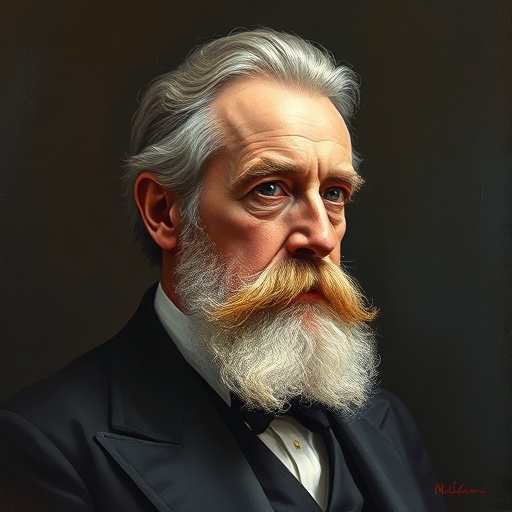
Alexander Graham Bell — "The day will come when the man in the street will be able to send his voice to a…"
The day will come when the man in the street will be able to send his voice to any part of the world, and hear the reply.
The day will come when the man in the street will be able to send his voice to any part of the world, and hear the reply.
Click any product to generate a realistic preview. Up to 3 at a time.
* Initial load can take up to 90 seconds — revising the preview in another color is nearly instant.
"The nation that secures control of the air will ultimately control the world."
"A man's own judgement should be the final appeal in all that relates to himself."
"The inventor is a man who looks at the world and is not contented with things as they are. He wants to improve them."
"The telephone will be a great convenience to business men, but it will never be used by the general public."
"I had made up my mind to find that for which I was searching even if it required the remainder of my life. After innumerable failures I finally uncovered the principle for which I was searching, and I…"
Found in 1 providers: grok
1 source checked
Ordinary people — not just the wealthy or powerful — will one day hold real-time conversations with anyone, anywhere on Earth. Bell envisions two-way voice communication as a universal human capability, not a luxury. The emphasis on 'man in the street' underscores democratization: global voice reach would belong to everyone. In modern terms, he's describing the smartphone call, the global telephone network, and the always-connected world billions now take entirely for granted.
Bell spoke this vision as the telephone's inventor, yet the device of his era required operators, reached only wealthy subscribers, and spanned just miles. His life was defined by deafness: his mother was hearing-impaired, his wife Mabel profoundly deaf. He believed voice communication was a human right. His later experiments with the photophone — transmitting speech via light beams — show he relentlessly pursued distance-free, universal voice connection as his life's central mission.
When Bell made this prediction, telephones were a novelty confined to short distances, requiring hand-cranked switchboards and operators. The telegraph was humanity's global communication backbone — text-only, costly, and slow. The 1866 transatlantic cable was considered a marvel. Transcontinental voice calls wouldn't exist until 1915; transoceanic until 1927. Most rural Americans had never touched a telephone, making Bell's vision of an ordinary person conducting globe-spanning voice conversations a genuinely radical leap of imagination.
AI-generated insights based on extensive research and information for context. Factual errors? Email [email protected].
Your cart is empty