What it means
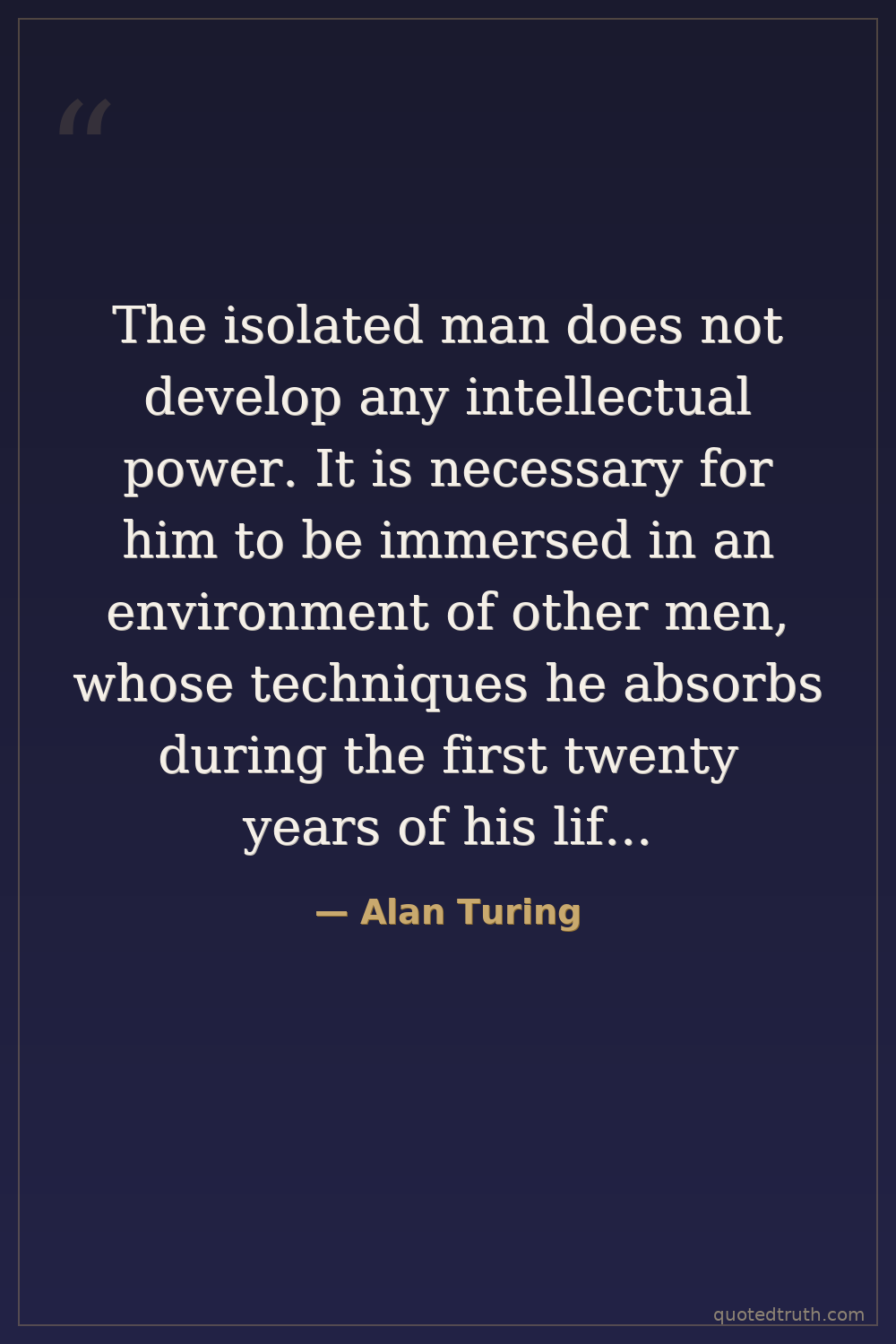
No person develops real intellectual power in isolation. The first two decades of life are spent absorbing knowledge, language, and methods from the people around you. Any original discoveries an individual makes are modest contributions built on that inherited foundation. Progress belongs to humanity as a collective enterprise — individuals are nodes passing techniques forward, not lone geniuses conjuring breakthroughs from nothing.
Relevance to Alan Turing
Turing's greatest work at Bletchley Park was deeply collaborative — mathematicians, linguists, and engineers cracking Enigma together. His own ideas built on Gödel, Church, and Hilbert. Yet the British government chemically castrated him for homosexuality, severing him from the intellectual community he argued was essential to thought. The man who theorized that isolation destroys the mind was deliberately isolated by his own society, and died two years later.
The era
Turing wrote as mid-20th-century science was becoming institutionally collaborative — Bell Labs, early computing consortia, and wartime research teams replaced the Victorian lone-genius model. The Cold War made collective technical effort a matter of national survival. Yet the romanticized myth of the solitary male inventor still dominated culture. Turing's framing of knowledge as a community inheritance quietly challenged that myth at the very moment computing was proving it true.
AI-generated insights based on extensive research and information for context. Factual errors? Email [email protected].