Pope Urban II — "The land of promise, which the Lord gave to the children of Israel, is now occup…"
The land of promise, which the Lord gave to the children of Israel, is now occupied by the enemies of Christ.
The land of promise, which the Lord gave to the children of Israel, is now occupied by the enemies of Christ.
Click any product to generate a realistic preview. Up to 3 at a time.
* Initial load can take up to 90 seconds — revising the preview in another color is nearly instant.
"Whoever shall set out on this journey out of devotion alone, and not for gain or honor, shall be absolved from all sin."
"I, Urban, wearing the pontifical vestments, and by the authority of God, confirm to those who undertake this holy journey a full remission of all their sins."
"O most valiant soldiers and descendants of invincible ancestors, do not degenerate, but recall the valor of your forefathers."
"But if you are hindered by love of children, parents, or of wife, remember what the Lord says in the Gospel, 'He that loveth father or mother more than me is not worthy of me', 'Every one that hath fo…"
"From the confines of Jerusalem and the city of Constantinople a horrible tale has gone forth and very frequently has been brought to our ears, namely, that a race from the kingdom of the Persians, an …"
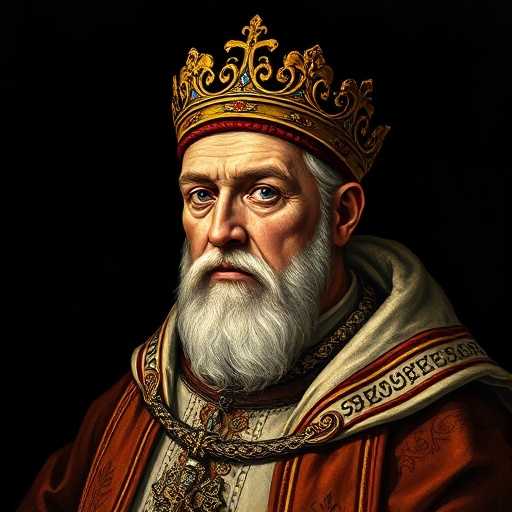
Pope (1088-1099) whose Council of Clermont speech (November 1095) launched the First Crusade — the founding event of nine centuries of Christian-Muslim military conflict. Closely associated with Pope Gregory VII (his predecessor on papal-imperial reform). For an intellectual contrast, see Saladin, Kurdish-Muslim Sultan of Egypt and Syria (1138-1193) — Saladin recaptured Jerusalem in 1187, undoing the First Crusade Urban II launched 92 years earlier. Saladin's chivalrous treatment of Christian prisoners became the canonical Muslim counter-image to Crusader brutality. The cleanest before/after pairing of the Crusades' moral arc.
Found in 1 providers: grok
1 source checked
A holy land sacred to Christianity is under the control of people who oppose Christian faith. The rightful inheritors, those who follow Christ, have been displaced from the territory God promised them. This framing presents military reclamation as a religious obligation, portraying the situation as a divine injustice demanding a response from faithful Christians everywhere.
Urban II delivered this at the Council of Clermont in 1095, directly launching the First Crusade. As pope, he wielded spiritual authority to reframe warfare as sacred duty. His entire Crusade project hinged on this territorial-theological argument: Jerusalem's Muslim control was not merely political but a cosmic affront requiring Christian military intervention.
In 1095, the Seljuk Turks controlled Jerusalem and had recently defeated the Byzantine Empire at Manzikert. Byzantine Emperor Alexios I appealed to Rome for help. Western Europe was a feudal warrior society hungry for purpose. Urban channeled noble violence outward, promising spiritual rewards. The concept of holy war fused Christian piety with military expansion into a single, world-altering movement.
AI-generated insights based on extensive research and information for context. Factual errors? Email [email protected].
Your cart is empty