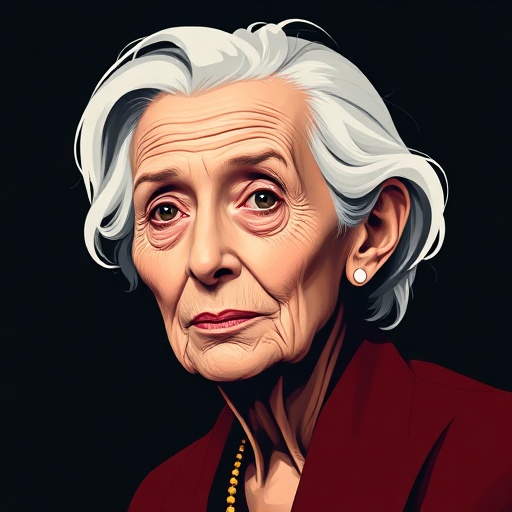
Jane Goodall — "The least I can do is speak out for those who cannot speak for themselves."
The least I can do is speak out for those who cannot speak for themselves.
The least I can do is speak out for those who cannot speak for themselves.
Click any product to generate a realistic preview. Up to 3 at a time.
* Initial load can take up to 90 seconds — revising the preview in another color is nearly instant.
"I have hope for the future, but we have to work together to make it happen."
"I don't understand why people are so afraid of nature. It's where we come from."
"The greatest hope for the future is the power of individual action."
"We must never give up hope. We must continue to fight for what is right."
"The greatest threat to our survival is the destruction of the natural world."
British primatologist who in 1960 began the longest-running wild primate study at Gombe Stream, transforming our understanding of chimpanzees. Closely associated with Dian Fossey (mountain-gorilla researcher) and Birutė Galdikas (orangutan researcher; together with Goodall and Fossey one of Louis Leakey's 'Trimates'). For an intellectual contrast, see Walter Palmer, American dentist who killed Cecil the Lion in Zimbabwe in 2015 — Palmer represents the trophy-hunting tradition Goodall's life's work has been organized against — the colonial-era hunter-naturalist worldview that treated primates and big game as specimens or trophies, which Goodall's Roots & Shoots and Jane Goodall Institute exist specifically to displace.
Found in 2 providers: grok,deepseek
2 sources checked
When you have a voice and others don't, using it on their behalf is the bare minimum moral obligation — not heroism, just basic duty. It rejects silence as an excuse, framing advocacy for the powerless as the simplest ethical responsibility a person can meet. Those without language, legal standing, or political power depend entirely on those who possess those advantages to act on their behalf.
Goodall spent decades at Gombe, Tanzania, living among chimpanzees who cannot vote, testify, or lobby against the habitat destruction and poaching threatening them. She witnessed their suffering firsthand and transformed from field scientist into global activist, founding the Jane Goodall Institute and Roots & Shoots. This quote captures her career pivot: once she understood what was happening to these animals, staying silent was simply not an option she considered ethical.
Goodall became a full-time activist in the 1980s as deforestation fragmented African forests, the ivory trade devastated elephant herds, and bushmeat poaching surged. The 1992 Rio Earth Summit formalized biodiversity loss as a global crisis. Simultaneously, captive chimpanzees were being used in biomedical research with little oversight. Human economic decisions were permanently silencing entire species, making the voices of scientists-turned-advocates like Goodall among the few checks on that destruction.
AI-generated insights based on extensive research and information for context. Factual errors? Email [email protected].
Your cart is empty