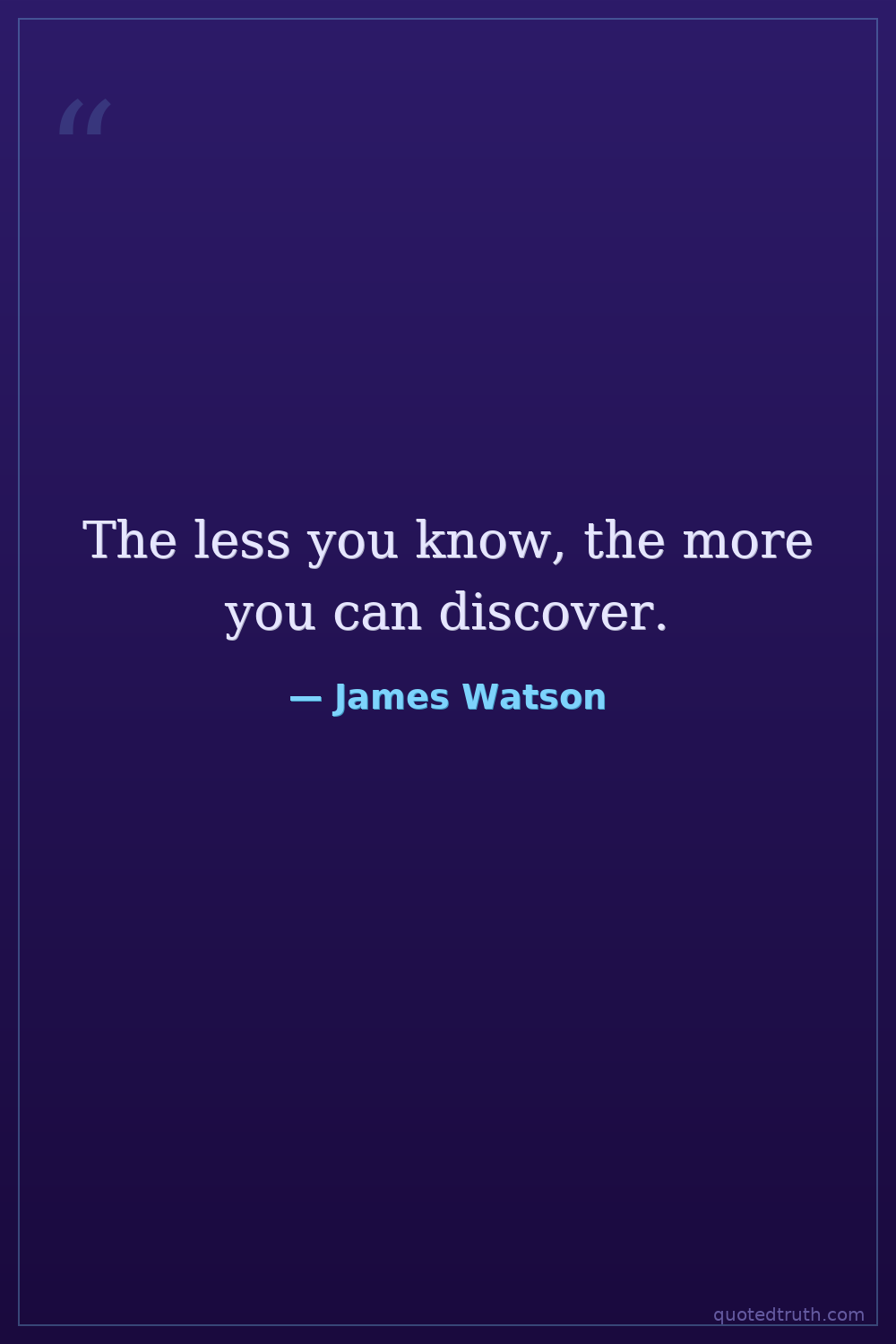
James Watson — "The less you know, the more you can discover."
The less you know, the more you can discover.
The less you know, the more you can discover.
Click any product to generate a realistic preview. Up to 3 at a time.
* Initial load can take up to 90 seconds — revising the preview in another color is nearly instant.
"I was never good at math."
"If you could find a way to make all girls pretty, you'd be a hero."
"There are a lot of people who would like to have me dead."
"I think it's wrong to pretend that all people are equal in all respects."
"Some people think that if you talk about race, you're a racist. I don't think so."
Found in 1 providers: grok
1 source checked
Approaching a problem with fewer preconceptions leaves your mind open to unexpected answers. Those who already 'know' the answer often stop looking. True discovery requires the humility to question assumptions and follow evidence wherever it leads, even when it contradicts established wisdom. This is a defense of curiosity over authority, of open inquiry over settled expertise—a mindset that fuels breakthroughs others miss.
Watson was 25 and relatively inexperienced in X-ray crystallography when he and Crick solved DNA's structure in 1953. Rather than being a limitation, this outsider perspective freed them to build bold molecular models others dismissed. Watson's career—from the double helix to leading the Human Genome Project—shows a pattern of crossing disciplinary boundaries and asking naive questions that unlocked discoveries entrenched experts had overlooked.
The early 1950s marked the birth of molecular biology, a field where no one was yet an expert. Post-WWII science was radically interdisciplinary—physicists, chemists, and biologists collided in labs like the Cavendish. DNA's function was suspected but its structure unknown. This openness to borrowing methods across fields drove the era's most transformative breakthroughs, and Watson's generation embodied the advantage of entering uncharted territory without inherited assumptions.
AI-generated insights based on extensive research and information for context. Factual errors? Email [email protected].
Your cart is empty