What it means
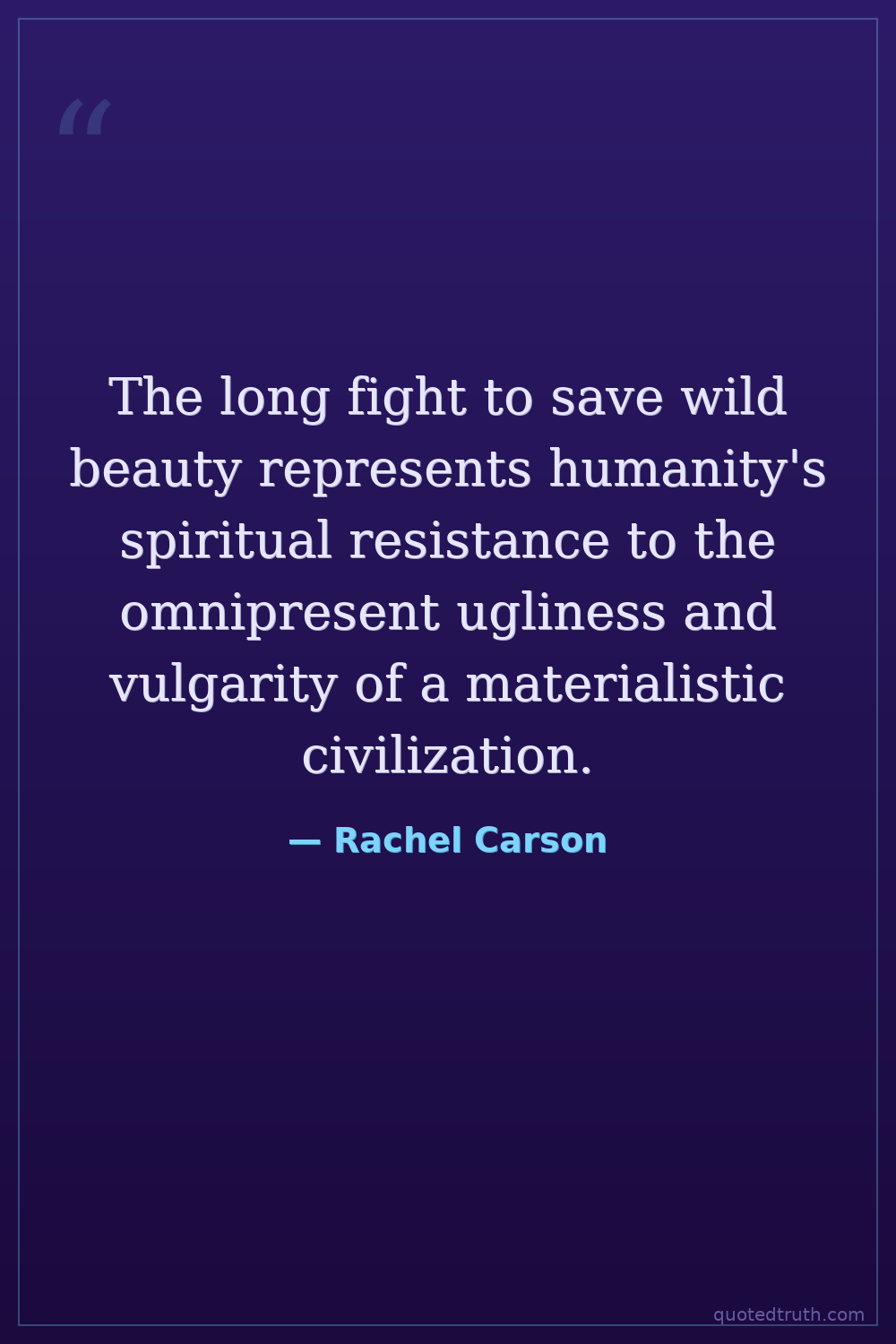
Fighting to protect nature is not merely practical — it is a spiritual act of resistance. When people defend wild places, they are pushing back against a society that prizes profit and consumption above all else. The ugliness Carson describes is not only visual but moral: the erosion of worth that happens when industry and materialism override the intrinsic value of the living world.
Relevance to Rachel Carson
Rachel Carson spent her career as a marine biologist and nature writer documenting the beauty and interconnectedness of the living world. Her 1962 book Silent Spring exposed how pesticides like DDT were poisoning ecosystems, igniting the modern environmental movement. Carson believed science and wonder were inseparable — her lyrical prose made a spiritual case as much as a scientific one. She saw defending nature as a moral duty that went far beyond policy or profit.
The era
Carson was writing in the post-WWII 1950s–60s, when American consumerism and industrial expansion were at their height. Suburbs spread over farmland, chemical companies promoted pesticides as progress, and economic growth was treated as an unqualified good. Television advertising glorified synthetic products. Against this backdrop of relentless commercialism, her insistence that wild beauty held spiritual value was genuinely countercultural — it helped seed the movement that created the EPA and the Clean Air Act.
AI-generated insights based on extensive research and information for context. Factual errors? Email [email protected].