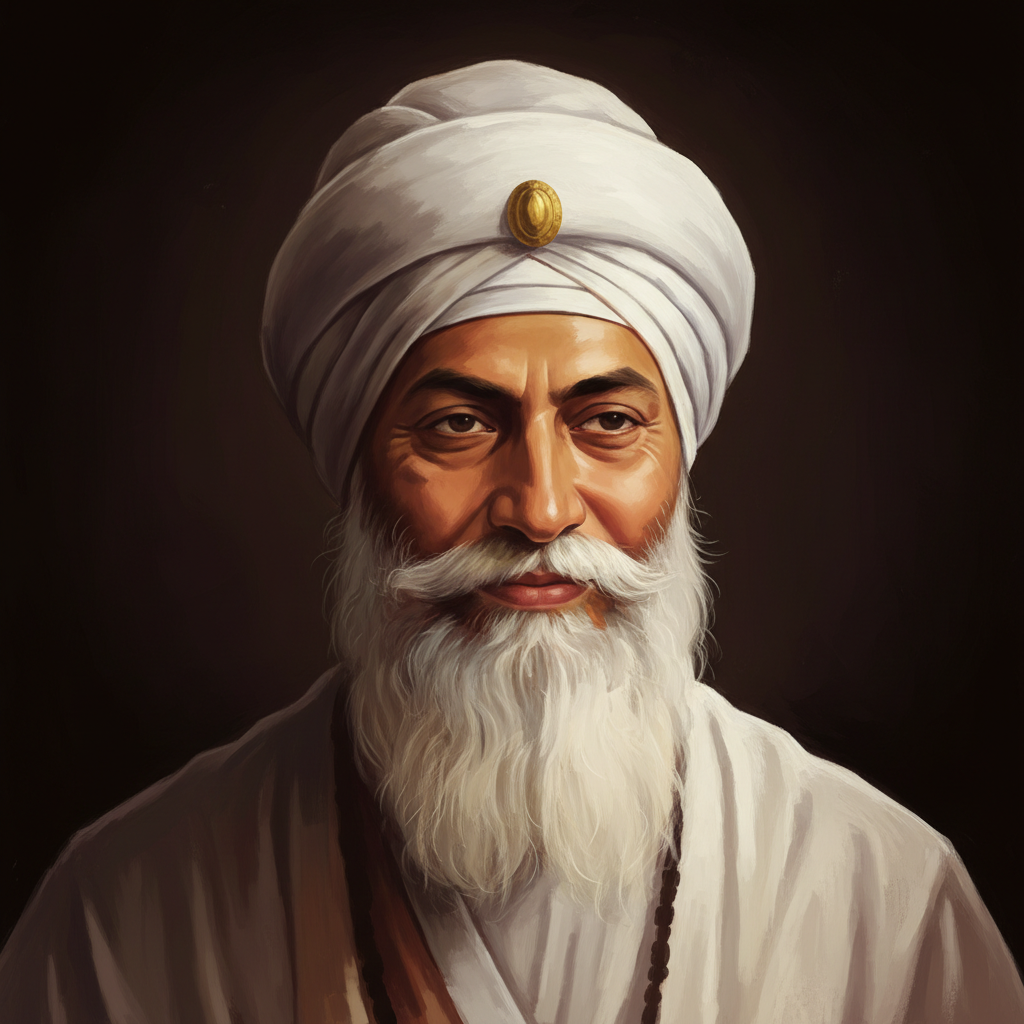
Guru Nanak — "The Lord is within us, but we search for Him outside."
The Lord is within us, but we search for Him outside.
The Lord is within us, but we search for Him outside.
Click any product to generate a realistic preview. Up to 3 at a time.
* Initial load can take up to 90 seconds — revising the preview in another color is nearly instant.
"By the grace of the Guru, one obtains the treasure of the True Name."
"There is no Hindu, there is no Muslim. There's just people trying to figure out what's for dinner."
"The blessings of God are for all, without discrimination."
"God is one, but he has innumerable forms. He is the creator of all and He himself takes the human form."
"The true Guru is the one who shows the path of truth and righteousness."
Founder of Sikhism and the first of the Ten Sikh Gurus, whose teachings of one universal God and rejection of caste shaped Punjab. Closely associated with Kabir (mystical poet whose verses appear in the Sikh Guru Granth Sahib). For an intellectual contrast, see Brahmanical orthodoxy, the Hindu caste-and-ritual establishment of his era — Sikhism was founded as a deliberate alternative to both Hindu ritual hierarchy and Islamic exclusivism — Nanak's universalism was a structural rejection of caste and priestly mediation.
Found in 1 providers: grok
1 source checked
True connection with the divine is not found through external rituals, pilgrimages, or idols, but by looking inward. People waste energy searching temples, shrines, and distant holy places for something that already lives inside them. The sacred presence is part of every person's own consciousness and heart. Recognizing this ends the futile outward chase and shifts the focus to inner reflection, honest living, and self-awareness as the real spiritual path.
Guru Nanak founded Sikhism on the principle of one formless God present everywhere, especially within each soul. He rejected empty ritualism, caste hierarchy, and priestly intermediaries dominating both Hindu and Muslim practice. His own travels, called udasis, took him to Mecca, Hardwar, and Tibet specifically to teach that God is not confined to any shrine. This quote distills his lifelong message: devotion, honest work, and remembrance of the divine name matter more than outward ceremony.
Guru Nanak lived from 1469 to 1539 in Punjab during the collapse of the Delhi Sultanate and the rise of the Mughal Empire under Babur. Hindu-Muslim tensions, rigid caste divisions, and elaborate ritualism dominated religious life, while ordinary people were crushed by pilgrimage fees, Brahminical gatekeeping, and sectarian violence. The Bhakti and Sufi movements were already challenging this outward religiosity. Nanak's inward, egalitarian message landed in fertile ground and offered a direct path bypassing entrenched clergy.
AI-generated insights based on extensive research and information for context. Factual errors? Email [email protected].
Your cart is empty