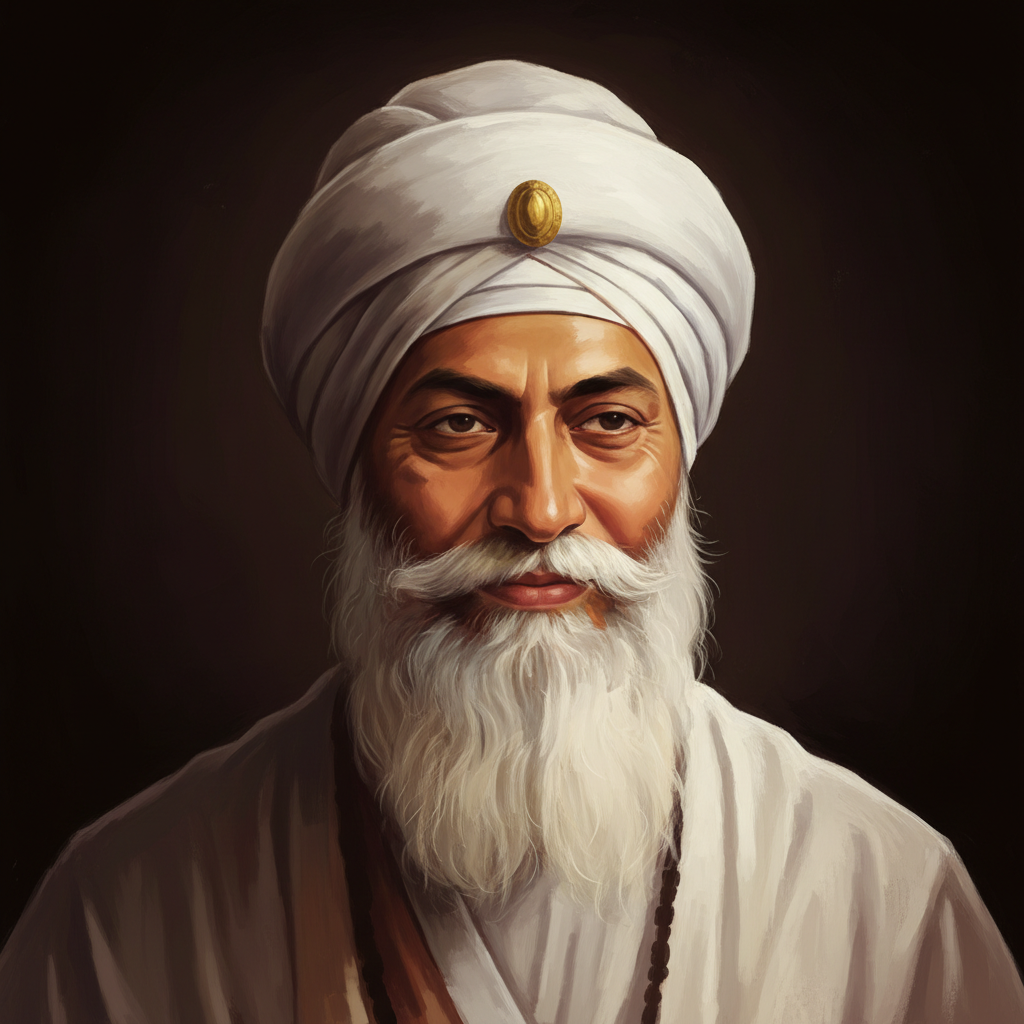
Guru Nanak — "The true Guru is the one who shows the path of truth and righteousness."
The true Guru is the one who shows the path of truth and righteousness.
The true Guru is the one who shows the path of truth and righteousness.
Click any product to generate a realistic preview. Up to 3 at a time.
* Initial load can take up to 90 seconds — revising the preview in another color is nearly instant.
"Those who have loved, have found God."
"By the grace of the Guru, one obtains the treasure of the True Name."
"Through suffering, one learns to love God."
"The greatest gift is to share. Especially if it's your last piece of samosa."
"Without the Guru, no one has found God."
Founder of Sikhism and the first of the Ten Sikh Gurus, whose teachings of one universal God and rejection of caste shaped Punjab. Closely associated with Kabir (mystical poet whose verses appear in the Sikh Guru Granth Sahib). For an intellectual contrast, see Brahmanical orthodoxy, the Hindu caste-and-ritual establishment of his era — Sikhism was founded as a deliberate alternative to both Hindu ritual hierarchy and Islamic exclusivism — Nanak's universalism was a structural rejection of caste and priestly mediation.
Found in 1 providers: gemini
1 source checked
This defines genuine spiritual leadership: a true teacher isn't someone with titles or hereditary authority, but one who actively guides others toward honest, ethical living. Truth and righteousness aren't abstract ideals — they're a way of daily conduct. The quote rejects blind deference to rank and demands that leaders be judged by whether they actually lead people toward moral clarity and honest action in the world.
Guru Nanak (1469–1539) spent years on Udasis — long journeys across South Asia, Persia, and Arabia — teaching people regardless of caste or creed. He rejected priestly gatekeeping and worked as a farmer and storekeeper, not a hereditary cleric. When choosing his successor, he picked Angad Dev based on devotion and virtue, not family lineage, embodying his own standard: a Guru earns legitimacy through moral example, not birth.
Guru Nanak lived during the fall of the Lodi Sultanate and rise of the Mughal Empire in northern India (late 15th–early 16th century). Religious authority was institutionalized: Brahmin priests controlled Hindu ritual access; Islamic clerics held political influence. Corruption among religious leaders was widespread. Declaring that a Guru's legitimacy rested solely on moral guidance — not birth, rank, or ritual power — was a direct challenge to both Hindu and Muslim religious establishments of the period.
AI-generated insights based on extensive research and information for context. Factual errors? Email [email protected].
Your cart is empty