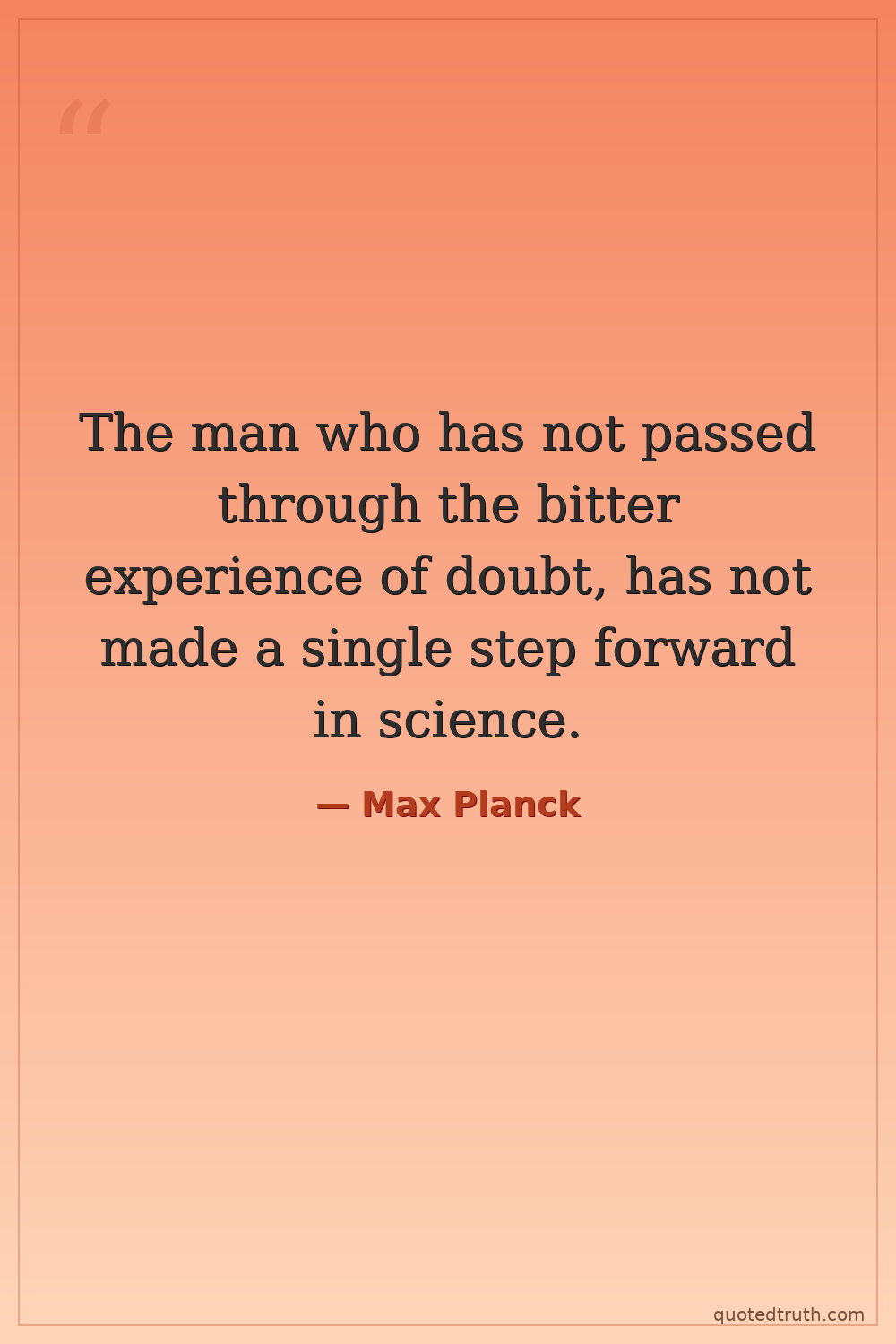
Max Planck — "The man who has not passed through the bitter experience of doubt, has not made …"
The man who has not passed through the bitter experience of doubt, has not made a single step forward in science.
The man who has not passed through the bitter experience of doubt, has not made a single step forward in science.
Click any product to generate a realistic preview. Up to 3 at a time.
* Initial load can take up to 90 seconds — revising the preview in another color is nearly instant.
"The history of science shows that even the most firmly established theories can be overturned by new discoveries."
"The ultimate goal of science is to understand the universe and our place in it."
"The constant changes in the scientific worldview show how important it is to remain open to new ideas."
"There is no matter as such. All matter originates and exists only by virtue of a force."
"Physics is a branch of knowledge which aims at the discovery of the laws governing the phenomena of nature."
Found in 1 providers: grok
1 source checked
Real scientific progress requires wrestling with uncertainty. You cannot simply accept what you are told or trust your first intuition; you have to question it, feel the discomfort of not knowing, and work through that confusion. Without that struggle, no genuine understanding or discovery happens. Confidence without doubt produces only repetition of old ideas, never the breakthroughs that push knowledge forward into new territory.
Planck lived this personally. A trained classical physicist, he was deeply reluctant to abandon continuous energy, yet his 1900 blackbody work forced him to introduce quantized energy packets, an idea he himself resisted for years. He called it an act of desperation. That painful break from his own convictions birthed quantum theory, reshaping physics. His career embodied productive doubt: trusting evidence over cherished assumptions, even his own.
Planck worked during the late 19th and early 20th century, when classical physics seemed nearly complete. Newtonian mechanics and Maxwell's equations explained almost everything, and physicists openly wondered if anything fundamental remained to discover. Then anomalies, blackbody radiation, the photoelectric effect, atomic spectra, cracked that confidence. Planck's era became the birth of modern physics, forcing a generation to doubt foundational certainties and accept relativity and quantum mechanics, theories that overturned centuries of intuition.
AI-generated insights based on extensive research and information for context. Factual errors? Email [email protected].
Your cart is empty