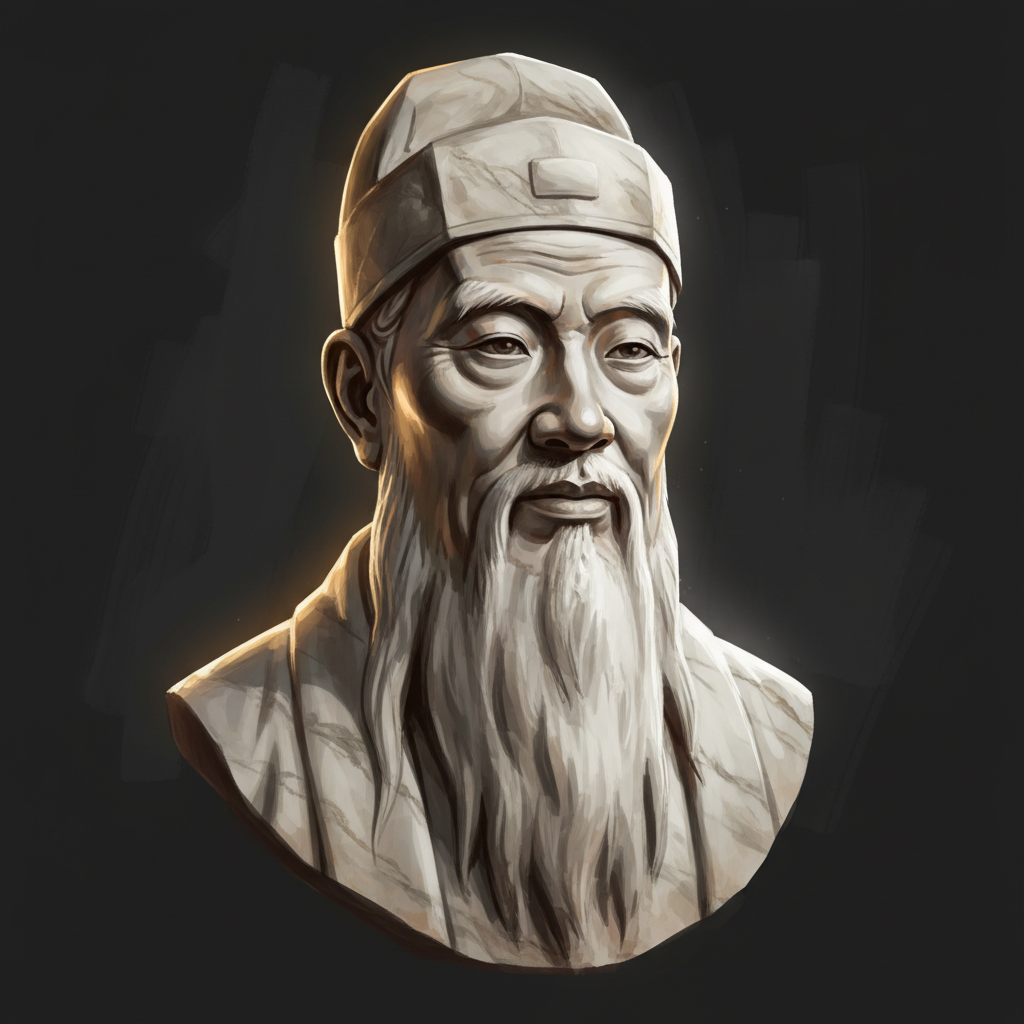
Confucius — "The Master said, 'He who is not concerned about the distant future will find tro…"
The Master said, 'He who is not concerned about the distant future will find trouble right at hand.'
The Master said, 'He who is not concerned about the distant future will find trouble right at hand.'
Click any product to generate a realistic preview. Up to 3 at a time.
* Initial load can take up to 90 seconds — revising the preview in another color is nearly instant.
"The superior man is distressed by his lack of ability, not by the failure of others to recognize him."
"The superior man thinks of virtue; the small man thinks of comfort. The superior man thinks of the sanctions of law; the small man thinks of favors which he may receive."
"By three methods we may learn wisdom: First, by reflection, which is noblest; Second, by imitation, which is easiest; and third by experience, which is the bitterest."
"If you make a mistake and do not correct it, this is called a mistake."
"Wheresoever you go, go with all your heart."
Chinese philosopher and teacher whose teachings (compiled by his students in the Analects) became the foundational ethical framework of East Asian civilization for 2,500 years. Closely associated with Mencius (his most-influential follower a century later). For an intellectual contrast, see Laozi, near-contemporary Chinese sage and Tao Te Ching author — Confucius systematized social order through ritual and family hierarchy; Laozi's Taoist effortless-action philosophy argued such systems were the disease, not the cure. The two founding poles of Chinese moral philosophy — every East Asian moral tradition since has positioned itself between them.
The standard scholarly entry points to Confucius's work: Philip J. Ivanhoe (Georgetown, Chinese philosophy) — Confucian Moral Self Cultivation (2000); Edward Slingerland (UBC, Asian Studies) — Effortless Action: Wu-wei as Conceptual Metaphor (2003); Tu Weiming (Harvard, Confucian scholar) — Confucian Thought: Selfhood as Creative Transformation (1985). These are the works graduate seminars cite when teaching Confucius.
Found in 1 providers: grok
1 source checked
If you don't think ahead and plan for what's coming, problems will pile up around you immediately. Short-term thinking creates near-term chaos. The person who refuses to consider consequences, anticipate obstacles, or prepare for future needs ends up scrambling to handle crises that could have been avoided. Foresight isn't optional luxury thinking; it's the basic maintenance that keeps daily life from collapsing into one emergency after another.
Confucius built his entire teaching around self-cultivation, ritual propriety, and the long arc of moral development. He spent years training disciples to become junzi, gentlemen who governed themselves and states through disciplined foresight. Having wandered between courts seeking a ruler wise enough to adopt his reforms, he saw firsthand how leaders who ignored long-term planning lost their kingdoms. This saying reflects his conviction that wisdom is inseparable from patient, future-oriented thinking.
Confucius lived during the Spring and Autumn period (roughly 551-479 BCE), when the Zhou dynasty's authority was collapsing and rival states fought constantly. Rulers routinely made short-sighted decisions, betrayed alliances, and taxed peasants into revolt. Families were torn apart by war and shifting loyalties. Against this chaos, Confucius preached that stability came from thinking beyond the immediate moment, building institutions, relationships, and moral habits that could weather decades of turbulence.
AI-generated insights based on extensive research and information for context. Factual errors? Email [email protected].
Your cart is empty