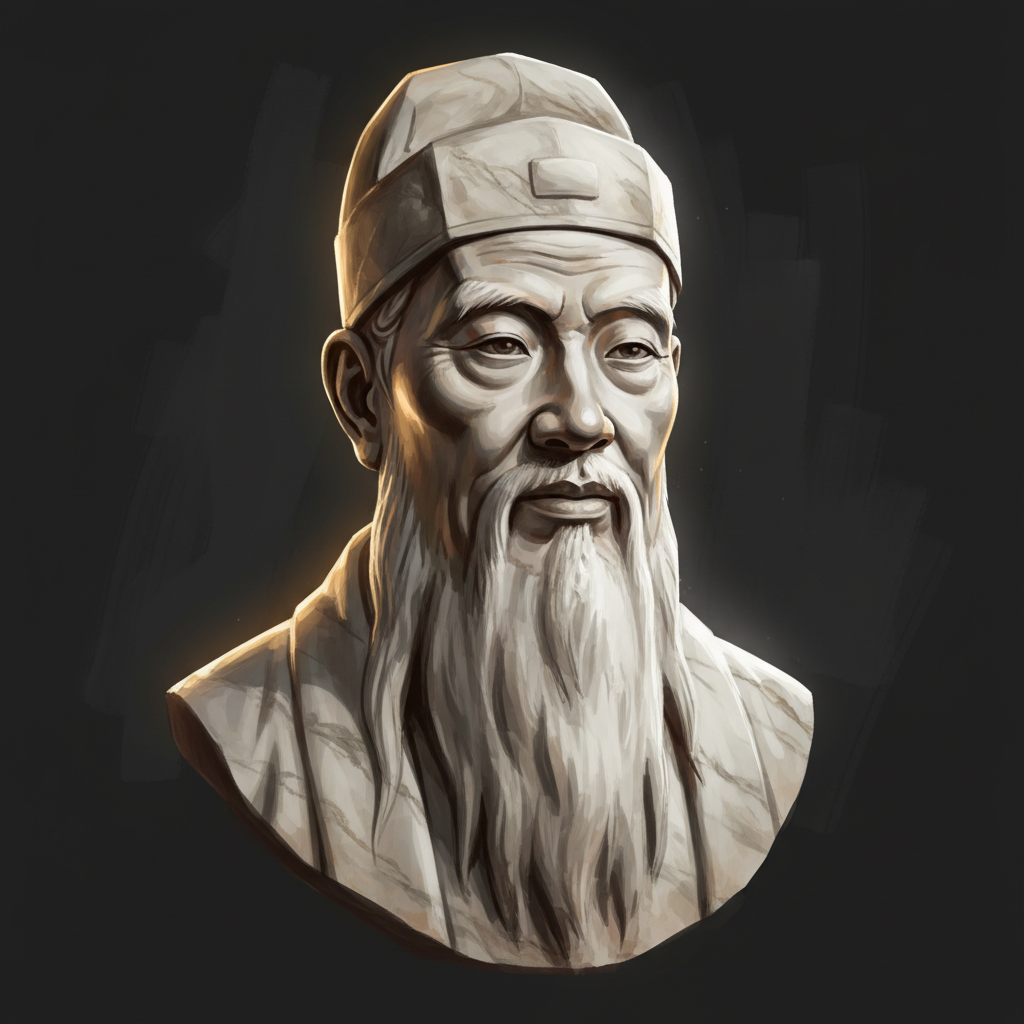
Confucius — "The superior man is distressed by his lack of ability, not by the failure of oth…"
The superior man is distressed by his lack of ability, not by the failure of others to recognize him.
The superior man is distressed by his lack of ability, not by the failure of others to recognize him.
Click any product to generate a realistic preview. Up to 3 at a time.
* Initial load can take up to 90 seconds — revising the preview in another color is nearly instant.
"I have never seen anyone who loved virtue as much as they loved sex."
"The Master said, 'To see what is right, and not to do it, is want of courage.'"
"A good man is not a complete vessel."
"Is it not pleasant to learn with a constant perseverance and application? Is it not delightful to have friends coming from distant quarters? Is he not a man of complete virtue, who feels no discomposu…"
"He who learns but does not think, is lost! He who thinks but does not learn is in great danger."
Chinese philosopher and teacher whose teachings (compiled by his students in the Analects) became the foundational ethical framework of East Asian civilization for 2,500 years. Closely associated with Mencius (his most-influential follower a century later). For an intellectual contrast, see Laozi, near-contemporary Chinese sage and Tao Te Ching author — Confucius systematized social order through ritual and family hierarchy; Laozi's Taoist effortless-action philosophy argued such systems were the disease, not the cure. The two founding poles of Chinese moral philosophy — every East Asian moral tradition since has positioned itself between them.
The standard scholarly entry points to Confucius's work: Philip J. Ivanhoe (Georgetown, Chinese philosophy) — Confucian Moral Self Cultivation (2000); Edward Slingerland (UBC, Asian Studies) — Effortless Action: Wu-wei as Conceptual Metaphor (2003); Tu Weiming (Harvard, Confucian scholar) — Confucian Thought: Selfhood as Creative Transformation (1985). These are the works graduate seminars cite when teaching Confucius.
Found in 2 providers: grok,gemini
2 sources checked
Focus your worry on your own shortcomings, not on whether other people notice or praise you. A person of strong character measures themselves by their actual competence and growth, not by recognition, status, or applause. If you lack skill, that is the real problem worth fixing. Being overlooked is someone else's oversight; being incapable is your own responsibility. Work on yourself instead of resenting the crowd.
Confucius spent years traveling between Chinese states seeking a ruler who would employ his political ideas, and was repeatedly passed over. Rather than grow bitter, he returned home to teach and refine his learning, embodying this very principle. His concept of the junzi, or 'superior man,' centered on self-cultivation, moral discipline, and mastery of ritual and virtue. He consistently told students that obscurity was no disgrace, but unpreparedness was.
During the late Spring and Autumn period (6th-5th century BCE), the Zhou dynasty's authority had collapsed and rival states competed through warfare, intrigue, and shifting alliances. Scholars wandered courts selling advice, and recognition by a powerful duke meant income, influence, and survival. In that status-obsessed climate, telling men to ignore external validation and focus inward on competence was radical. Confucius was building an ethical alternative to the era's ruthless careerism and political flattery.
AI-generated insights based on extensive research and information for context. Factual errors? Email [email protected].
Your cart is empty